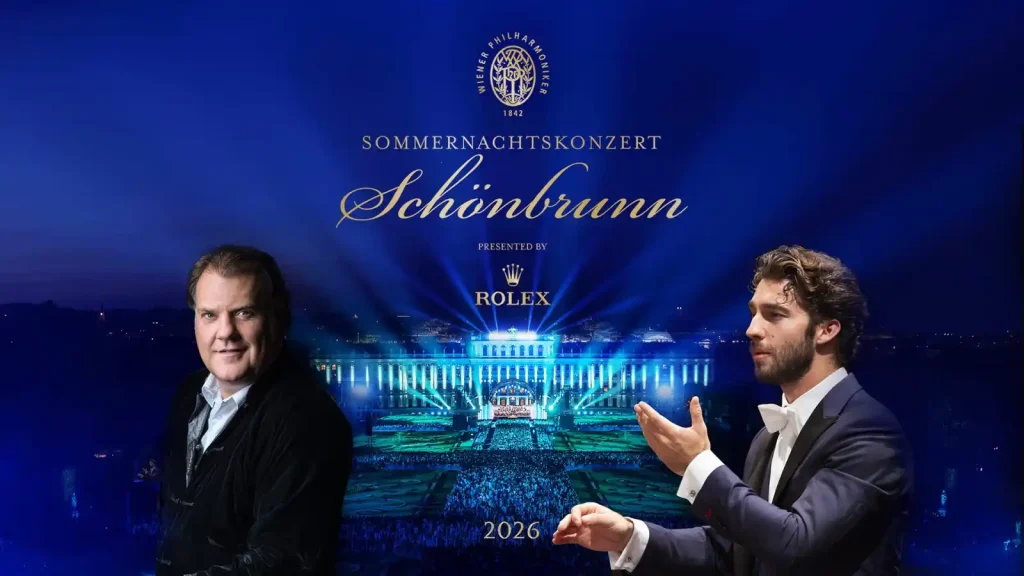
The Summer Night Concert 2026 brings the Vienna Philharmonic back to the floodlit gardens of Schönbrunn Palace on June 19, with conductor Lorenzo Viotti and Welsh bass-baritone Sir Bryn Terfel leading a program that swings from grand opera to Broadway in a single, generous evening. This year’s Summer Night Concert marks two notable firsts: Viotti steps onto the open-air podium for the first time, and Terfel sings at the event for the first time in his career. Together they anchor a free, world-broadcast spectacle that draws tens of thousands of listeners onto the lawns of a UNESCO World Heritage site and reaches millions more on screens across the globe.
The appeal of the Summer Night Concert has always been its breadth. The 2026 lineup leans hard into that promise, threading operatic showpieces by Verdi, Wagner, Boito, Puccini, and Massenet through orchestral favorites from Suppè, Tchaikovsky, Ravel, Korngold, and Florence Price. The night closes not with a thunderous symphonic flourish but with a song from a musical, as Terfel delivers Tevye’s “If I Were a Rich Man” from Fiddler on the Roof. That arc, from the underworld menace of Mefistofele to the warmth of a village dairyman’s daydream, defines the evening’s character.
What makes the Summer Night Concert 2026 worth circling on the calendar is the collision of scale and intimacy. The orchestra plays in front of the Neptune Fountain and the palace façade, with the Vienna State Ballet bringing the ancient lovers Daphnis and Chloe to life as shadow figures projected against the stone. The program rewards both the casual listener who came for the melodies and the devoted opera follower who knows exactly how much voice Terfel must summon for Wotan. Below is a full guide to the music, the artists, and the stakes of a night built to be heard by everyone.
Lorenzo Viotti arrives at the Summer Night Concert as one of the most discussed conductors of his generation, and the 2026 invitation confirms his standing inside the European concert establishment. Born in Lausanne in 1990, he is the son of the late conductor Marcello Viotti, and he grew up inside the profession he now commands. He studied piano, voice, and percussion in Lyon before training in conducting in Vienna, a city that has shaped his musical instincts in ways this concert makes obvious.
His Vienna connection runs deeper than a guest engagement. Viotti played percussion alongside several orchestras during his student years, including the Vienna Philharmonic itself. Conducting that same ensemble at Schönbrunn closes a loop that began when he was a young player watching from inside the ranks. The 2015 Young Conductors Award at the Salzburg Festival announced his arrival, and his subsequent leadership of the Netherlands Philharmonic Orchestra and Dutch National Opera built the operatic fluency this program demands.

Scan smarter. Create faster. Free.
Download QR & Barcode Studio — Create and scan unlimited QR codes & barcodes.
No paywalls. No limits. 100% Free.

That operatic fluency matters here more than usual. A Summer Night Concert built around a singing soloist needs a conductor who can breathe with a voice, not simply beat time over it. Viotti has spent years in the pit, accompanying singers through Verdi and Wagner, and that experience shapes how he will pace the arias. The orchestral showpieces give him room to display the Vienna Philharmonic’s color, while the vocal numbers test his ability to lead from a place of restraint.
The Summer Night Concert 2026
Sir Bryn Terfel Brings Wagnerian Weight to the Summer Night Concert 2026
Sir Bryn Terfel stands among the defining bass-baritones of the past three decades, and his first appearance at the Summer Night Concert 2026 gives the evening its dramatic spine. The Welsh singer built his reputation on roles that demand both vocal power and theatrical presence, and the program assembled for Schönbrunn reads like a tour of his strengths. He moves from the sneering devilry of Boito to the bluster of Verdi’s fat knight to the noble resignation of Wagner’s chief god, all within a single night.
His selections are not crowd-pleasing throwaways. Terfel opens his operatic contributions with “Son lo spirito che nega,” the credo of Mefistofele in Boito’s opera of the same name, a piece that asks the singer to embody negation itself with menace and wit. He then turns to “Ehi! paggio!” from Verdi’s Falstaff, trading the underworld for the comic indignation of an aging rogue. The contrast showcases the actor inside the singer, and the Schönbrunn audience gets both registers in close succession.
The emotional summit arrives with Wagner. Terfel sings “Abendlich strahlt der Sonne Auge,” Wotan’s entrance into Valhalla from the fourth scene of Das Rheingold, a passage that demands sustained nobility and an unforced grandeur. Few living singers carry the role as convincingly. After that weight, the closing turn to “If I Were a Rich Man” lands as deliberate release, letting Terfel show the humor and humanity that have always lived alongside his power.
Franz von Suppè’s Light Cavalry Overture Sets the Tone for the Open-Air Evening
The Summer Night Concert traditionally opens with a piece that signals festivity, and Franz von Suppè’s Light Cavalry Overture does exactly that. The work is one of the most recognizable curtain-raisers in the orchestral repertoire, its galloping middle section instantly familiar even to listeners who have never heard the composer’s name. Choosing it to launch the 2026 program tells the audience precisely what kind of night lies ahead.
Suppè occupies a particular place in Viennese musical history as a master of operetta, and his overtures distill that tradition into compact, propulsive packages. The Light Cavalry Overture begins with a brassy fanfare before settling into a lyrical cello melody, then explodes into the famous cavalry charge. The structure rewards an orchestra that can shift mood quickly, and the Vienna Philharmonic handles those transitions with a polish few ensembles match.
Importantly, the choice ties the concert to its setting. Schönbrunn was an imperial summer residence, and Suppè’s bright, ceremonial energy suits a palace park designed for spectacle. The overture functions as both a musical and an architectural welcome, drawing the eye toward the floodlit façade as the first notes carry across the lawns. From this opening, the program can travel almost anywhere, and over the course of the evening it does.
Puccini, Massenet, and the Orchestral Heart of the Summer Night Concert
Between the vocal showpieces, the 2026 program places two of the most beloved orchestral interludes in all of opera, and they give the Summer Night Concert its moments of pure lyrical beauty. Giacomo Puccini’s Intermezzo from Manon Lescaut arrives as a wave of unguarded emotion, the orchestra carrying the full weight of a love story without a single word sung. The piece bridges acts in the opera, but on its own it becomes a self-contained meditation on longing and loss.
Jules Massenet’s Méditation from Thaïs offers a quieter but equally powerful counterpart. Scored around a solo violin, the Méditation depicts a spiritual awakening, and in the Schönbrunn setting it allows the orchestra’s concertmaster a rare turn in the spotlight. The contrast between Puccini’s surging strings and Massenet’s intimate violin line gives the middle of the program a shape that feels considered rather than assembled at random.
These two pieces do something specific for an open-air audience. They lower the temperature after the vocal fireworks and invite genuine stillness, the kind that settles over a crowd of tens of thousands when a single melody holds the night. For listeners new to classical music, both works serve as accessible entry points, melodies that lodge in memory immediately. For the seasoned audience, they reaffirm why these interludes have outlived the operas that contain them in popular affection.
Florence Price and Erich Wolfgang Korngold Expand the Summer Night Concert 2026 Repertoire
One of the most forward-looking choices in the Summer Night Concert 2026 is the inclusion of Florence Price’s “Adoration,” heard here in an orchestration by Elaine Fine. Price was the first African American woman to have a symphony performed by a major American orchestra, and her gradual return to concert programs marks one of the most meaningful shifts in recent classical programming. Placing her work in front of a global Schönbrunn audience signals an intent to widen the canon the orchestra celebrates.
“Adoration” began as a short, hymn-like piece, and in its orchestrated form it carries a gentle warmth that fits the reflective stretches of the program. The work asks for sincerity rather than showmanship, and that simplicity becomes its strength on a night otherwise dominated by grand gestures. By giving Price a place beside Wagner and Verdi, the concert treats her not as a token but as a peer.
Erich Wolfgang Korngold contributes another layer of Viennese history with his Straussiana, a sequence of polka, mazurka, and waltz. Korngold was a child prodigy in early twentieth-century Vienna before emigrating and reinventing himself as a pioneering Hollywood film composer. His Straussiana looks back affectionately at the dance traditions of his home city, and hearing it at Schönbrunn returns the music to the streets that inspired it. The pairing of Price and Korngold reveals a program with a genuine point of view.
Wagner’s Das Rheingold and the Mythic Power of the Summer Night Concert
The Wagner selection gives the Summer Night Concert 2026 its mythic weight, and it represents the most demanding music of the night for both singer and orchestra. “Abendlich strahlt der Sonne Auge” comes from the final scene of Das Rheingold, the moment when Wotan leads the gods across a rainbow bridge into the newly built fortress of Valhalla. The passage is at once triumphant and shadowed by foreboding, since the audience knows the price that triumph will demand.
For Terfel, the scene is a study in controlled majesty. Wotan must sound like a god surveying his greatest achievement while a darker undercurrent runs beneath the splendor. The orchestral writing builds toward a luminous climax, with the brass painting the gleam of sunset on the fortress walls. Few moments in the repertoire reward an open-air setting more completely, the sound rising into the night sky above the palace.
The choice also deepens the evening’s emotional architecture. Coming after the comedy of Falstaff and the menace of Mefistofele, the Wagner places Terfel at the peak of his expressive range before the program turns toward lighter fare. Consequently, the night does not simply accumulate highlights; it builds toward this scene and then steps gently down from it. That sense of design separates a curated concert from a mere parade of favorites.
Ravel’s Daphnis et Chloé and the Vienna State Ballet’s Shadow Figures
Maurice Ravel’s Suite No. 2 from Daphnis et Chloé delivers the most ambitious orchestral statement of the Summer Night Concert 2026, and it arrives paired with a striking visual concept. As the orchestra plays, dancers of the Vienna State Ballet bring the ancient tale of the foundlings Daphnis and Chloe to life, appearing as shadow figures cast against the palace façade in a choreography by Eno Peçi. The result fuses sound, movement, and architecture into a single experience.
The music itself ranks among the great achievements of orchestral color. Ravel composed Daphnis et Chloé as a ballet, and the second suite captures its most rapturous stretches, from the hushed “Lever du jour” to the whirling “Danse générale.” The score demands enormous forces and pinpoint precision, and the Vienna Philharmonic’s depth of sound suits its shimmering textures. Daybreak unfolds in slow, glowing waves before the finale erupts into ecstatic motion.
Pairing that score with projected dancers turns the Schönbrunn façade into a stage of its own. The shadow figures let the audience see the story Ravel painted in sound, the lovers separated and reunited against the backdrop of a Greek pastoral. For an event that lives partly on television screens worldwide, the visual dimension extends the music’s reach, giving viewers at home a spectacle equal to the one unfolding in the park.
Tchaikovsky’s Trepak and the Festive Spirit of Schönbrunn
Peter Ilyich Tchaikovsky’s Trepak from The Nutcracker injects a burst of pure energy into the Summer Night Concert program. The dance is one of the shortest pieces of the evening, a whirlwind of Russian rhythm that lasts barely a minute, yet it delivers an outsized jolt. Its breathless tempo and stamping accents make it an immediate crowd favorite, the kind of music that pulls a relaxing audience suddenly to attention.
The choice fits the concert’s strategy of pacing variety. After expansive scores like the Ravel and the weight of the Wagner, the Trepak resets the room with sheer momentum. Tchaikovsky wrote it as one of the character dances in the second act of The Nutcracker, and its folk-derived drive contrasts sharply with the ballet’s more delicate numbers. Heard on its own, it becomes a compact demonstration of orchestral precision under pressure.
There is also a seasonal irony worth noting. A piece born from a winter holiday ballet appears in a midsummer open-air concert, and that incongruity becomes part of its charm. The Summer Night Concert has never been bound by season or single tradition, and the Trepak embodies that freedom. It is festive music unmoored from its origins, repurposed to lift a June evening in the gardens of an Austrian palace.
Why the Free Open-Air Summer Night Concert Reaches the World
Beyond the music, the defining feature of the Summer Night Concert is its accessibility, and that principle shapes everything about the 2026 edition. Admission to the live event at Schönbrunn is free, a deliberate choice that reflects the Vienna Philharmonic’s stated goal of making classical music a gift to everyone rather than a privilege for ticket-holders. Year after year since 2004, the concert has filled the palace park with an enormous public audience drawn by that open door.
The broadcast reach multiplies that audience many times over. Television networks carry the concert to viewers across Europe and beyond, and the production treats the home audience as seriously as the crowd on the lawns. The projected ballet sequence during the Ravel, the floodlighting of the palace, and the careful staging all serve a performance designed to translate through a screen. As a result, a free local event becomes a global cultural broadcast.
That combination of free access and worldwide transmission gives the Summer Night Concert a civic meaning that few classical events can claim. It positions the Vienna Philharmonic not only as a guardian of tradition but as an institution actively widening its audience. The 2026 program, with Florence Price beside Wagner and a Broadway closer following grand opera, embodies that openness in its very design. The night insists that great music belongs to anyone willing to listen.
What to Expect from the Summer Night Concert 2026 in Vienna
For anyone planning to experience the Summer Night Concert 2026, whether in person or through the broadcast, the evening promises a carefully built journey rather than a random sampler. The program opens with festivity in Suppè, deepens through the operatic showpieces with Terfel, expands into the orchestral grandeur of Ravel, and resolves into the warmth of Fiddler on the Roof. That shape gives the concert its momentum and its emotional payoff.
The pairing of Lorenzo Viotti and Sir Bryn Terfel offers the central draw. A conductor making his debut at the event meets a singer making his own first appearance, and the freshness of both arrivals charges the night with anticipation. Viotti’s operatic experience and Terfel’s command of the Wagnerian and Verdian repertoire align perfectly with a program that rises and falls on the partnership between podium and voice.
Ultimately, the Summer Night Concert 2026 captures why this midsummer tradition endures. It places world-class music in a setting of extraordinary beauty, opens the doors to everyone, and trusts a broad audience to follow the journey from Mefistofele’s defiance to Tevye’s hopeful song. Schönbrunn provides the stage, the Vienna Philharmonic provides the sound, and a single June night turns a palace park into one of the most generous concert halls on earth.
FAQ The Summer Night Concert 2026
Q: When and where is the Summer Night Concert 2026 taking place?
A: The Summer Night Concert 2026 takes place on June 19 in the gardens of Schönbrunn Palace in Vienna. The Vienna Philharmonic performs open-air in front of the floodlit palace façade. The event has been held at this UNESCO World Heritage site every year since 2004, drawing tens of thousands of listeners to the lawns.
Q: Is the Summer Night Concert at Schönbrunn free to attend?
A: Yes, admission to the live concert at Schönbrunn is completely free. The Vienna Philharmonic keeps the event open to everyone as part of its stated goal of treating classical music as a gift rather than a privilege. This open-door policy is why the concert fills the palace park with an enormous public audience each year.
Q: Who is conducting the Summer Night Concert 2026?
A: Lorenzo Viotti conducts the Summer Night Concert 2026, marking his first appearance at the event. Born in Lausanne in 1990, he is the son of conductor Marcello Viotti and trained in Lyon and Vienna. He once played percussion alongside the Vienna Philharmonic, so leading the orchestra at Schönbrunn closes a personal loop.
Q: What will Sir Bryn Terfel sing at the concert?
A: Sir Bryn Terfel performs arias from Boito’s Mefistofele and Verdi’s Falstaff, plus Wotan’s entrance from Wagner’s Das Rheingold. The Welsh bass-baritone closes his contributions with “If I Were a Rich Man” from Fiddler on the Roof. The selections move from underworld menace to comic bluster to noble grandeur, then warm humanity.
Q: Why does the program mix opera with a Broadway musical?
A: The 2026 program deliberately spans opera, operetta, ballet, symphonic works, and musical theater to reflect the event’s broad appeal. Ending with Tevye’s “If I Were a Rich Man” rather than a symphonic flourish lands as deliberate release after Wagner’s weight. The variety lets casual listeners and devoted opera followers both find something to love.
Q: How does the Vienna State Ballet feature in the concert?
A: During Ravel’s Daphnis et Chloé Suite No. 2, dancers of the Vienna State Ballet bring the ancient lovers to life. In a choreography by Eno Peçi, they appear as shadow figures projected against the palace façade. The staging fuses music, movement, and architecture, extending the spectacle to viewers watching the broadcast at home.
Q: Why is Florence Price included in a Vienna Philharmonic program?
A: Florence Price was the first African American woman to have a symphony performed by a major American orchestra. Including her “Adoration,” orchestrated by Elaine Fine, signals an intent to widen the canon the orchestra celebrates. Placed beside Wagner and Verdi, her hymn-like piece is treated as the work of a peer, not a token.
Q: What is the most demanding piece for the performers?
A: Wagner’s “Abendlich strahlt der Sonne Auge” from Das Rheingold is the night’s most demanding music. It depicts Wotan leading the gods into Valhalla, requiring sustained nobility and unforced grandeur from Terfel. The orchestral writing builds toward a luminous climax, and few living singers carry the role as convincingly in an open-air setting.
Q: Can I watch the Summer Night Concert 2026 on television?
A: Yes, the concert is broadcast to viewers across Europe and beyond. The production treats the home audience as seriously as the crowd on the lawns, with floodlighting, careful staging, and the projected ballet sequence all designed to translate through a screen. A free local event becomes a worldwide cultural broadcast reaching millions.
Q: What makes the orchestral interludes by Puccini and Massenet special?
A: Puccini’s Intermezzo from Manon Lescaut carries a full love story without a single sung word, surging with longing and loss. Massenet’s Méditation from Thaïs centers on a solo violin depicting a spiritual awakening. Both lower the temperature after vocal fireworks, inviting genuine stillness across an audience of tens of thousands.