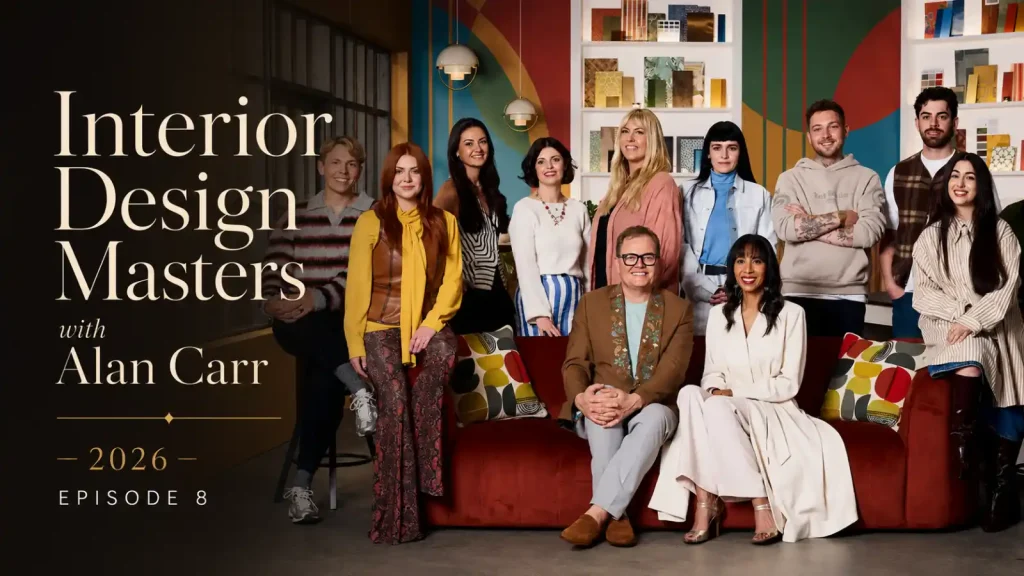
Interior Design Masters with Alan Carr 2026 episode 8 delivers the showdown the entire series has been building towards, sending finalists Lia and Sophie to the Longleat Estate in Wiltshire to transform two period holiday cottages. The prize on the line is genuinely life-changing: the winner secures a partnership with retailer Next to create their own line of homeware. After eight weeks, ten novice designers have been whittled down to two maximalists with completely different instincts. One leans into animal print and wild escapism. The other builds her schemes around botanicals, family and hosting. Judges Michelle Ogundehin and guest judge Laurence Llewelyn-Bowen must decide which finalist has evolved furthest.
The setting raises the stakes considerably. Longleat House is a stately home surrounded by 9,000 acres, including the famous safari park with 32 lions, five rhinos, three gazelle and a pack of wolves. Alan Carr opens the final among the animals themselves, with Michelle admiring a lion’s lair for its colour, natural textures and total absence of fake plants. The finalists each receive a key to a period rental property. Sophie draws The Island, a Grade II Georgian cottage, while Lia takes the Victorian Stalls Farmhouse.
Three days, £7,000 per designer, and six spaces to transform in each property: a hallway and landing, a twin bedroom, a master bedroom, a dining room and a living room. The brief offers two clear creative angles, the beautiful architecture and gardens of the estate, or the animals in the park. What follows is a battle of the maximalists that ends with one of the most emotional victories the design competition has produced.
Sophie has showcased her love of animal prints since week one, and the safari park feels like fate. She calls it her licence to do animal print at last, her time to shine. As a rock and roll maximalist with a background as a specialist painter, her strength has always been what Michelle describes as a beautiful, painterly eye for colour and texture. Her limewash finish and pattern clashing in the castle won her Stand Out Space as early as week two.
Her concept for The Island is wild escapism. She wants holidaymakers to walk in and feel they have entered somewhere untamed, with leopard print running across the entire hallway and landing ceiling. Her words capture the ambition perfectly: she wants the cottage so fully booked that people cannot get in because it is that busy.

Scan smarter. Create faster. Free.
Download QR & Barcode Studio — Create and scan unlimited QR codes & barcodes.
No paywalls. No limits. 100% Free.

Lia takes the opposite path. Rather than the safari side of Longleat, her concept draws on the gardens and grounds of the estate. The Scottish-Italian designer has gone big with botanicals since week one, using dried flowers in every scheme while gradually learning to edit. Michelle has repeatedly observed that Lia’s work is strongest when she leans into her roots, that sense of conviviality and family. Her farmhouse will celebrate nature, hosting and connection rather than spectacle.
Interior Design Masters with Alan Carr 2026 episode 8
The Biggest Build in Any Final: Lia’s Structural Arch Gamble
Lia opens the final with a genuinely bold structural decision. She swaps her downstairs rooms entirely, turning the current living room into a dining space with a cocktail nook and making the largest room the social heart of the home. To divide the new dining area from a snug den, she commissions a large structural arch, a false wall with a carved wooden archway running floor to ceiling.
The risk is real. Tasking a carpenter with one build for almost his entire time on site leaves no margin for error. Lia openly acknowledges the danger, especially after the previous week’s sofa left her finishing in a panic. She requests at least another ten to fifteen lengths of timber beyond the original ten, an early signal of just how ambitious the construction is.
The gamble nearly derails her schedule. She cannot wallpaper the den until the arch is complete, so that entire space sits on hold through day one. When the arch finally goes in after nearly two days, the relief is visible. She claims it has been crowned the biggest build in any final, and she takes the title gladly. Crucially, it looks like it was always meant to be there, exactly how a structural build should read. The decision later proves pivotal with the judges.
Inside Sophie’s Wild Escape: Leopard Ceilings, Peacock Hallways and Hand-Painted Africa
Sophie’s design for Interior Design Masters with Alan Carr 2026 episode 8 commits to the safari park without apology. Her living room pairs an exotic animal-embellished wallpaper with panelling painted avocado green, the colour continuing across window frames and mantle beneath a rich burgundy ceiling. A log store and TV unit fill the corner, while two large fringed lights illuminate furniture adorned with faux-fur throws.
Her hallway becomes the statement piece of the whole cottage. Bold peacock teal walls meet gold-painted stairs, fake animal decor and leopard-print wallpaper stretched across the entire ceiling, flowing up to the landing. When Alan Carr visits, he tells her this is no time to be meek and mild, and she confirms she has gone all out. His verdict lands as a compliment from a good place: she deserves to be in a zoo.
The dining room carries her most personal experiment. She showcases her signature limewash walls in a warm stone colour, then begins hand-painting black and gold outlines of African countries famous for safaris, starting with Namibia, with Kenya and Tanzania planned. A second-hand dining table and chairs, upholstered by returning designer Ben, sit beside stripy alcoves and a built-in corner bar. The maps, however, will become the episode’s most telling editing decision.
Why Lia’s Connected Colour Palette Becomes Her Secret Weapon
While Sophie deliberately changes colour in every room so the schemes clash beautifully, Lia plays a longer game with her home design. She commits to a green-toned blue and a terracotta colour running through every single room, convinced the colours are deeply complementary. Each space also carries a botanical element, through print, paper or her signature dried flowers.
Her new dining room wears a dusky olive green with a built-in bar, alcove unit, upcycled dining set and dried flowers along the mantel. The den behind the arch takes botanical-print paper with an inky blue ceiling and panels, plus terracotta velvet chairs. The smaller new living room moves to a paler olive green, with inky blue on the skirting and picture rail and botanical paper across the ceiling. A terracotta pink fireplace clad in geometric tiles sits between two new arched alcove units.
The masterstroke only reveals itself upstairs. The same hues continue, but everything gradually tones itself down as guests climb the house. Her twin room uses light taupe walls, sage green stripy wallpaper and headboards upholstered in mottled pink. Her master bedroom is colour drenched in muddy green, contrasted with muted pink curtains, headboard and cushions. The judges later single out this gradual softening of the palette as evidence of a designer fully in control.
The £500 Wallpaper That Echoes Longleat’s Own Tapestries
Lia’s master bedroom contains the most expensive single decision of the final. Its centrepiece is a show-stopping mural wallpaper depicting a bucolic scene, a paper she has loved for years but could never afford. When the challenge arrived, she ordered it regardless of cost. One wall alone came to around £500.
The investment is strategic as much as emotional. Alan Carr immediately notes the paper resembles the tapestries found in stately homes like Longleat House itself, and Lia confirms that is exactly where the inspiration came from. The trees mirror those lining the drive down to Longleat House, complete with the estate’s beautiful lake. There is even a hidden naked woman among the trees, which Lia cheerfully describes as leaving a little memory of herself behind.
Laurence Llewelyn-Bowen later validates the choice completely. He calls the tapestry effect quite wonderful and clever, pointing out that there are tapestries in Longleat. For a paying guest, he argues, the paper gives a real sense of staying on the Longleat estate. His only quibble is tiny: he would have taken the tapestry paper up onto a section of the ceiling for a beautiful feeling of enclosure. As a piece of site-specific interior design, the bedroom shows how far Lia’s instincts have matured.
Sophie’s Crisis of Confidence and the Cheetah Print That Almost Never Arrived
Confidence has been Sophie’s recurring weakness throughout the design competition, and the final tests it relentlessly. Michelle has long observed that when Sophie has a wobble, everything slightly crashes down, yet when she believes in herself she is capable of amazing things. Two crises in the final put that pattern on full display.
The first arrives through a delivery. Sophie’s cheetah print fabric for the twin bedroom headboards simply does not turn up, and with hours left she begins to unravel. She admits she is losing her mind and cannot understand how Ben stays so calm. Ben’s role becomes as much emotional as practical, keeping her steady, keeping her head clear, repeating that it will be fine. The fabric finally arrives with literally minutes to spare. She gets it onto the headboards in time and declares it worth the stress.
The second crisis is sharper because it is self-inflicted. After visiting Lia’s cottage at the end of day two, Sophie sees the arch and the room swap and calls the idea genius. Panic follows immediately. By the final morning, her hand-painted African country outlines come down. She could not make them look the way she wanted, so she scrapped the experiment entirely and returned to pure limewash. It is a brutal piece of self-editing, made under pressure, and the judges’ reaction to it proves fascinatingly split.
Family Stories Behind the Finalists: A DIY Dad and a Designer Mum
Interior Design Masters with Alan Carr 2026 episode 8 grounds both finalists in the people who shaped them, and the visits give the final its emotional spine. Lia grew up in Glasgow in a Scottish-Italian household where there was never a quiet moment. Holidays with family and friends, big shared dinners and constant socialising explain her obsession with large, open, communal spaces where everyone can sit together with somewhere to make a nice drink.
Her father is her main inspiration, the biggest DIY person you will ever meet. She watched everything he did as a child, asking why this screw, why that nail, why that method. He now believes she has far surpassed his ability and says there should be a stronger word than proud. Lia’s motivation is disarmingly simple: she would love to win just to make her parents that one inch prouder.
Sophie’s route into interior design runs through her mother, who qualified as an interior designer herself a few years ago. Their styles diverge completely, her mum’s leaning classic and traditional with a French twist while Sophie remains defiantly maximalist. Beige and boring were never Sophie, her mother says, and the experience has brought them closer through a shared passion. Her mum’s verdict cuts deep: Sophie has astounded her every step of the way, and she wishes she could be more like her daughter.
How the Judges Scored Two Cottages With Opposite Personalities
The judging walk-through becomes a masterclass in what separates good maximalism from great home design. In Sophie’s cottage, Laurence is immediately charmed by the living room’s anti-good taste, the leopard on the ceiling, faux leopard underfoot and feathers on the lights. Michelle adores the peacocky greeny-blue hallway, comparing it to walking inside a jewellery box. Both agree holidaymakers would love the constant safari references.
The criticisms are precise rather than dismissive. A huge corner unit holds only two furled-up blankets and a box of matches where thoughtfully curated objects should live. The dining room’s limewash, almost like onyx and romantic by candlelight, now cries out for the very pattern or motif Sophie painted over. Michelle suspects the map might have been too literal, yet its absence leaves the room missing something, along with the little styling touches. The twin room, by contrast, is textbook maximalism, cheetah headboards taming bonkers snake and grasshopper wallpaper in Percy Pig pink. Her elegant, commercial master bedroom delivers a genuine boutique hotel experience.
Lia’s farmhouse draws warmer language from the very first room. The dining room swap is called clever, beyond decorating, and Michelle admits she was skipping around the space. Laurence loves the conversational snug behind the arch and promises to pinch the idea. The living room furniture feels a little squeezed in, the one note of criticism, but the arched niches read as authentically Victorian. Upstairs, the gradually softening palette convinces both judges they are watching an empathic designer who understands what people want to feel in a room.
The Verdict That Crowns the Winner of Interior Design Masters 2026
Before the decision, both finalists face one last sofa conversation. Lia tells the judges she now knows how to use tonal colour far better than at the start, and that becoming a professional interior designer would mean waking up every day in her dream job. She has found her purpose, and even if she loses, her dad would still call her a winner. Sophie, named a colour witch by Laurence in the best possible way, makes her own breakthrough out loud. She has been her own worst enemy, but having designed an entire cottage at Longleat, she resolves to be confident from now on.
The previous designers return to explore both cottages and split almost evenly. Some are firmly team Sophie, calling her house an experience like walking into a dream and coveting the snake wallpaper as an outfit. Others are moved to tears by Lia’s farmhouse and call the arch a stroke of genius. The choice crystallises as leopard print or florals.
The winner of Interior Design Masters is Lia. For Michelle, the extremely sophisticated colour palette nudged it, the connected scheme that paled gracefully up through the house. For Laurence, there was something magical about stepping into that dining room as a complete world he immediately wanted to stay in. Lia’s reaction is pure disbelief: she has just won, and her life is literally going to change.
What This Final Reveals About Risk, Self-Belief and Winning Design
The closing moments of Interior Design Masters with Alan Carr 2026 episode 8 distil why this final resonates beyond a simple result. Lia’s victory rewards calculated risk. The room swap and the arch could have consumed her schedule and sunk the whole scheme. Instead, the build that looked like it had always been there became the architectural heart of a cottage the judges read as confident, accomplished and commercially irresistible for Longleat’s paying guests.
Sophie’s journey lands differently but no less powerfully. She leaves having designed an entire cottage at Longleat, having survived a vanishing fabric delivery and a scrapped centrepiece, and having finally named the doubt that held her back all series. Her promise to be confident from now on, and her toast of cheers to Lia and cheers to me, frame her final as a victory of a more personal kind. She departs proud, genuinely happy for her rival, and excited to unleash Sophie on the world.
The last word belongs to family. Lia phones her dad, the DIY hero who taught her everything, and his joy spills out in bleeped delight. It is the best news he has had since her wedding, since she was born. She is number one. For a designer who entered the competition simply wanting to make her parents one inch prouder, Interior Design Masters with Alan Carr 2026 episode 8 ends with that wish granted in full, alongside a Next homeware range and the career she always dreamed of.
FAQ Interior Design Masters with Alan Carr 2026 episode 8
Q: Who won Interior Design Masters with Alan Carr 2026?
A: Lia won Interior Design Masters 2026, beating fellow finalist Sophie in the Longleat final. Judges Michelle Ogundehin and Laurence Llewelyn-Bowen praised her sophisticated, connected colour palette and the dining room they described as a complete world they wanted to stay in. The victory earns her a partnership with retailer Next to create her own homeware line.
Q: Where was the Interior Design Masters 2026 final filmed?
A: The final took place at the Longleat Estate in Wiltshire, a stately home surrounded by 9,000 acres including the famous safari park. The finalists transformed two period rental properties: The Island, a Grade II Georgian cottage, and the Victorian Stalls Farmhouse. The park’s residents include 32 lions, five rhinos, three gazelle and a pack of wolves.
Q: What was the prize for winning Interior Design Masters 2026?
A: The winner secured a partnership with retailer Next to create their own line of homeware, a prize described as life-changing and game-changing. For Lia, the win also meant launching a full-time interior design career, something she said was impossible to break into without experience before the competition.
Q: How much time and budget did the finalists get for the Longleat challenge?
A: Each finalist received three days and £7,000 to transform an entire holiday cottage. Both properties required six spaces to be redesigned: a hallway and landing, a twin bedroom, a master bedroom, a dining room and a living room. Each designer also got two carpenters, three decorators and one returning former contestant as a helper.
Q: Why did Lia swap the living room and dining room in her cottage?
A: Lia gave the largest room to dining because she believes holiday guests want sprawling shared meals more than television. The swap reflected her Scottish-Italian upbringing in Glasgow, where socialising and hosting never stopped. Judges called the decision clever, since it made the biggest space the social heart of the home for a holiday let.
Q: What was the arch Lia built in the Interior Design Masters final?
A: Lia constructed a large structural wooden arch, a false wall dividing her new dining room from a cocktail snug. The build occupied a carpenter for nearly two days and was called the biggest build in any final. Laurence Llewelyn-Bowen loved the conversational snug so much he promised to pinch the idea, and fellow designers called it a stroke of genius.
Q: What was Sophie’s design concept for her Longleat cottage?
A: Sophie created a wild escape inspired by the safari park, using leopard-print wallpaper across the hallway and landing ceilings, peacock teal walls, gold stairs and animal-embellished wallpaper. Her rooms deliberately clashed colours, pairing avocado green panelling with a burgundy ceiling, plus cheetah-print headboards set against snake and grasshopper wallpaper in coral pink.
Q: Why did Sophie scrap her hand-painted African country maps?
A: Sophie painted black and gold outlines of safari countries like Namibia onto her limewashed dining room walls, but she could not make them look the way she wanted. On the final morning she scrapped the experiment and returned to plain limewash. Michelle felt the maps were too literal, yet both judges said the finished room was missing a pattern or motif.
Q: How expensive was the wallpaper in Lia’s master bedroom?
A: A single wall of Lia’s mural wallpaper cost around £500. She had loved the paper for years but could never afford it, so she ordered it regardless of price for the final. The bucolic scene resembles the tapestries inside Longleat House itself, which judges said gave paying guests a genuine sense of staying on the estate.
Q: What did the judges say separated Lia from Sophie in the final?
A: Michelle Ogundehin said Lia’s extremely sophisticated colour palette nudged the result, with the same blues, greens and terracottas gradually softening as guests moved upstairs. Laurence Llewelyn-Bowen found Lia’s dining room magical and immediately wanted to stay there. Sophie’s cottage was praised for joyful maximalist confidence, but it lacked curated styling touches in key rooms.