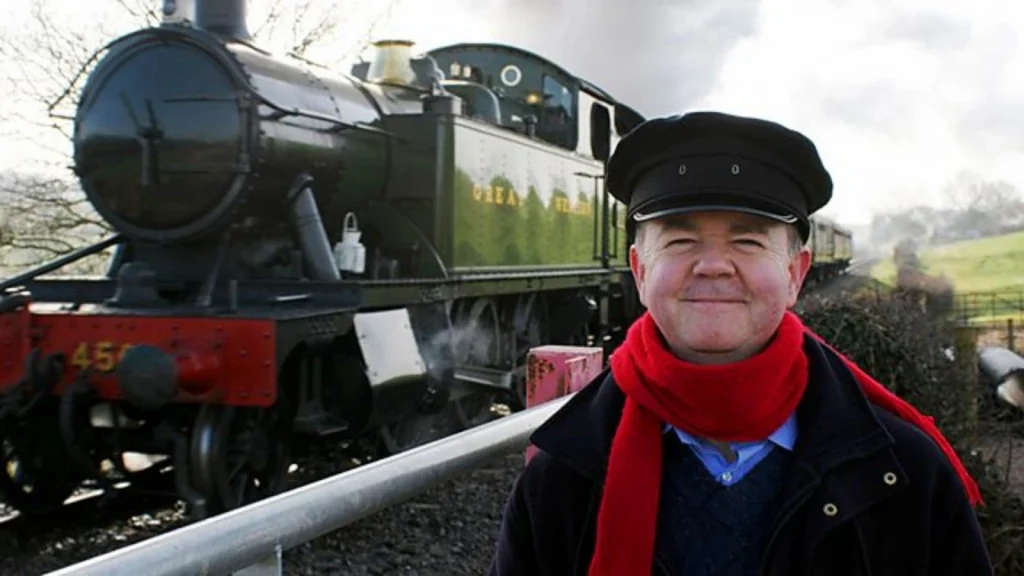
Ian Hislop Goes off the Rails: Imagine a time when steel ribbons connected every town and village. These were the arteries of Britain, pulsing with the rhythm of steam and diesel. People relied on the railway for everything. It brought them to work, to family, and to the seaside. Indeed, this network was the lifeblood of countless communities. Yet, in one swift move, a third of it vanished. In his fascinating documentary, Ian Hislop embarks on a journey to understand this seismic event. He explores the infamous Beeching Report of 1963 with his trademark wit and sharp analysis.
This report, officially titled “The Reshaping of British Railways,” is better known as the Beeching Axe. Its legacy is etched into the very landscape of the nation. Consequently, more than two thousand stations fell silent. Over five thousand miles of track were torn from the earth. Hislop investigates this brutal chapter of British history. He seeks to understand the man and the motives behind the plan. Moreover, he questions whether this was a necessary evil or a catastrophic miscalculation. The report forced tens of thousands of people into cars. As a result, Britain’s love affair with the automobile truly began.
At the heart of the storm was one man: Dr Richard Beeching. Was he a cold-hearted pragmatist, a Genghis Khan with a slide rule, as his critics claimed? Or was he simply a man tasked with an impossible job? Beeching was brought in to make the nationalized railways profitable. However, Hislop questions if he became the convenient fall guy for the government. Perhaps short-sighted politicians, already dazzled by the promise of motorways, were the true architects of the railway’s demise. They ultimately favoured the freedom of the car over the community of the train.
Before the axe fell, train travel enjoyed a golden age. These were the halcyon days celebrated in the poetry of John Betjeman. Trains were not just transport; they were an experience. They had character and charm, connecting people and places with a comforting certainty. Hislop delves into this romantic past, recalling a time when the local station was the heart of the village. He remembers when the guard’s whistle signalled the start of an adventure. This nostalgia serves a crucial purpose. Specifically, it highlights the profound sense of what was lost when the railway map of Britain shrank so dramatically.
To uncover the true story, Ian Hislop travels the length of the country. His journey takes him from the coastal lines of Cornwall to the forgotten tracks of the Scottish borders. Along the way, he meets the people whose lives were forever changed. He speaks with former railway workers who lost their livelihoods overnight. In addition, he listens to villagers who found their communities suddenly isolated. Their personal stories transform the abstract statistics of the report into a moving human drama. These encounters reveal the deep social wounds left by the Beeching Axe.

Scan smarter. Create faster. Free.
Download QR & Barcode Studio — Create and scan unlimited QR codes & barcodes.
No paywalls. No limits. 100% Free.

The consequences were far-reaching and immediate. For instance, with the local line gone, the car became a necessity, not a luxury. This shift dramatically altered British life. It fragmented communities that had relied on the railway for their connection to the wider world. Hislop investigates this fallout, discovering a trail of ghost stations and overgrown embankments. These are the silent monuments to a lost way of life. He paints a vivid picture of a landscape irrevocably altered, where the hum of the train was replaced by the roar of the road.
Ian Hislop Goes off the Rails
Hislop confronts the justifications head-on. Were these brutal measures truly necessary for economic progress? He speaks with those who made the decisions, seeking to understand their logic. The quest for profitability was the official reason. However, looking back, the plan seems remarkably narrow in its focus. It failed to account for the social value of the railways. Furthermore, it completely overlooked the long-term environmental consequences of pushing a nation onto the roads. This oversight seems particularly glaring from our modern perspective.
Today, we face congested roads and a pressing climate crisis. We now understand that trains are far more energy-efficient than cars. They offer a more environmentally sound way to travel. Knowing this, the Beeching plan can look like one of the greatest follies of the 1960s. Was it a colossal failure of imagination? Did Britain trade a sustainable future for the short-term convenience of the automobile? Hislop poses these uncomfortable questions, forcing us to re-evaluate a pivotal moment in our recent history.
Ultimately, Hislop’s journey is a search for answers in the rust and rubble of the past. He doesn’t offer simple conclusions. Instead, he presents a complex story of politics, economics, and people. The documentary is a powerful exploration of loss and legacy. It challenges us to think about what progress truly means. By examining the Beeching Report, we can better understand how the Britain of today was shaped. More importantly, we can reflect on the choices we make for the future of our transport and our communities.
Ian Hislop Goes off the Rails review
The documentary Ian Hislop Goes off the Rails revisits a pivotal and painful moment in British history: the wholesale closure of the nation’s railways. Once a source of immense national pride, Britain’s rail system was the first and greatest in the world, a network that stitched together cities, towns, and villages with comfort and style. However, this legacy was irrevocably altered in 1963 by the infamous Beeching Report, a document that recommended shutting down a third of the country’s railway network and became a devastating assault on the nation’s industrial and cultural heritage.
The man behind this upheaval was Dr Richard Beeching, a physicist and high-flying executive from Imperial Chemical Industries (ICI). In 1961, the government hired him to solve a monumental problem. The railways, nationalised in 1948, were hemorrhaging money, sinking into debt to the colossal sum of £136 million by 1961. Beeching was the technocrat brought in to run the railways like a business and make them pay for themselves. His appointment was a landmark moment, an early example of a private industry manager being parachuted into an ailing public company.
His approach was unsentimental and purely commercial, a stark contrast to the romantic vision of rail travel championed by figures like the poet John Betjeman. For Betjeman, the railway was integral to the fabric of national life, from the unique charm of a village station to the unfolding view from a first-class carriage. Yet, this idyllic image did not reflect the reality for many passengers in the 1950s, who frequently complained about high fares, dirty carriages, and persistent delays—grievances that echo those of modern commuters. Exploring the context of the Beeching Report, Ian Hislop Goes off the Rails questions whether Beeching was a mad axe man or the necessary evil of his time.
The problems Beeching inherited had deep roots, stretching back to the very creation of the railway network. Britain’s system was not born from a grand plan but evolved chaotically, built by competing Victorian railway barons whose primary motive was a quick profit. This led to a haphazard map with duplicated lines and unsustainable routes. While passenger travel became popular, the real business of rail was freight—coal, iron ore, and manufactured goods that powered the Industrial Revolution. This commercial imperative was the engine of the railways’ creation.
An 1844 Act of Parliament forced companies to offer cheap fares, opening travel to the masses and cementing the railway’s place in the public heart as a democratic right. By the early 20th century, Britain had 18,500 miles of track. The period between 1890 and the First World War is often considered the golden age, a time of peak profitability and investment in passenger comfort. However, this prosperity was not to last. The rise of the lorry, combined with restrictive government pricing laws and severe underinvestment during two world wars, sent the railways into a steep decline.
Before Dr Richard Beeching was brought in, the government had already made a disastrous attempt to fix the problem. Following nationalisation in 1948, the British Transport Commission launched the Modernisation Plan in the 1950s, a scheme with a staggering price tag of over a billion pounds. This was a great lost opportunity. Instead of a carefully considered overhaul, the money was spent unwisely on hastily commissioned diesel engines notorious for breaking down and on massive freight marshalling yards that stood empty as freight traffic never returned to pre-war levels. Crucially, the government’s investment was a loan, not a subsidy, which only deepened the debt of British Railways and made drastic action seem inevitable.
The Architect of an Unsentimental Vision
Dr Richard Beeching was appointed Chairman of the British Railways Board with a clear mandate from a Conservative government led by Harold Macmillan. Working under the pro-road Transport Minister Ernest Marples—a man who had made his fortune building motorways—Beeching was tasked with imposing commercial discipline on the network. He did not believe the railways should be run as a public service subsidized by the general taxpayer; instead, he argued that those who use the service should pay for it. His controversial £24,000 salary, more than double the Prime Minister’s, signaled a new, hard-nosed approach.
To build his case, Beeching commissioned a comprehensive seven-day traffic survey in April 1961. The results were stark and provided the statistical justification for his plans. The survey revealed that 95% of all rail traffic travelled on just half of the network. Conversely, the other half of the system carried very little traffic and was, in his view, commercially unviable. This single statistic became the foundation for a policy of mass closure, a decision that Beeching and Marples had seemingly intended to implement from the start.
The Reshaping of British Railways
The Beeching Report, officially titled “The Reshaping of British Railways,” was published in March 1963. The euphemistic title masked the brutal reality of its recommendations. Beeching proposed closing over 200 branch lines, shutting down more than 2,000 stations, and tearing up 5,000 miles of track. The report came in two parts: one filled with charts and arguments, and another with detailed maps. However, it was Appendix Two in the first part that captured the public’s horrified attention. This was the list of lines and stations slated for closure.
The list read, as some have said, like the names on a war memorial, a death sentence for a huge portion of Britain. The public reaction was one of shock and outrage. The report became a cultural touchstone, immortalized in songs like Flanders and Swann’s “The Slow Train,” which lamented the loss of romantic, rural destinations. The cuts were sweeping, hitting remote areas in the Scottish Highlands, decimating the network in Wales, and leaving little more than the main north-south line in the North East. Holiday resorts in the West Country, once served by the glamorous Atlantic Coast Express, were cut off entirely.
The community of Padstow in North Cornwall, whose economy had been revolutionized by the railway’s arrival in 1899, was left isolated as its tracks were carried off for scrap. Today, a car park sits where the station once stood. For many, the report was not just an economic plan but a PR disaster. It enshrined Dr Richard Beeching in British folklore as a villain, a man who, as one newspaper poem lamented, “stops at nothing.”
The Controversy of the Axe
In the wake of the report, accusations flew that the data had been manipulated. Railway workers in Cornwall claimed that the clipboard-wielding surveyors only appeared at off-peak times, deliberately ignoring the busy commuter and school-run periods. While Beeching’s publicity officer dismissed these claims as “absolute rubbish,” other experts suggest the analysis was indeed rushed. There was little consideration for alternative cost-cutting measures or initiatives to increase traffic. In one instance, a divisional manager at Plymouth proposed a viable plan to save the Exmouth line, only to be told by headquarters that his job was not to run the railways efficiently but to close them down.
The government’s proposed solution for displaced passengers was a comprehensive bus service. The Beeching Report even included a map showing that nearly every hamlet, village, and town in the country was covered by a bus route. However, this promise was hollow. A former government minister later admitted that this was merely a “sop” to placate the public and that the Cabinet was fully aware that a replacement bus service would never materialize. The government’s real vision for the future was not the bus, but the car.
This vision was embodied by Ernest Marples, who oversaw a massive motorway construction program. Satirical magazine Private Eye accused Marples of being in league with motor cartels to deliberately run down public transport and clog the roads, a prophetic take from 1962. While politicians publicly insisted that social needs would be considered before any line was closed, political expediency often won out. The Labour party, after campaigning against the cuts, continued them upon winning the 1964 election, only sparing certain lines in Wales that ran through seven marginal constituencies.
The Enduring Legacy of Ian Hislop Goes off the Rails
Beeching left British Railways in 1965, his mission incomplete. He had been hired to make the railways profitable, but despite the brutal cuts, they never did pay their way. His core belief that one could strip away unprofitable branches to find a profitable core was, according to one expert, a myth. A railway is like an onion; you can keep peeling away layers, but you will never find the profitable center until you have destroyed the entire thing. While it is acknowledged that Britain did have too many uneconomical lines, it is also believed that at least a third of the mileage Beeching closed should have remained open and would provide a useful service today.
The consequences of these closures are still being felt. In the remote Scottish Borders, the closure of the Waverley line left the town of Hawick further from a railway station than anywhere else in mainland Britain. This was despite a passionate campaign by local housewife Madge Elliot, who delivered a petition to the Prime Minister at 10 Downing Street. Today, in a remarkable turn of events, millions of pounds are being spent to reinstate a portion of that same line, highlighting the short-sightedness of the original decision.
The romantic image of steam trains puffing through the English countryside, so beloved by John Betjeman, has been preserved by over 100 volunteer-run heritage railways, such as the Severn Valley Railway. These popular lines serve as a reminder of a time before the railways lost the nation’s respect. Yet, this nostalgia often obscures the reality that the pre-Beeching era was far from perfect.
The fundamental conflict presented in Ian Hislop Goes off the Rails is one that persists today, not just for trains but for buses, post offices, and the NHS. It is the struggle between the cold efficiency of a business and the intrinsic social value of a public service. This is perfectly symbolized at London’s St Pancras Station, a Victorian masterpiece saved from demolition by John Betjeman. Recently restored to its former glory, the station features a statue not of the visionary modernizer Dr Beeching, but of the nostalgic poet who championed the nation’s railway heritage.
From Beeching’s Axe to Betjeman’s Vision: The Track Ahead
The story of Britain’s railways, as Ian Hislop so vividly recounts, is ultimately a tale of two competing visions, perfectly captured by that statue in St Pancras Station. On one side stands the ghost of Dr Beeching, a man armed with logic, slide rules, and a mandate for ruthless efficiency. It’s tempting to cast him as the sole villain of this piece, but the reality is far more complex. He was handed a rusting, debt-ridden inheritance—a magnificent but chaotic network struggling to find its place in a modern world already besotted with the automobile. The Beeching Report was not the cause of the railways’ crisis, but rather a brutal, and arguably misguided, symptom of it.
Yet, where the plan truly “went off the rails” was in its profound failure of imagination. The report was a spreadsheet brought to life, an exercise in pure accountancy that could calculate the cost of a rural branch line but remained blind to its value. It saw tracks and stations not as the vital arteries of community life, but as liabilities on a balance sheet.
In trading the railway for the road, the government championed a future of individual freedom but failed to foresee the cost: the fragmentation of communities, the isolation of towns like Hawick, and the slow, creeping paralysis of traffic congestion. The promise of replacement buses was a hollow excuse, a footnote in a grander strategy that had already decided the car was king. The Beeching Axe didn’t just sever steel rails; it severed human connections that had taken a century to forge.
Today, the echoes of Beeching’s decisions reverberate more strongly than ever. As we confront the twin challenges of a climate emergency and overburdened roads, the logic of the 1960s appears not just flawed, but dangerously short-sighted. The irony is palpable: we now spend millions to reopen a fraction of the lines that were once closed for being “uneconomical,” tacitly admitting the folly of a plan that ignored long-term social and environmental health. The ghost stations and overgrown embankments scattered across the landscape are no longer just relics of a bygone era; they are monuments to a missed opportunity, a reminder of a more sustainable path not taken.
Ultimately, Hislop’s journey through this history leaves us at a critical junction. The debate between Beeching’s pragmatism and Betjeman’s romanticism is not a relic of the past; it is the central question we face today with every public service, from local libraries to the NHS. Do we define progress solely by what is profitable, or do we account for the intangible value of community, connection, and heritage? The ghost of Beeching still haunts the corridors of power, urging efficiency at any cost. But as we look to the future, it is perhaps John Betjeman’s vision—one that sees infrastructure as the backbone of a humane and connected society—that offers the only truly sustainable track forward.
Q: What was the Beeching Report and why is it significant in British railway history?
A: The Beeching Report, officially titled “The Reshaping of British Railways,” was published in March 1963 by Dr. Richard Beeching. This controversial document recommended closing over 200 branch lines, shutting down more than 2,000 stations, and removing 5,000 miles of track—essentially eliminating a third of Britain’s railway network. Furthermore, the report became a pivotal moment that transformed British transport policy, forcing thousands of communities to rely on cars instead of trains. Consequently, it marked the beginning of Britain’s modern car-dependent culture and remains one of the most debated infrastructure decisions in the nation’s history.
Q: Who was Dr. Richard Beeching and what was his background?
A: Dr. Richard Beeching was a physicist and high-flying executive from Imperial Chemical Industries (ICI) who was appointed Chairman of the British Railways Board in 1961. The government hired him specifically to make the financially struggling, nationalized railways profitable. His appointment represented a landmark moment in British public policy, marking an early example of bringing private industry management into ailing public companies. Additionally, his controversial salary of £24,000—more than double the Prime Minister’s pay at the time—signaled the government’s commitment to a new, commercially-focused approach to running the railways.
Q: Why were Britain’s railways losing money before the Beeching cuts?
A: The railway system faced multiple interconnected problems that created financial difficulties. Britain’s rail network evolved chaotically through competing Victorian railway barons seeking quick profits, resulting in duplicated lines and unsustainable routes. Moreover, the rise of lorries for freight transport, combined with restrictive government pricing laws and severe underinvestment during two world wars, devastated profitability. Following nationalization in 1948, the railways had accumulated debts of £136 million by 1961. The government’s failed Modernisation Plan of the 1950s worsened the situation by spending over a billion pounds on unreliable diesel engines and empty freight yards, deepening the financial crisis.
Q: What evidence did Beeching use to justify the railway closures?
A: Beeching commissioned a comprehensive seven-day traffic survey in April 1961 to build his case for closures. The survey revealed that 95% of all rail traffic traveled on just half of the network, while the other half carried minimal traffic and appeared commercially unviable. This single statistic became the foundation for his policy of mass closure. However, the methodology faced criticism, with railway workers claiming surveyors only appeared during off-peak times, deliberately ignoring busy commuter and school-run periods. Additionally, experts suggest the analysis was rushed and failed to consider alternative cost-cutting measures or traffic-increasing initiatives.
Q: How did Ian Hislop’s documentary approach the Beeching story?
A: Ian Hislop’s documentary “Goes off the Rails” takes viewers on a journey across Britain, from Cornwall’s coastal lines to the Scottish Borders’ forgotten tracks. Through his trademark wit and sharp analysis, Hislop investigates whether Beeching was a cold-hearted pragmatist or simply a man given an impossible job. The documentary presents personal stories from former railway workers and villagers whose communities were suddenly isolated, transforming abstract statistics into moving human drama. Rather than offering simple conclusions, Hislop presents a complex narrative of politics, economics, and people, challenging viewers to reconsider what progress truly means.
Q: What role did Transport Minister Ernest Marples play in the railway closures?
A: Ernest Marples, who had made his fortune building motorways, served as the pro-road Transport Minister overseeing Beeching’s work. He championed a massive motorway construction program and embodied the government’s vision for a car-dependent future. Satirical magazine Private Eye accused Marples of conspiring with motor cartels to deliberately undermine public transport. Notably, a former government minister later admitted that promised replacement bus services were merely a “sop” to placate the public, revealing that the Cabinet knew these services would never materialize. The government’s true intention was promoting private car ownership over community-focused rail travel.
Q: What were the immediate social consequences of the Beeching cuts?
A: The closures created far-reaching and immediate social devastation across Britain. With local railway lines gone, cars transformed from luxury items into necessities, fundamentally fragmenting communities that had relied on trains for connection to the wider world. Former railway workers lost their livelihoods overnight, while entire villages found themselves suddenly isolated. Communities like Padstow in North Cornwall, whose economy had been revolutionized by the railway’s arrival in 1899, were left stranded when tracks were carried off for scrap. The closures left a trail of ghost stations and overgrown embankments—silent monuments to a lost way of life that had connected people and places with comforting certainty.
Q: Did the Beeching cuts achieve their goal of making railways profitable?
A: Despite the brutal closures, the railways never became profitable. Beeching left British Railways in 1965 with his mission incomplete and unfulfilled. His core belief that stripping away unprofitable branches would reveal a profitable core proved to be a myth. According to experts, a railway functions like an onion—you can keep peeling away layers, but you’ll never find the profitable center until you’ve destroyed the entire system. While Britain undoubtedly had too many uneconomical lines, researchers believe at least a third of the mileage Beeching closed should have remained open and would provide valuable service today, as evidenced by costly modern reinstatement projects.
Q: How does the Beeching Report look from today’s environmental perspective?
A: From a modern viewpoint, the Beeching plan appears as one of the 1960s’ greatest follies. Today’s congested roads and pressing climate crisis highlight how the report completely overlooked long-term environmental consequences of pushing a nation onto the roads. We now understand that trains are far more energy-efficient than cars, offering a more environmentally sound way to travel. The plan’s remarkably narrow focus on profitability failed to account for railways’ social value and environmental benefits. Essentially, Britain traded a sustainable future for the short-term convenience of the automobile, a decision that seems particularly shortsighted given current sustainability challenges.
Q: What is the lasting legacy of the Beeching cuts in modern Britain?
A: The fundamental conflict presented by the Beeching story persists today across public services including buses, post offices, and the NHS. It represents the enduring struggle between cold business efficiency and the intrinsic social value of public services. This legacy is symbolized at London’s St Pancras Station, a Victorian masterpiece saved from demolition by poet John Betjeman, who championed Britain’s railway heritage. The station features a statue of Betjeman rather than Beeching, reflecting which vision ultimately captured the nation’s heart. Furthermore, ongoing expensive projects to reinstate closed lines—like portions of the Waverley line in Scotland—demonstrate the original decision’s short-sightedness and continuing impact on British infrastructure planning.