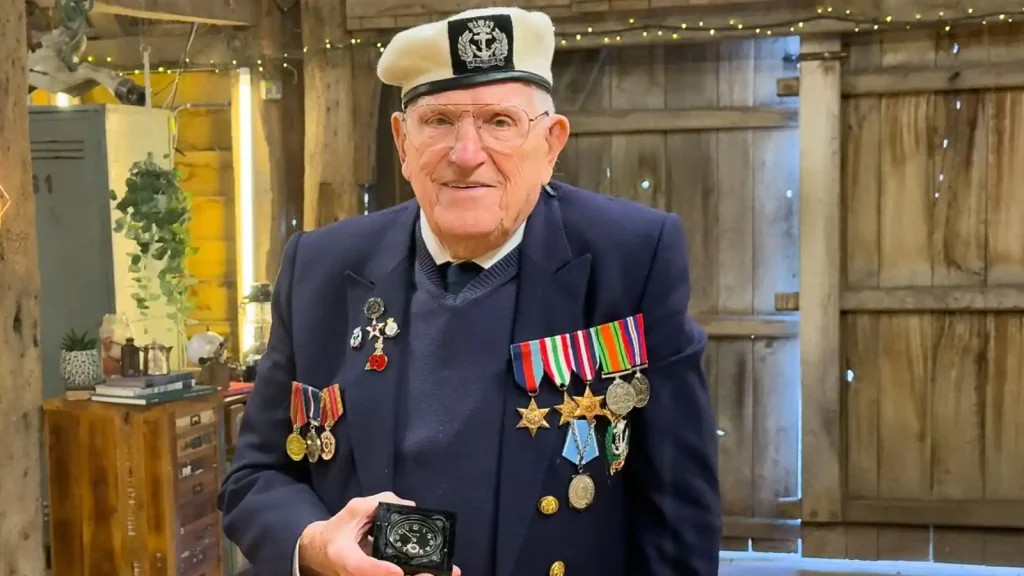
The Repair Shop 2025 episode 17: In a poignant tribute to the 80th anniversary of Victory in Europe Day, The Repair Shop’s craftspeople open the doors of their rustic barn to four extraordinary wartime treasures. Each item carries not just physical damage, but also the weight of remarkable historical journeys that shaped a generation.
The familiar workshop buzzes with reverence as horologist Steve Fletcher welcomes a very special guest. At 101 years old, Royal Navy veteran John Holloway stands tall despite his century of life, clutching a timepiece that represents far more than merely hours and minutes. During the tumultuous days of World War II, John served as an engineer aboard the aircraft carrier HMS Formidable. His skilled hands were responsible for maintaining the aircraft and installing the precisely calibrated cockpit clocks that American pilots relied upon for their perilous missions over enemy territory.
“These weren’t just clocks,” John explains, his eyes glistening with memories. “They were lifelines. One minute off could mean the difference between hitting a target or missing it completely—between coming home or not.”
When peace finally arrived in 1945, John found himself in possession of one of these remarkable timepieces. Rather than keeping it as a personal souvenir of his wartime service, he transformed it into a symbol of love by gifting it to his beloved wife Connie. For decades afterward, the clock maintained its place of honor on her bedside table, marking every precious moment of their life together until her passing.
Now silent and still, the intricate mechanism presents a formidable challenge. Steve enlists the help of his watchmaker son Fred, creating a touching parallel between the father-son relationship and the generational impact of the war itself. Together, they carefully dismantle the delicate inner workings, discovering that decades of dust and deterioration have brought the historic timepiece to a standstill.

Scan smarter. Create faster. Free.
Download QR & Barcode Studio — Create and scan unlimited QR codes & barcodes.
No paywalls. No limits. 100% Free.

“This isn’t just a repair,” Steve confides to the camera. “It’s a responsibility to history and to John’s memories of both his service and his marriage.”
Meanwhile, across the workshop, teddy bear restoration experts Julie Tatchell and Amanda Middleditch face what might be the most emotionally charged challenge of their careers. They’re introduced to ‘Haisi,’ a small plastic doll whose appearance—cracked limbs and faded features—belies her extraordinary historical significance.
Eighty-six-year-old Haisi belongs to Ruth, who was just two years old when the doll became her sole companion on an extraordinary journey from Nazi-occupied Austria to the safety of British shores. As a Jewish orphan with neither passport nor papers, Ruth’s future in Vienna looked impossibly bleak. Death camps were claiming thousands daily, and children were not spared the horrors.
“Haisi wasn’t just my doll,” Ruth explains softly. “She was my only constant in a world that had taken everything else.”
Through tears, Ruth recounts how a courageous network of resistance fighters smuggled both her and Haisi out of Austria. The culmination of their dangerous journey involved a remarkable feat of subterfuge at Dover customs, where Ruth’s rescuers managed to bring her into Britain despite the lack of documentation. Throughout it all, Haisi remained clutched in her tiny hands—a silent witness to both humanity’s capacity for cruelty and for extraordinary compassion.
The restoration team quickly realizes that Haisi’s repairs require specialized expertise. Julie calls in plastics restorer Charlotte Abbott to examine the doll’s cracked and shattered celluloid limbs. Celluloid, an early plastic known for its fragility, presents unique challenges that even seasoned restorers approach with caution.
“This material is notoriously difficult to work with,” Charlotte explains as she carefully assesses the damage. “It’s unstable, prone to further deterioration, and extremely sensitive to temperature. But given what this doll represents, we simply have to find a way.”
The Repair Shop 2025 episode 17
Despite having three top experts collaborating on the restoration, the team exchanges worried glances. Even with their combined decades of experience, saving Ruth’s precious companion feels like an uncertain proposition. The weight of responsibility is palpable; they’re not just repairing a toy but preserving a tangible link to one of history’s darkest chapters.
As the restorations progress, the barn fills with stories of courage, sacrifice, and human resilience. The craftspeople work with extraordinary care, knowing that their skills are serving something far greater than mere objects—they’re honoring the lived experiences of a generation that faced unimaginable circumstances with remarkable fortitude.
Through these meticulous restorations, The Repair Shop does what it does best: breathing new life into treasured possessions while preserving the profound human connections they represent. In this special episode, those connections stretch across time to remind viewers that behind the grand historical narratives of war lie countless personal stories—stories of ordinary people who lived through extraordinary times, carrying small, precious items that bear witness to humanity’s darkest hours and brightest moments.
The Repair Shop 2025: VE Day Special Continues
Beyond the delicate timepiece and fragile doll, two more extraordinary wartime treasures await restoration in the barn’s warm glow. Each item carries whispers from the past—connections to individuals whose lives were forever altered by global conflict yet who responded with remarkable courage and compassion.
Master hatter Jayesh Vaghela reverently examines an RAF cap that represents not just military service, but a powerful story of diversity and determination. The cap belonged to Johnny Smythe, a young man from Sierra Leone who, hearing the call of duty from thousands of miles away, volunteered to serve alongside Allied forces. Despite the pervasive racial prejudice of the era, Johnny’s exceptional skills earned him selection as a navigator with the elite Bomber Command.
“Johnny was one of only 60 Black African airmen to serve in the RAF during the war,” explains his son Eddy, handling the cap with unmistakable pride. “In those days, the color bar was still firmly in place, yet my father was determined to defend freedom against fascism.”
The cap bears silent testimony to Johnny’s extraordinary wartime journey. During a perilous mission over German territory, his aircraft was shot down—a catastrophe that countless airmen did not survive. Johnny not only lived through the crash but endured subsequent imprisonment in Stalag Luft 1, a prisoner-of-war camp where conditions were notoriously harsh. Throughout this ordeal, his dignity and resilience never wavered.
After liberation, Johnny’s remarkable life took another significant turn. Returning to his homeland, he channeled his experiences and natural leadership into diplomacy, eventually rising to become a senior diplomat representing Sierra Leone on the world stage. The trajectory from volunteer airman to diplomat illustrates how the crucible of war often revealed extraordinary potential in ordinary individuals.
Eddy’s request for the restoration presents Jayesh with a thoughtful challenge. “I don’t want it to look new,” Eddy emphasizes. “The wear and battle scars are part of its history—part of my father’s story. I just want it preserved and presentable enough to honor his legacy.”
Jayesh nods in understanding, his experienced fingers already assessing the delicate balance between restoration and preservation. “Every mark on this cap represents a moment in your father’s journey,” he reflects. “My job isn’t to erase that history but to stabilize it so it can continue telling his story for generations to come.”
Across the workshop, bookbinder Chris Shaw unfolds the fragile pages of what initially appears to be a modest autograph book. However, as he carefully turns each leaf, his expression transforms from professional interest to profound emotional connection. Within these simple pages lies a chronicle of humanity at its most vulnerable—and its most resilient.
The book belongs to Dorothy Orr from County Antrim, Northern Ireland, who shares that it was the treasured possession of her mother Margaret. As a wartime nurse stationed in military hospitals across Scotland, Margaret tended to wounded soldiers from across the globe—young men far from home, bearing both physical and psychological wounds from the battlefield.
“My mother rarely spoke about her wartime experiences,” Dorothy explains, her voice softening. “But she kept this book close all her life. I think these messages from her patients meant more to her than any official recognition ever could.”
The pages reveal heartfelt expressions of gratitude penned by soldiers in various handwritings—some steady, others shaky from injury. Messages appear in multiple languages, reflecting the truly international nature of the conflict and the universal language of care that Margaret provided. Some entries include small sketches or poems; others contain simple but profound thank-yous from men who had stared death in the face and found comfort in Margaret’s compassionate presence.
“What we have here isn’t just an autograph book,” Chris observes thoughtfully. “It’s a document of healing—physical and emotional—captured in real-time during one of history’s darkest chapters.”
The binding has deteriorated over decades, with several loose pages threatening to separate completely. Acid in the paper has caused yellowing and brittleness, while water damage has blurred some of the precious inscriptions. For Chris, the restoration requires not just technical skill but a profound respect for the emotional significance this humble book represents.
As the restoration team works their magic across these four remarkable items, The Repair Shop becomes more than a workshop—it transforms into a living museum where history breathes through personal artifacts. Each expert approaches their task with the understanding that they’re not simply fixing objects; they’re preserving tangible connections to extraordinary human experiences that shaped the world we inhabit today.
Through these careful restorations, the 80th anniversary of VE Day receives a commemoration that goes beyond ceremonies and speeches. It honors the individual stories that collectively created history—stories of courage, compassion, and resilience that continue to inspire long after the echoes of conflict have faded.
I’ll write a 400-word conclusion for the article about The Repair Shop’s VE Day special episode. Based on the content you’ve provided, I’ll create a conclusion that maintains the emotional tone while wrapping up the themes presented in the text.
A Living Bridge Between Past and Present
As the final restorations are unveiled to their owners, The Repair Shop transforms into a sacred space where history breathes once more through these cherished artifacts. Each item—John’s aircraft timepiece, Ruth’s beloved Haisi doll, Johnny’s RAF cap, and Margaret’s autograph book—stands as a tangible connection to extraordinary moments that shaped our world.
The emotional reunions remind us why these objects matter so deeply. They aren’t merely things but vessels carrying profound human experiences across decades. When John holds his restored cockpit clock and hears its steady rhythm after years of silence, we witness more than mechanical revival—we see memories awakening. Similarly, as Ruth cradles her restored companion Haisi, the doll becomes a bridge spanning eighty years of personal and collective history.
Through these meticulous restorations, The Repair Shop does what it does best: breathing new life into treasured possessions while preserving the profound human connections they represent. However, this special episode reaches beyond typical repairs to touch something universal about human resilience. Each object tells a story of ordinary people facing extraordinary circumstances with remarkable courage and dignity.
The craftspeople approach their work with reverence, understanding they’re not merely fixing objects but preserving living history. Their skilled hands become conduits between generations, ensuring these firsthand accounts of war and peace continue speaking to future audiences. Moreover, their careful work honors experiences that might otherwise fade as fewer firsthand witnesses remain among us.
As the restoration team works their magic across these four remarkable items, The Repair Shop becomes more than a workshop—it transforms into a living museum where history breathes through personal artifacts. These aren’t grand historical narratives but intimate stories that collectively formed the world we inhabit today.
Through these careful restorations, the 80th anniversary of VE Day receives a commemoration that goes beyond ceremonies and speeches. It honors the individual stories that collectively created history—stories of courage, compassion, and resilience that continue to inspire long after the echoes of conflict have faded. In this way, The Repair Shop reminds us that history isn’t distant or abstract but lives on through objects that connect us to those who came before—and to the better world they fought to create.
FAQ The Repair Shop 2025 episode 17
Q: What is The Repair Shop and how does it honor historical artifacts?
A: The Repair Shop is a beloved television program where skilled craftspeople restore treasured family heirlooms and historical artifacts in a rustic barn workshop. Rather than simply fixing objects, these experts meticulously preserve the stories and emotional connections attached to each item. For instance, in their VE Day special episode, they restored wartime treasures that represented extraordinary human experiences—from a naval cockpit clock to a doll that accompanied a Jewish child escaping Nazi persecution. Through these restorations, The Repair Shop creates a living bridge between past and present, ensuring historical narratives continue to inspire future generations.
Q: How do The Repair Shop craftspeople approach wartime artifacts differently?
A: When handling wartime artifacts, The Repair Shop craftspeople approach each item with exceptional reverence and historical awareness. First, they thoroughly research the item’s historical context to understand its significance. Subsequently, they often consult with specialized experts, as seen when teddy bear restorers brought in a celluloid specialist for Ruth’s fragile doll. Furthermore, they balance technical restoration with historical preservation, being careful not to erase meaningful wear that tells part of the item’s story. Most importantly, they recognize they’re not just fixing objects but preserving tangible connections to pivotal historical moments that shaped our collective history.
Q: What techniques do horologists use to restore antique timepieces like John’s aircraft clock?
A: Horologists like Steve Fletcher employ several specialized techniques when restoring antique timepieces such as John’s aircraft clock. Initially, they perform a thorough assessment, carefully documenting the condition before disassembly. Then, they meticulously dismantle the mechanism, cleaning each component with specialized solutions to remove decades of accumulated dust and corrosion. Additionally, they might fabricate replacement parts that match original specifications when necessary. Furthermore, they apply period-appropriate lubricants to ensure smooth movement without compromising authenticity. Finally, they reassemble and calibrate the timepiece, often requiring extraordinary patience as they balance historical accuracy with functional reliability.
Q: Why are personal wartime artifacts historically significant beyond their physical value?
A: Personal wartime artifacts carry historical significance far beyond their material value because they humanize grand historical narratives through individual experiences. Consequently, items like Margaret’s autograph book from wounded soldiers provide intimate glimpses into how ordinary people experienced extraordinary circumstances. Moreover, these objects often survived against incredible odds, making them rare firsthand witnesses to pivotal historical moments. Additionally, they frequently represent personal courage, resilience, and compassion amidst humanity’s darkest chapters. In essence, these artifacts create emotional connections to history that textbooks alone cannot achieve, helping us understand both the tragedy of conflict and the triumph of human spirit.
Q: What challenges arise when restoring celluloid dolls like Ruth’s Haisi?
A: Restoring celluloid dolls presents unique challenges due to the material’s inherent instability. Firstly, celluloid is notoriously fragile and becomes increasingly brittle with age, making even gentle handling risky. Moreover, it’s extremely temperature-sensitive and can crack or warp under minor environmental changes. Additionally, celluloid is highly flammable, requiring special safety precautions during restoration. Furthermore, finding matching materials for repairs is particularly difficult since modern substitutes often look visibly different. Consequently, restorers like Charlotte Abbott must combine historical knowledge with specialized chemistry expertise, often developing custom solutions for each doll while respecting both the physical object and its emotional significance.
Q: How does The Repair Shop balance preservation versus restoration in historical items?
A: The Repair Shop expertly navigates the delicate balance between preservation and restoration by following several guiding principles. Initially, they consult closely with owners to understand which aspects of wear represent meaningful history versus damage requiring intervention. Subsequently, they prioritize stabilization to prevent further deterioration before considering cosmetic improvements. Additionally, they employ reversible techniques whenever possible, ensuring future conservators can work with the item if needed. Furthermore, they document their process thoroughly, preserving knowledge about the item’s condition and treatment. Ultimately, their approach honors each object’s unique journey through time, preserving its historical integrity while ensuring it continues telling its story for generations to come.
Q: What emotional impact do restorations have on families connected to wartime histories?
A: Restorations of wartime artifacts create profound emotional impacts on families, often serving as healing intergenerational bridges. Initially, the restoration process frequently prompts family members to share previously untold stories, preserving oral histories that might otherwise be lost. Moreover, seeing a treasured item restored often provides emotional closure, particularly for second-generation family members who inherited both the object and its unresolved historical trauma. Furthermore, these restorations transform fragile items from something too delicate to handle into living family heirlooms that can be actively engaged with and shared. Consequently, these renewed objects become tangible connections to ancestral experiences, helping families honor their personal histories within broader historical narratives.
Q: What specialized knowledge do bookbinders need when restoring wartime documents like Margaret’s autograph book?
A: Bookbinders restoring wartime documents require specialized knowledge spanning multiple disciplines. Primarily, they must understand historical papermaking techniques and materials to identify appropriate conservation approaches. Additionally, they need chemistry expertise to address paper acidity, which causes yellowing and brittleness in aging documents. Furthermore, they must recognize period-specific inks and understand how each type interacts with preservation treatments. Moreover, they need traditional binding skills alongside modern conservation techniques to maintain historical authenticity. Perhaps most importantly, bookbinders like Chris Shaw must balance preserving physical characteristics with safeguarding written content, often making careful compromises to ensure both the object and its precious messages survive for future generations.
Q: How do The Repair Shop experts research historical context for unusual wartime items?
A: The Repair Shop experts employ comprehensive research strategies when encountering unusual wartime items. Initially, they gather firsthand accounts from the owners, recording family stories that provide crucial contextual information. Subsequently, they consult specialized reference materials about military equipment, civilian artifacts, and historical manufacturing techniques from the specific era. Furthermore, they often collaborate with museums and historical societies to access comparative examples and documented provenance. Additionally, they analyze materials scientifically to determine authentic composition and appropriate conservation methods. Through this multifaceted approach, they develop nuanced understandings of each item’s historical significance, ensuring their restorations honor both the physical object and its place within broader historical narratives.
Q: Why are VE Day commemorations still important 80 years after the end of World War II?
A: VE Day commemorations remain vital 80 years after World War II because they preserve essential collective memory as firsthand witnesses become increasingly rare. Furthermore, these remembrances honor both the extraordinary sacrifices made and celebrate the triumph of human resilience against overwhelming adversity. Additionally, they provide crucial historical context for understanding modern geopolitical realities that emerged directly from the conflict. Moreover, commemorations like The Repair Shop’s special episode transform abstract historical events into relatable human stories, making history accessible and emotionally resonant for new generations. Consequently, these observances serve as powerful reminders of both humanity’s capacity for destruction and our equal potential for compassion, courage, and rebuilding—lessons that remain eternally relevant.