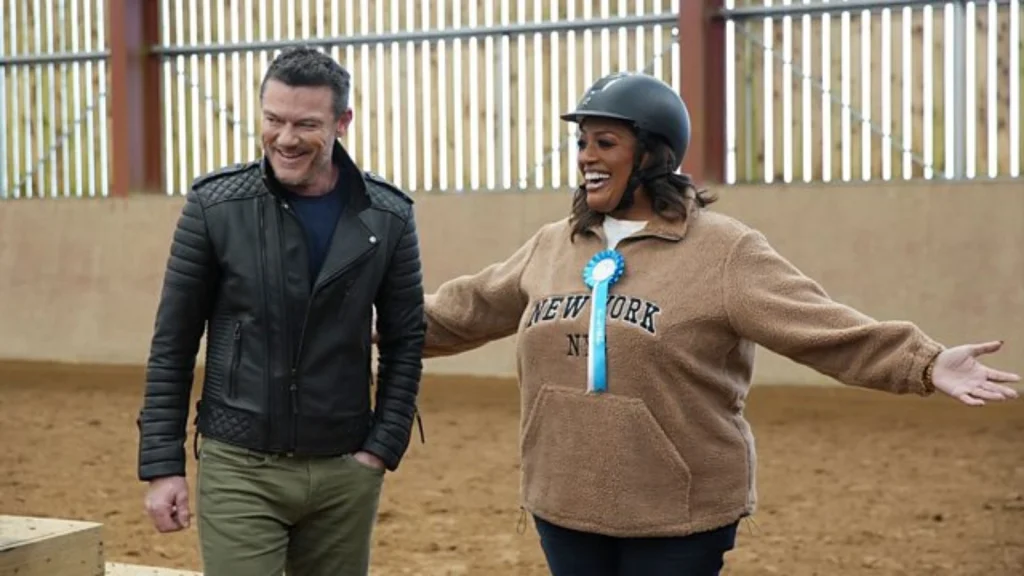
An intimate look into the life of a global star provided by Alison Hammond’s Big Weekend episode 3 reveals a man whose journey from the valleys of Wales to the heights of Hollywood was paved with profound personal struggle and immense resilience. The episode peels back the layers of celebrity, offering a rare and candid portrait of the actor Luke Evans, far from the glamour of red carpets and blockbuster film sets.
When presenter Alison Hammond anticipated meeting the actor, her mind conjured images of Los Angeles sunshine and Hollywood extravagance. Instead, the reality was a world away: wet, freezing, and snowing in his native Wales. This stark contrast immediately sets the tone for an interview that prioritizes substance over spectacle, grounding his story in the raw, unfiltered experiences that shaped him. This type of in-depth celebrity interview resonates deeply in an era where audiences seek authenticity, moving beyond curated public personas to understand the human being behind the star.
The scope of Alison Hammond’s Big Weekend episode 3 is both broad and deeply personal, tracing a compelling narrative arc from his past pain to his present peace. It explores Evans’s formative years, the unseen battles with his identity and mental health, his artistic development, and his current life as a globally recognised actor.
The journey presented is not a simple rags-to-riches tale but a complex story of overcoming internal and external obstacles, a narrative that finds its beginning not in a Californian studio but in the heart of the Welsh countryside, a place of both cherished memories and painful associations for the star. The episode promises to uncover what truly drives a man who has made over $3 billion at the box office, seeking to understand the person behind the blockbuster roles.
The foundation of the story is set against the backdrop of his Welsh upbringing, where presenter Alison Hammond joins him for a weekend that uncovers his roots. From a nostalgic visit to an equestrian centre he frequented as a child to the family home where he grew up, every location serves as a catalyst for reflection.

Scan smarter. Create faster. Free.
Download QR & Barcode Studio — Create and scan unlimited QR codes & barcodes.
No paywalls. No limits. 100% Free.

This exploration of his past provides essential context for understanding the man he is today, a man who seems as comfortable on a horse as he is on a film set. The episode masterfully contrasts the public image of Luke Evans, the confident action hero, with the vulnerable boy who once felt profoundly lost in the very places he now revisits with a new perspective.
This journey into his past begins not with a limousine but with a horseback ride through the Welsh countryside, an activity that immediately connects him to his childhood. He fondly recalls visiting the same equestrian centre with his mother, establishing a deep link to his family and his origins. Although a seasoned rider who performed his own stunts in films like Beauty and the Beast, Evans appears most at home in this simple, rustic setting.
It is a powerful visual metaphor for the episode’s core theme: stripping away the veneer of Hollywood to reveal the authentic self beneath. The weekend, therefore, becomes a pilgrimage back to the source, setting the stage for the deeply personal revelations that follow, far from the carefully managed world of celebrity press tours.
Alison Hammond’s Big Weekend episode 3 – Luke Evans
A Journey Home: Faith, Family, and Formative Years
The weekend’s emotional core is the visit to Aberbargoed, where Luke Evans’s parents, David and Yvonne, still reside in his childhood home. The welcome is warm and unassuming, a stark contrast to the high-stakes world he now inhabits. His parents, devout Jehovah’s Witnesses, provide a glimpse into the unique environment that shaped their only son. The revelation that the family does not celebrate Christmas offers a subtle but significant insight into the strict religious framework of his upbringing, a framework that would later create immense internal conflict for the young actor. The house itself, filled with Welsh cakes and quiet affection, represents a sanctuary that was simultaneously a source of unspoken tension.
His parents share heartfelt memories, painting a picture of a happy, energetic child. His mother, Yvonne, recalls a house constantly filled with friends and laughter, describing him as “a full house” from the moment he was born. She shares never-before-heard audio recordings of a young Luke, made when he was just six years old, narrating his day-to-day activities with a natural flair for performance.
In the tapes, he is heard commentating on watching TV-am and playing in the garden, his youthful voice brimming with a confidence that seems to foreshadow his future career. Listening to the tapes, it is easy to see the seeds of the future entertainer. Yet, his parents seem unaware of the deeper turmoil that was brewing beneath the surface of this seemingly idyllic childhood.
Yvonne expresses immense pride in her son’s accomplishments, not just for his success but for how he has remained grounded and kept his “feet firmly on the floor.” However, the episode carefully juxtaposes this parental perspective with Luke’s own recollections. While his parents believe he had a fun and simple childhood, Luke reveals a different story from the confines of his old bedroom.
He speaks of feeling awkward and uncomfortable in his own skin, a skinny kid who lacked confidence because he was relentlessly bullied. This disconnect between his parents’ perception and his own experience highlights the profound isolation he felt, unable to share the true nature of his struggles with the people closest to him, creating a hidden life behind closed doors.
The Unseen Struggle: Bullying, Identity, and a Battle for Survival
Beneath the surface of his formative years lay a dark and painful reality. Luke Evans reveals that he was the victim of severe and violent bullying throughout his school years. He explains how this constant torment led him to believe that he was the problem, eroding his self-worth and making school a place of dread rather than learning. The experience was so traumatic that he had absolutely no intention of continuing his education, choosing to leave home at sixteen to escape the hostile environment. This decision was not born of ambition alone but of a desperate need to find a place where he could simply exist without fear, a place where he could begin to discover who he was.
This struggle was compounded by a profound internal conflict regarding his sexuality. Growing up as a Jehovah’s Witness, he was taught that being gay was a grave sin, equivalent to murder in the eyes of the religion, and that gay people would be destroyed at Armageddon. He knew he was different from a very young age, but within his community, there was no one he could turn to for guidance or understanding. All of his friends were also Jehovah’s Witnesses, and the fear of being ostracised was absolute. To be openly gay would mean being completely cut off from his family and everything he had ever known, a punishment he describes as cold and absolute.
This crushing sense of isolation left him with no outlet. At the age of fourteen, in a desperate search for help, he sought out a psychologist. He simply wanted someone to talk to, to help him understand what he was going through. However, he was met with a clinical proposition: a fourteen-week course he could not possibly afford, at £200 per session. The encounter only deepened his feeling of hopelessness, reinforcing the belief that he was utterly alone in his struggle. This lack of support from a system meant to provide it pushed him into a dark and dangerous place, making him feel that there was truly no way out.
The weight of this internal conflict and isolation became unbearable during his teenage years. Evans speaks with raw honesty about contemplating suicide, revealing he had gone to the bottom of his valley with the intention of ending his life. The pain of his secret life had become too much to bear.
What stopped him was a powerful, life-affirming thought: a curiosity about the future he had not yet lived. He asked himself what he would be missing out on if he made that final choice. He clung to the hope that his life could be different, that there was a world beyond his current suffering waiting to be discovered. It was this determination to live and pursue his dreams that ultimately pulled him back from the brink.
Finding His Voice: From Castell Coch to Hollywood Stunts in Alison Hammond’s Big Weekend episode 3
A pivotal part of his journey of self-discovery was finding his artistic voice. During Alison Hammond’s Big Weekend episode 3, Luke takes Alison to Castell Coch, the Red Castle, a magical, fairytale-like setting, to meet his former singing teacher, Louise Ryan. Ryan, who also taught Welsh singing sensation Charlotte Church, recalls being immediately struck by Evans’s talent when he came to her as a teenager, describing it as a “jaw-dropping” moment. This moment marks a turning point, where his natural gift for performance began to be professionally nurtured, providing him with a new path forward and a constructive outlet for his powerful emotions.
After some playful vocal exercises, Evans delivers a deeply moving performance of “Bring Him Home” from Les Misérables. The rendition is not just technically proficient; it is saturated with an emotion born from lived experience. As Alison Hammond observes, the performance feels like a conduit for all the pent-up frustration and pain from his childhood. In that moment, the music becomes a powerful form of release, transforming his past struggles into profound artistic expression. It is a clear demonstration of how he channelled his experiences into the craft that would define his life, turning pain into art.
His performance skills, however, are not limited to his voice. The episode highlights his physicality and love for action, connecting directly to his Hollywood career. During the horse-riding segment, he casually mentions performing his own stunts, including having to leap onto a moving horse for his role as Gaston. Later, he takes Alison drifting, a nod to his role in the high-octane Fast & Furious franchise. He thrills her with his skill behind the wheel, showcasing a fearlessness and adrenaline-seeking side to his personality. These moments showcase a different side of his talent, proving his versatility as a performer who is as comfortable with demanding physical action as he is with emotional ballads.
Life and Love Beyond the Spotlight
The final leg of the weekend takes place at Luke Evans’s London home, offering a glimpse into his present-day life and happiness. Here, Alison meets his long-term partner, Fran. Evans speaks lovingly about their relationship, describing Fran as a calming presence in his life and a vital part of their team who makes him a better person. He admits that it took him a while to find this sense of partnership, candidly stating he “kissed a lot of frogs” along the way. This journey to personal happiness mirrors his professional one, marked by trial and error but ultimately leading to a place of contentment and stability.
The domestic scene is relaxed and relatable. A playful conversation about marriage and their shared habit of sending each other dog videos on Instagram paints a picture of a normal, loving couple. This normalcy is then delightfully contrasted when Evans proudly shows off his collection of props from his films. He reveals the ornate sword from Dracula Untold and the ancestral sword and black arrow his character used to slay the dragon in The Hobbit. These artifacts are not just souvenirs; they are tangible symbols of a life and career he never thought possible, powerful reminders of the battles he has won, both on-screen and off.
Standing among these priceless pieces of movie history, Evans reflects on his incredible journey. He feels a deep sense of pride in what he has accomplished, connecting his success directly back to his humble beginnings in his small bedroom in South Wales. He marvels at the goals he has achieved, emphasizing that he does not take any of it for granted. He views his success not just as a personal victory, but as something his loved ones can share in. It is a powerful testament to the resilience of the human spirit and a moving conclusion to a weekend that revealed the true depth and strength of the man behind the movie star.
The Alchemy of Authenticity: When Scars Become Stars
Luke Evans’s story isn’t just another celebrity profile—it’s a masterclass in the alchemy of transformation, where the very experiences that nearly broke him became the foundation of his unshakeable strength. In an industry notorious for manufactured personas and carefully curated narratives, his willingness to expose the raw truth of his journey feels revolutionary. Here was a man who stood at the precipice of ending it all at fourteen, yet somehow found the courage to ask a simple but profound question: “What might I be missing?”
That question, posed in the depths of a Welsh valley during his darkest hour, reverberates through every aspect of his remarkable ascent. From the bullied teenager who felt like a stranger in his own skin to the action hero performing death-defying stunts, Evans embodies something our success-obsessed culture desperately needs to remember: authentic achievement isn’t about erasing your past—it’s about integrating it. His childhood recordings, preserved by his loving mother, capture the seeds of a performer who was always there, waiting beneath layers of pain and silence. The little boy narrating his day with natural flair grew into the man who could channel decades of suppressed emotion into a spine-tingling rendition of “Bring Him Home.”
What makes Evans’s narrative so compelling isn’t just the Hollywood ending—the blockbuster films, the loving partnership with Fran, the London home filled with swords and memories of conquered dragons. It’s the way he’s learned to hold space for both his trauma and his triumph simultaneously. Standing among his collection of movie props, he doesn’t distance himself from that frightened teenager in Aberbargoed; instead, he honors that boy’s courage to survive and dream beyond his circumstances.
For anyone wrestling with their own version of feeling fundamentally different, misunderstood, or trapped by circumstances beyond their control, Evans’s story offers something more valuable than inspiration—it offers permission. Permission to believe that the very qualities that make you feel like an outsider might be precisely what the world needs from you. Permission to understand that seeking help, even when the system fails you, isn’t weakness but wisdom. Permission to know that the chapters of your life that feel like endings might actually be the most important beginnings.
In our age of mental health awareness and authentic storytelling, Evans’s journey from near-suicide to self-acceptance reads like a blueprint for resilience. His willingness to share the messy, uncomfortable truth about growing up gay in a religion that viewed his identity as sinful, about being bullied to the point of despair, about the long road to finding both professional success and personal love, creates space for others to examine their own stories with similar honesty.
The real magic isn’t that Luke Evans escaped his past—it’s that he transformed it into something beautiful, something useful, something that connects rather than isolates. In a world that often asks us to choose between our authentic selves and our ambitions, he proves that the most powerful performances, both on screen and in life, happen when we refuse to make that choice at all.
FAQ Alison Hammond’s Big Weekend episode 3 – Luke Evans
Q: Who is Luke Evans and what makes him a notable figure in Hollywood?
A: Luke Evans is a Welsh actor and singer who has achieved global recognition through blockbuster films that have grossed over $3 billion at the box office. Additionally, he’s known for his roles in major franchises including The Hobbit trilogy, Fast & Furious, and Beauty and the Beast. However, what truly sets Evans apart is his remarkable personal journey from a bullied teenager in rural Wales to becoming an internationally celebrated performer.
Q: What was Luke Evans’s childhood like growing up in Wales?
A: Evans grew up in Aberbargoed, Wales, in a loving household with his parents David and Yvonne, who are devout Jehovah’s Witnesses. Furthermore, his mother recalls a house constantly filled with friends and laughter, describing him as naturally entertaining from birth. Nevertheless, beneath this seemingly idyllic surface, Evans struggled with profound feelings of awkwardness and isolation that his parents were unaware of at the time.
Q: How did Luke Evans’s religious upbringing impact his personal identity?
A: Growing up as a Jehovah’s Witness created immense internal conflict for Evans regarding his sexuality. Consequently, he was taught that being gay was equivalent to murder in the religion’s eyes and that gay people would be destroyed at Armageddon. This belief system meant that being openly gay would result in complete ostracism from his family and community, creating a crushing sense of isolation during his formative years.
Q: What challenges did Luke Evans face during his school years?
A: Evans endured severe and violent bullying throughout his school years, which destroyed his self-confidence and made him believe he was fundamentally flawed. Moreover, this constant torment made school a place of dread rather than learning. The experience was so traumatic that he chose to leave home at sixteen, not from ambition alone, but from a desperate need to escape the hostile environment and find a place where he could exist without fear.
Q: How did Luke Evans overcome his mental health struggles and suicidal thoughts?
A: During his darkest moment at fourteen, Evans contemplated suicide and even went to the bottom of his valley with that intention. However, a powerful life-affirming thought stopped him: curiosity about the future he had not yet lived. He asked himself what he would be missing out on if he made that final choice. This determination to live and pursue his dreams ultimately pulled him back from the brink, demonstrating remarkable resilience.
Q: What role did music and singing play in Luke Evans’s personal development?
A: Music became a transformative outlet for Evans’s emotions and a pathway to self-discovery. His former singing teacher, Louise Ryan, who also taught Charlotte Church, was immediately struck by his talent, describing it as a “jaw-dropping” moment. Furthermore, his performance of “Bring Him Home” from Les Misérables demonstrates how he channels decades of suppressed emotion into profound artistic expression, effectively turning his pain into art.
Q: How did Luke Evans transition from his Welsh roots to Hollywood success?
A: Evans’s journey from Wales to Hollywood wasn’t a typical rags-to-riches story but rather a complex narrative of overcoming internal and external obstacles. Initially, his natural performance abilities were evident from childhood recordings, but professional nurturing of his talent began with singing lessons at Castell Coch. Subsequently, his versatility as both a vocalist and physical performer, including his ability to perform his own stunts, opened doors to major film franchises.
Q: What are some of Luke Evans’s most significant film roles and achievements?
A: Evans has appeared in several major franchises, including playing Gaston in Disney’s Beauty and the Beast, where he performed his own stunts including leaping onto a moving horse. Additionally, he starred in The Hobbit trilogy, wielding the ancestral sword and black arrow used to slay the dragon, and appeared in the Fast & Furious franchise, showcasing his skills in high-octane action sequences and drift racing.
Q: Who is Luke Evans’s partner and what is their relationship like?
A: Evans is in a long-term relationship with his partner Fran, whom he describes as a calming presence and vital team member who makes him a better person. Their relationship appears remarkably normal and relatable, characterized by playful conversations about marriage and sharing dog videos on Instagram. However, Evans candidly admits it took time to find this partnership, stating he “kissed a lot of frogs” along the way.
Q: What lessons can people learn from Luke Evans’s personal journey?
A: Evans’s story demonstrates that authentic achievement involves integrating rather than erasing your past struggles. His willingness to share uncomfortable truths about growing up gay in a restrictive religious environment, experiencing severe bullying, and contemplating suicide creates space for others to examine their own stories honestly. Ultimately, his journey proves that the qualities making you feel like an outsider might be precisely what the world needs from you.