The Antiques Roadshow 2025 – Stephens House & Gardens 3 draws to a magnificent close. Its final, eagerly awaited stop is Stephens House & Gardens in Finchley. This historic north London venue provides a stunning backdrop for the day. Indeed, the team prepares for one last day of incredible discoveries. The gates opened early to a hopeful queue. The air is filled with excitement and anticipation. What amazing antiques will emerge from the bags and boxes? This special episode, Stephens House & Gardens 3, promises to be truly memorable. It’s the last chance this season for visitors to share their family heirlooms. Therefore, everyone hopes for a magical end to the series.
Sometimes, the greatest treasures are hidden. They are hiding right under our noses, mistaken for junk. Jewellery expert Joanna Hardy discovers exactly this. She finds two genuinely precious rings sparkling amongst a box of costume jewellery. They are like diamonds found in the rough. Meanwhile, military specialist Mark Smith spots something else unusual. He examines a rare collection of US uniform badges. A Second World War dry cleaner carefully collected them over many years. This collector certainly had a keen eye for detail. Each badge tells its own story of service and sacrifice.
From personal stories, we turn to items that shaped global history. Robert Tilney handles a truly remarkable document. It is a letter written by the Duke of Wellington himself. Amazingly, Wellington penned this note just hours before the Battle of Waterloo. You can almost feel the tension and gravity of the moment in the ink. This single piece of paper connects us directly to that fateful day. It is a chilling and powerful artifact. Consequently, the valuation could be absolutely staggering. It is a potent reminder of history’s great turning points.
History, however, isn’t always about battles. Sometimes, it is about the beloved stories that shape our childhoods. Justin Croft explores a rare and valuable collection of letters. These letters shed new light on the author A.A. Milne. Furthermore, they reveal intimate details about his son, Christopher. We know him, of course, as the famous Christopher Robin. This correspondence offers a private glimpse into the Winnie-the-Pooh creator. These pages reveal the real family behind the cherished fiction. It’s a touching find for book lovers everywhere.
The Antiques Roadshow also loves to celebrate local heroes. Fiona Bruce takes a moment to learn about a famous north London resident. He was the brilliant illustrator and creator, Heath Robinson. His whimsical cartoon machines are legendary. Robinson’s work truly defined a generation of British humour. Fiona chats with his great-nephew, Peter Higginson, about the man behind the drawings. Additionally, literary treasures continue to appear. Fuchsia Voremberg is thrilled to see a nostalgic set of Doctor Who books. These items bring back fond memories for so many viewers.

Scan smarter. Create faster. Free.
Download QR & Barcode Studio — Create and scan unlimited QR codes & barcodes.
No paywalls. No limits. 100% Free.

Often, guests face a difficult choice. Do you keep a beloved treasure, or do you sell it? Ben Wright explores this very problem with a guest. He carefully weighs the merits of two very different watches. One timepiece might be perfect for daily wear. The other, however, could fetch a life-changing sum at auction. Ben patiently ponders which one to flog and which to wear. It’s a classic Antiques Roadshow dilemma. This is a question many collectors must ask themselves. Ultimately, the decision is deeply personal for the owner.
The show always celebrates stunning design and craftsmanship. Gordon Foster, for example, positively covets a beautiful mid-century cabinet. The cabinet is not empty. It is filled with elegant and timeless tableware. Famed Danish silversmiths Georg Jensen made every single piece. The clean lines and flawless finish are simply timeless. In contrast, Lee Young is delighted by a different style entirely. He examines a delicate and beautiful Chinese export cup and saucer. Its beauty is simply breathtaking. Both finds represent the absolute peak of craftsmanship in their eras.
Antiques Roadshow 2025 – Stephens House & Gardens 3
Of course, art can come in many different forms. Ronnie Archer-Morgan inspects a truly unique item. It is an exquisitely carved walking stick. The detail and skill involved are simply breathtaking. The carver was clearly a master of their craft. Elsewhere, Frances Christie views a series of intricate paintings. The talented Pakistani artist Tassaduq Sohail created them. These artworks are unusual for the roadshow. Yet, they bring a vibrant and fascinating new story to light. They show the incredible diversity of items people treasure. Each piece tells a unique story.
Finally, the day ends with a bit of characteristic fun. Ceramics expert Serhat Ahmet challenges Fiona Bruce. He decides to test her skills in his speciality area. The topic is fine European porcelain. Specifically, they examine some very realistic trompe l’oeil fruit. Fiona must use her knowledge to guess which is Basic, Better, or Best. However, Serhat seems to be withholding crucial information. He might just have a trick up his sleeve! Will Fiona spot the clever fake? It’s a playful and charming end to the Stephens House & Gardens 3 episode.
This final visit of the Antiques Roadshow 2025 season was truly spectacular. Stephens House & Gardens provided a wonderful and fitting send-off. The day was filled with history, art, and deeply personal memories. From priceless letters to rings hidden in plain sight, the experts saw it all. What a fantastic conclusion to the series. The show proves, once again, that extraordinary antiques can be found anywhere. We say goodbye to the Antiques Roadshow for now. But the stories and treasures discovered here will surely be remembered for a long time.
Antiques Roadshow 2025 – Stephens House & Gardens 3 review
The Antiques Roadshow 2025 – Stephens House & Gardens 3 brought experts and enthusiasts together for a remarkable day of discovery. This event took place in Finchley, north London, at a magnificent Victorian mansion. Stephens House provided a perfect backdrop for the day’s events. The house itself is a notable piece of history. It sits within ten acres of beautifully maintained gardens.
The mansion’s origins are linked to a significant commercial success. A family fortune, famously made from ink, funded its creation. The Stephens Ink company thrived during the Victorian era. Its success was due, in part, to a modern approach. The company embraced the new business of advertising. This strategy helped make Stephens Ink a household name.
An example of this advertising survived. One item highlighted was a fabulous barometer. This piece was made from enamelled tin in 1895. Its maker was Chromo of Wolverhampton. The barometer prominently features the “Stephens’ Inks” name at the top and bottom. It serves as a testament to the brand’s savvy marketing.
This historic setting of Stephens House & Gardens hosted the bustling antique hunt. Hopeful visitors arrived early, queuing with their family heirlooms. The air was full of excitement and anticipation. Everyone hoped their items might reveal a hidden story or a surprising value. This final day of the season promised memorable finds.
Experts prepared for one last day of incredible discoveries. What amazing antiques would emerge from bags and boxes? The team evaluated a vast array of items. These objects spanned centuries of history and craftsmanship. This installment of the Antiques Roadshow 2025 provided fascinating insights. It highlighted rare jewelry, unique furniture, and significant historical documents.
The day revealed many special treasures. These discoveries ranged from personal mementos to items of national importance. Each piece offered a window into the past. The experts shared their knowledge, uncovering the stories behind these collectibles. The day at Stephens House & Gardens proved to be a magical end to the series.
Extraordinary Finds from Family Collections
The jewelry table saw some of the day’s most stunning surprises. One guest brought items from her mother-in-law’s collection. They were found within a simple box of costume jewelry. A clearance gentleman had suggested one piece, a diamond, might be real. The owner remained skeptical about the other, a blue stone. A local jeweler had previously dismissed this second item as “blue glass.”
Expert Susan Rumfitt selected these two specific pieces from the owner’s collection. The first item was identified as a large, rose-cut diamond. It possesses significant age and character. The expert dated it to the 19th or possibly even 18th century. She noted its natural inclusions and slight yellow tint. These features, she explained, were part of its historic charm.
The expert then examined the “glass” stone. After a cleaning, she found two feather inclusions. This detail was the key. It indicated the stone was, in fact, a Sri Lankan sapphire. The stone was a beautiful violet-y light blue, possibly a color-change sapphire. It was not glass, but a large gem of about 12 carats. Furthermore, its setting was identified as valuable platinum.
The valuations for these items stunned the owner. The rose-cut diamond, found in the trinket box, received an auction estimate of £5,000. The Sri Lankan sapphire, once dismissed as glass, was valued even higher. The expert placed its auction value between £9,000 and £12,000. The owner was overjoyed. She confirmed the pieces would remain family treasures for her grandchildren.
Another remarkable heirloom involved a sparkling diamond brooch. The owner shared its dramatic backstory. Her grandmother’s second husband, a gambler, had taken her money. Instead of returning the cash, he bought her this brooch in the 1950s. The piece itself is a “double clip” brooch, meaning it separates into two halves.
This feature played a role in its family history. When the grandmother passed away, her two daughters each took one half. The owner’s mother and aunt wore the clips separately. Sadly, after the aunt passed, the two halves were reunited. This history gave the item immense sentimental value.
Expert Geoffrey Munn identified it as a classic 20th-century English design. It was likely made by the famous jeweler Mappin & Webb. The piece is set in white gold. Given its quality, design, and sentimental history, the brooch received a high valuation. The expert estimated its current value between £8,000 and £10,000.
Innovations in Domestic Design
The roadshow also highlighted significant pieces of functional art and furniture. One guest brought a fascinating armchair. He and his wife had purchased it 20 years ago at an antiques fair. The seller told them it was a “campaign chair.” They believed a general had used it during battles. The owner admitted he rarely lets his children sit in it.
He demonstrated the chair’s features. A leg rest extended, and a small reading stand folded out. The chair also reclined into a sleeping position. A small plaque identified the maker. It read “J Foot & Son, Patentees, Manufacturers, 171 New Bond Street, London.”
Expert Lennox Cato, however, corrected the campaign chair story. He identified it as a Victorian-era piece. It was, in fact, known as a “chair for the disease of kings,” or gout. Sufferers needed soft, adjustable furniture. The chair also featured a mahogany “waiter” side table on a brass arm.
The owner had paid a couple of thousand pounds for it. The expert noted that Victorian furniture is less fashionable today. Consequently, its current auction valuation is between £1,200 and £1,500.
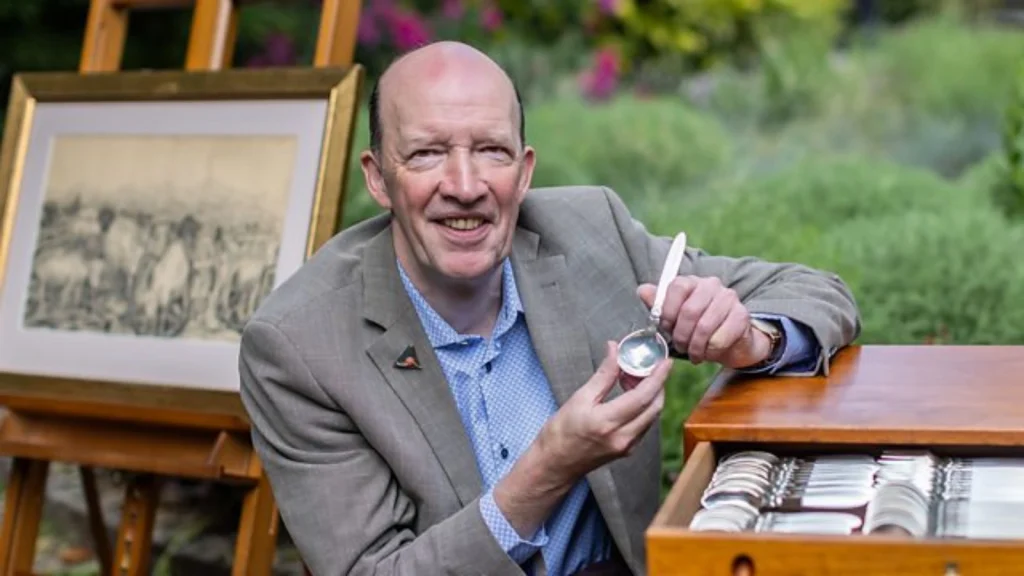
A stunning mid-century modern piece also appeared. This was a complete canteen of cutlery in its original cabinet. The owner’s great-aunt Phyllis had owned it. She worked for the American Foreign Service in Europe. She likely bought the set in the mid-1950s. The owners plan to use the set for their Thanksgiving dinner.
Expert Duncan Campbell identified it as the work of Georg Jensen. The famous Danish silversmith’s firm created it. The specific “Cactus” pattern was designed in 1930 by Gundorph Albertus. The set was impressively complete. It included solid silver-handled knives and round-bowl soup spoons.
The cabinet itself was a key part of the item’s value. The expert explained that the loose cutlery alone would be valuable. A 12-place setting might fetch £3,000 to £5,000. However, the presence of the original cabinet significantly increases the value. The expert valued the complete set at £5,000 to £8,000.
A visually striking umbrella stand represented the Arts and Crafts movement. The owner had bought it when she was 25. She paid £400, which was a significant bonus at the time. She loved how it incorporated natural emblems into a functional item.
Expert Will Farmer identified the designer as Shapland & Petter. He dated the piece to around 1910. This English movement was a reaction against Victorian mass industrialization. The stand features a beautiful copper panel. This design was created using “repousse,” a technique of hammering the design from the reverse.
The timber was identified as oak. Its characteristic “medullary rays” were visible in the grain. The expert noted that the market for Arts and Crafts furniture has fluctuated. Today, however, the piece has a retail value of around £1,000. This is more than double what the owner originally paid.
Masterworks in Miniature and Metal
Fine art and sculpture were also well-represented. A magnificent bronze stag captured the attention of expert Steven Moore. The owner explained it had been inherited. It first belonged to his wife’s father’s cousin in New York. He also wisely noted that they have never cleaned it.
The expert identified the sculptor as Pierre-Jules Mene. Mene was a leading figure of the 19th-century French Animalier school. This movement focused on highly naturalistic depictions of animals. Mene is considered one of its best artists. The stag showed extraordinary finish and sharpness in the casting.
The expert praised the owner for not cleaning it. The bronze’s patina, or colored finish, is delicate. Over-cleaning can easily destroy it. Because of its superb quality and condition, the bronze received a high valuation. It was estimated to be worth £2,000 to £4,000 at auction.
A post-war painting offered a different aesthetic. The owner’s parents bought it in St Ives, Cornwall, around 1965. Expert Grant Ford identified the artist as Denis Mitchell. Mitchell is often known primarily as Barbara Hepworth’s studio assistant. The expert argued this description plays down his significant talent.
The painting, dated 1961, is titled Zelah. It is an oil-on-board study related to a major sculpture by Mitchell. That ten-foot-high sculpture is now in Colombia. The artist used a scratching technique to create clean white lines. This is visible in the work and in his signature. The painting was valued at £3,000 to £5,000.
Two other unusual paintings were brought by a guest. She had bought them directly from the artist, Tassaduq Sohail. She met him after giving him a lift home from Bayswater Road. The Pakistani artist fled India for Pakistan after the 1947 partition. He later studied at Saint Martin’s in London.
Expert Frances Christie noted this traumatic background informed his work. His art often features animals held above critical depictions of humankind. One painting was titled The World Of Storytellers. Its subtitle on the back read Liars And Hypocrites.
The paintings show bold colors but contain dark imagery, like skulls. Sohail used a unique technique. He would paint broad colors, then use a knife or brush handle to carve the outlines. This created a “painting in reverse” effect. The smaller painting was valued at £700 to £900. The larger, more complex work was valued at £2,000 to £3,000.
A Study in 18th-Century Craftsmanship
Several high-quality 18th-century antiques also appeared. One was a sophisticated bronze sundial. Expert Jonathan Snellenburg identified the maker as Thomas Wright. Wright was a famous instrument maker in Fleet Street. He was even appointed as maker to King George II. The sundial was signed and dated 1729.
The item came from the nearby St Mary-at-Finchley church. The owner’s interest began with a J.M.W. Turner painting. Turner painted the church in 1793. That painting clearly shows the sundial’s Georgian stone base. The original sundial was sadly removed due to fear of theft.
The expert explained the sundial’s original purpose. In the 18th century, most people did not have accurate timepieces. The sundial was more accurate than early church clocks. Therefore, it was used to set the clock for ringing the bells. The original sundial and its pedestal were valued at £2,500 to £3,000.
A second 18th-century piece surprised its owner. She brought in a small teapot found in her mother’s cupboard. She believed it might be worth £40 or £50.
Expert Lee Young identified it as Chinese export porcelain. It was made during the Qianlong Emperor’s reign (1736-1795). The piece was specifically made for the Western market. It features a floral, European-style feel. The “grisaille” decoration, a black-and-white technique, is considered a rare and unusual design. This rarity led to a much higher valuation. The expert placed its auction estimate at £1,000 to £1,500.
The Antiques Roadshow 2025 – Stephens House & Gardens 3: A Test of Perception
A popular segment of the roadshow involves a “Basic, Better, Best” challenge. Expert Serhat Teksab_ un_veiled three ornate Meissen porcelain items. All were examples of “trompe l’oeil,” meaning “to fool the eye.” These realistic pieces were status symbols in 18th-century Europe. Porcelain was extremely expensive at the time.
The first item was a tureen shaped like a pile of cherries. It dated to the 1740s. It was part of a known service with over 2,000 pieces. This piece, however, had some damage.
The second item was a lidded box shaped like an apple. It was surrounded by delicate flowers. This piece was much later, dating to around 1840. Unlike the cherries, it was clearly functional. It was likely used to serve fruit compote.
The third item depicted peas in pods on a dish. It dated to the 1750s. It featured a decorative green border and gilding. This piece was not from an identified service. It also had some damage.
The expert revealed the three valuations. One was worth £1,500, one £5,000, and one £9,000. The challenge was to correctly order them.
The “Basic” item, at £1,500, was the apple. Although it was in perfect condition, it was made in 1840. By this time, production techniques were more advanced.
The “Better” item, at £5,000, was the pea tureen. While from the 1750s, it was from an unidentified service. It was likely a stand-alone piece.
The “Best” item, valued at £9,000, was the cherry tureen. It was part of a famous service from the 1740s. This service was commissioned by Count von Bruhl. He was the Prime Minister of Saxony and the head of the Meissen factory. Research shows this specific cherry design is unique. Only one was ever made.
Valuations of Wartime Memorabilia
The roadshow also examined several important military collectibles. One owner brought a fantastic collection of American military badges. They had belonged to her father. Her father’s uncle ran a dry-cleaning business in Manchester during World War II. He had the contract for American servicemen. At the war’s end, he gave his ten-year-old nephew a set of the badges.
Expert Mark Smith was thrilled by their perfect provenance. He explained that many copies exist, but these were genuine. The collection included the most sought-after badges of the war. These were the 101st Airborne (Screaming Eagles) and the 82nd Airborne. It also included the 1st Infantry Division (the Big Red One) and the Eighth Air Force.
These units are famous. The 101st and 82nd were the paratroopers who dropped into Normandy. The 1st Infantry landed on Omaha Beach. The owner had assumed the collection was worth a few hundred pounds. The expert corrected this, stating they were easily worth £3,000.
A document of immense historical importance also appeared. Expert Clive Farahar examined a letter written by the Duke of Wellington. It was written at 3am on the morning of the Battle of Waterloo. This was just eight hours before the first shots were fired.
The letter’s text reveals Wellington’s mindset. He wrote that everything would be all right if the Prussians arrived. This, of course, they famously did, just in time. The owner’s grandmother, a historian, had acquired the letter. The expert valued this single piece of paper at £2,000. The owner agreed it was “historically priceless.”
The Antiques Roadshow 2025 – Stephens House & Gardens 3: Chronicles of Christopher Robin at War
Perhaps the most moving discovery of the day was an archive of letters. These letters detailed the wartime life of Christopher Robin Milne. The owner brought the letters along with four Winnie-the-Pooh books. She explained that Christopher Robin was her godfather. She knew him well; he ran a bookshop in Dartmouth.
The books themselves were special. They were signed by both AA Milne (the author) and Christopher Milne in 1947. Although not first editions, this double signature made them valuable.
The real treasures, however, were the 12 unpublished letters. The correspondence was between AA Milne and the owner’s mother, Mrs. Bertram. This friendship began during World War II, around 1943.
The connection was Christopher Robin. The owner’s father, Major Bertram, was Christopher’s commanding officer. They were serving together in the North Africa campaign. AA Milne referred to his son by his family nickname, “Moon.”
These letters formed a vital “triangle” of communication. AA Milne and Mrs. Bertram were both in England. They were desperate for news of their loved ones overseas. They exchanged information funneled from North Africa. These letters are culturally significant and have never been published.
One moving letter from AA Milne quotes Christopher directly. Christopher was reporting news from Italy. He wrote, “Bertram has been wounded.” This is how the owner’s mother learned her husband had been shot.
This unique and personal archive received a significant valuation from the Antiques Roadshow 2025 team. The four signed books were valued at £2,000 to £3,000. The unpublished letters, detailing this unknown aspect of Christopher Robin’s life, were valued much higher. The paper archive was estimated to be worth between £8,000 and £10,000.
Historical Perspectives and Ephemera
The day at Stephens House & Gardens concluded with several other unique collectibles. A guest shared his Doctor Who books. He acquired them at a book signing in Finchley in 1976. He was five years old. Tom Baker, the new Doctor, was there in full costume. Baker signed the books with personal messages, such as “To Ketan from Who with love.” The expert noted these Target paperbacks were the only way fans could re-experience episodes at the time. The collection was valued at £400.
A wonderfully detailed walking stick was also presented. The owner’s great-great-grandfather, a woodcarver in Illinois, had made it. The 19th-century stick was covered in remarkable iconography. It featured a carved squirrel, hare, fish, elephant, and turtle. This intricate folk art piece was valued at £800 to £1,000.
Finally, a special item from the Brunel Museum was shown. Curator Katherine McAlpine presented a paper and card model. It is one of only two known to exist. The model depicts the Thames Tunnel, the world’s first tunnel under a river.
The project was started in 1825 by Marc Isambard Brunel. His son, Isambard Kingdom Brunel, also worked on it. The tunnel took 18 years to dig. This model was made as a “proof of concept” to attract investors. It was crafted by children from the Philanthropic Society. This Victorian charity gave skills to children of criminals. This delicate piece of engineering history provided a fascinating close to the roadshow.
FAQ Antiques Roadshow 2025 – Stephens House & Gardens 3
Q: What made Stephens House & Gardens 3 the final episode of Antiques Roadshow 2025?
A: This episode marked the culminating event of the 2025 season at the historic Victorian mansion in Finchley, north London. The location itself provided significant cultural resonance, as Stephens House was built from a fortune made by the famous Stephens Ink company. Furthermore, the eagerly awaited finale promised one last opportunity for visitors to present family heirlooms to the expert team. The atmospheric ten-acre gardens and the mansion’s rich heritage created an unforgettable backdrop for extraordinary discoveries.
Q: How did Joanna Hardy discover genuine precious rings among costume jewelry?
A: Expert Susan Rumfitt examined a collection brought in a simple box of costume pieces. One item was a large rose-cut diamond dating to the 18th or 19th century, valued at £5,000. The second piece, previously dismissed as “blue glass” by a local jeweler, revealed itself as a 12-carat Sri Lankan sapphire set in platinum. After careful cleaning, the expert spotted feather inclusions characteristic of genuine sapphires. Consequently, this remarkable gem received an auction estimate between £9,000 and £12,000, transforming what appeared to be worthless trinkets into valuable family treasures.
Q: What historic significance does the Duke of Wellington’s Waterloo letter hold?
A: This extraordinary document was penned by Wellington himself at 3am on the morning of the Battle of Waterloo, merely eight hours before combat commenced. The letter reveals Wellington’s strategic mindset, expressing confidence that “everything would be all right if the Prussians arrived.” Expert Clive Farahar emphasized its immense historical importance, noting how the correspondence connects us directly to that pivotal moment in 1815. Although valued at £2,000 for auction purposes, the owner acknowledged its cultural worth transcends monetary assessment, making it historically priceless.
Q: What unpublished letters about Christopher Robin Milne were discovered?
A: The archive contained 12 previously unpublished letters exchanged between A.A. Milne and Mrs. Bertram during World War II around 1943. These letters formed a vital communication triangle, as Christopher Robin served under Major Bertram’s command in North Africa. The correspondence provided desperate family members in England with news from overseas. Notably, one poignant letter quotes Christopher reporting that “Bertram has been wounded,” revealing how Mrs. Bertram learned her husband had been shot. This culturally significant archive, offering unknown insights into the Winnie-the-Pooh creator’s family, was valued between £8,000 and £10,000.
Q: Why did the Georg Jensen cutlery set receive such high valuation?
A: The complete canteen featured the iconic “Cactus” pattern designed by Gundorph Albertus in 1930 for the renowned Danish silversmith. Expert Duncan Campbell explained that while the solid silver-handled pieces alone might fetch £3,000 to £5,000 for a 12-place setting, the original mid-century cabinet significantly enhanced value. The combination of exceptional Danish craftsmanship, complete service pieces including round-bowl soup spoons, and the accompanying period-appropriate storage cabinet elevated the total valuation to £5,000 to £8,000. Additionally, the set’s American Foreign Service provenance added historical interest.
Q: What makes the American military badge collection particularly valuable?
A: The collection’s perfect provenance distinguishes it from countless reproductions flooding the market. The badges were genuine items collected by a Manchester dry-cleaner who serviced American troops during World War II. Expert Mark Smith identified the most sought-after units represented: the 101st Airborne (Screaming Eagles), 82nd Airborne, 1st Infantry Division (Big Red One), and Eighth Air Force. These divisions participated in pivotal D-Day operations, with paratroopers dropping into Normandy and infantry landing on Omaha Beach. The authenticated collection, far exceeding the owner’s expectation of “a few hundred pounds,” was valued at £3,000.
Q: How does the trompe l’oeil Meissen challenge work on the show?
A: Expert Serhat Ahmet presented three ornate Meissen porcelain pieces designed to “fool the eye” as realistic fruit. The challenge required identifying which item was Basic (£1,500), Better (£5,000), or Best (£9,000). The 1840 apple box, despite perfect condition, ranked lowest due to advanced production techniques of that era. The 1750s pea tureen from an unidentified service placed second. Surprisingly, the damaged 1740s cherry tureen topped the rankings because it belonged to Count von Bruhl’s famous 2,000-piece service. Research confirmed this unique cherry design was a one-of-a-kind piece, making it extraordinarily valuable.
Q: What unusual Arts and Crafts umbrella stand appeared at the roadshow?
A: The striking piece was designed by Shapland & Petter around 1910, exemplifying the Arts and Crafts movement’s reaction against Victorian mass industrialization. The stand incorporated natural emblems into functional design, featuring a beautiful copper panel created using the repousse technique. This involved hammering the decorative pattern from the reverse side. Expert Will Farmer identified the timber as oak, noting the characteristic medullary rays visible in the grain. The owner, who originally paid £400 as a young woman, learned the piece now carries a retail value of approximately £1,000, more than doubling her initial investment.
Q: Who was Heath Robinson and why was he featured at Stephens House?
A: Heath Robinson was a brilliant illustrator and creator famous for his whimsical cartoon depictions of fantastically complicated machines. His work truly defined a generation of British humour during the early 20th century. Host Fiona Bruce took time to celebrate this local north London resident, interviewing his great-nephew Peter Higginson about the man behind the legendary drawings. The Finchley location made this tribute particularly appropriate, as Robinson’s connection to the area added regional significance. His imaginative mechanical contraptions became so iconic that “Heath Robinson” entered the English language as a term for unnecessarily complex devices.
Q: What dilemma did Ben Wright explore regarding two different watches?
A: The expert carefully examined the merits of two timepieces facing vastly different futures. One watch proved perfect for everyday wear, offering practical functionality and durability. However, the second timepiece possessed characteristics that could command a life-changing sum at auction. Ben Wright patiently pondered this classic Antiques Roadshow dilemma: which watch should the owner flog for profit, and which should remain as a wearable treasure? Ultimately, this deeply personal decision balanced sentimental attachment against financial opportunity. The scenario perfectly illustrated the emotional complexity many collectors experience when assessing their possessions’ monetary versus personal value.