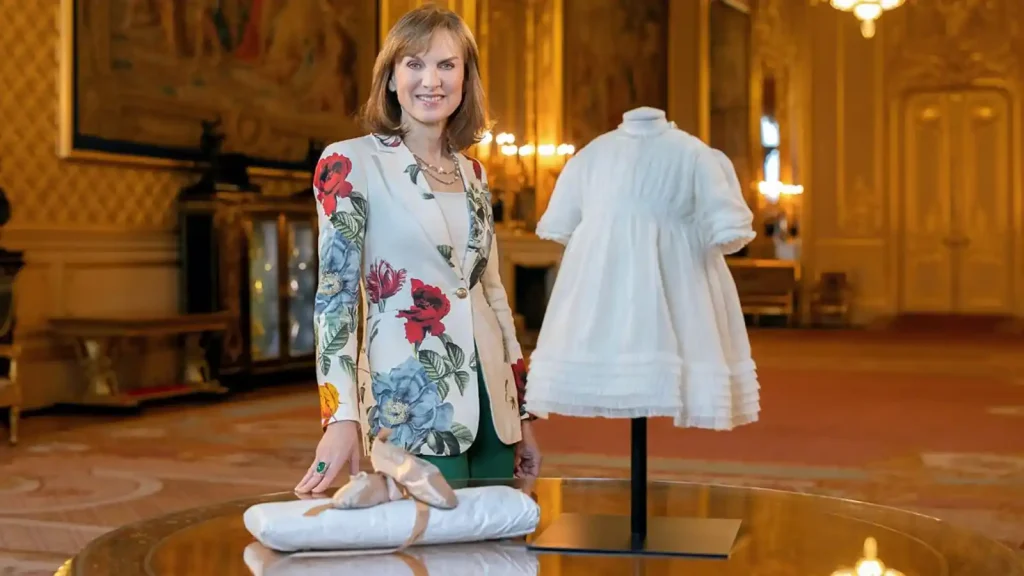
Antiques Roadshow 2026 – Remembering Queen Elizabeth II offers an intimate, affectionate portrait of the late monarch, broadcast from the rain-softened grounds of Windsor Castle to mark what would have been her centenary year. Presented by Fiona Bruce, this special edition of Antiques Roadshow, filmed at one of the most iconic royal residences in the country, traces the life of Queen Elizabeth II decade by decade, from the cotton lawn dress she wore as a one-year-old princess to the marmalade-loving Paddington Bear who joined her for tea at the Platinum Jubilee.
The significance of this moment is inescapable. Elizabeth II was born on 21 April 1926, and the episode arrives precisely when Britain and the wider Commonwealth are pausing to reflect on a monarch whose reign stretched across 70 years. Windsor Castle, begun around 1070 by William the Conqueror, has sheltered some 40 monarchs, yet none forged a deeper bond with it than Elizabeth. She spent much of her childhood at Windsor, returned to it as a place of duty and private retreat, and now rests within its walls.
Across this Antiques Roadshow 2026 – Remembering Queen Elizabeth II broadcast, the programme pursues two parallel threads. One weaves through the Royal Collection itself, with curator Caroline de Guitaut guiding Fiona Bruce through childhood dresses, pantomime costumes, and the legendary coronation gown. The other gathers at the Guildhall in London, where experts including Hilary Kay, Geoffrey Munn, Alexandra Gill and Lisa Lloyd receive the cherished mementoes that viewers have brought forward in response to a public appeal.
The background to that appeal is worth pausing on. Antiques Roadshow has, for decades, built its reputation as a chronicler of British history and cultural heritage, and the show’s experts frequently encounter objects with royal associations. In asking the nation to come forward with treasures connected to Queen Elizabeth II, the programme effectively invited personal history and national history to intersect, producing an archive of first-hand memory that the broadcast transforms into something close to a collective biography.
What follows unfolds with a documentary rhythm, moving from Elizabeth’s earliest years through the pageantry of her coronation, her decades of state service, her private passions, and finally her late-life resonance with a new generation. The pacing is steady, the objects speak in their own voices, and the tone honours a life that was lived, to its final months, in the public eye.

Scan smarter. Create faster. Free.
Download QR & Barcode Studio — Create and scan unlimited QR codes & barcodes.
No paywalls. No limits. 100% Free.

Throughout the episode, cameras linger on the Waterloo Chamber, the Grand Reception Room, and the Garter Throne Room at Windsor, each staged with textiles, diplomatic gifts, and hand-embroidered silks. At the Guildhall, the gilded interiors provide a stage for sketches, scrapbooks, letters, photographs, and a remarkably preserved biscuit tin. Every artefact carries its own weight of story, and together they compose a layered portrait of a sovereign whose life belonged simultaneously to her family and to the nation.
That combination of the personal and the ceremonial is the animating idea of the entire broadcast. The childhood clothes sit beside the coronation gown; the Maori war club rests on the same table as a silk scarf from Nelson Mandela. Nothing is treated as inert museum stock. Every piece is reanimated by the testimony attached to it.
Antiques Roadshow 2026 – Remembering Queen Elizabeth II
Childhood Clothes And The Beginnings Of A Royal Life
The episode opens at Windsor Castle with two charming items from Princess Elizabeth’s earliest years. In the Grand Reception Room, curator Caroline de Guitaut presents Fiona Bruce with a delicate cotton lawn dress worn by Princess Elizabeth at one year old. Made by Smith & Co of Sloane Street, a firm that supplied much of her childhood clothing, the dress shows pristine pleats and flounces around the sleeves and waist, where a silk ribbon was originally threaded. It appears in a widely reproduced photograph of the infant princess.
Alongside the dress sit a pair of ballet shoes, small and softly worn, made by the couture shoemaker H & M Rayne. Princess Elizabeth and her sister Princess Margaret took dance lessons from a teacher known as Madame Vacani, and Elizabeth was probably around five years old when she wore these particular shoes. H & M Rayne went on to supply the Queen with couture footwear for many decades.
Caroline de Guitaut observes that these are the first threads in a lifelong relationship between Queen Elizabeth II and British fashion. Everything, she explains, was carefully cleaned, preserved, pressed and kept, which is why such small garments have survived so well. The pieces anchor Antiques Roadshow 2026 – Remembering Queen Elizabeth II in the texture of a real childhood, one whose protected domesticity was about to be disrupted by history.
A Girl Guide Princess At Buckingham Palace
Elizabeth’s world shifted in 1936 when her uncle, Edward VIII, abdicated, making her father King George VI and herself first in line to the throne. She was ten years old. Lessons in constitutional history and law began, yet the Queen Mother was determined that her daughters should also experience something resembling an ordinary girlhood.
At the Guildhall, Hilary Kay meets a group of Girl Guides alongside archivist Hannah Jenkinson, who explains how the Queen Mother approached Chief Guide Olave Baden-Powell to ask whether Princess Elizabeth and Princess Margaret might join a Guide company. The result was the 1st Buckingham Palace Company, led by an experienced and adventurous captain named Violet Synge. Thirteen guides were registered at its founding, drawn from the princesses’ friends, relatives, and the children of palace staff. They met in the summer house in the palace grounds, from which they could set off on treks and hikes.
Archival treasures emerge from this conversation. Princess Margaret’s Guide uniform, dense with badges including the little house emblem signifying achievements such as Child Nurse and Cook, is displayed alongside the company’s original flag. A particularly touching document from 1943 shows Princess Elizabeth participating in the Guides’ pigeon post, a wartime exchange of letters carried by carrier pigeon. A photograph captures Princess Margaret holding the cage as the bird prepared for flight.
Pantomime Costumes And The Waterloo Chamber Secrets
Inside the Waterloo Chamber, lined with Sir Thomas Lawrence’s portraits of those who defeated Napoleon and members of the restored French monarchy, a wartime secret came to light during recent restoration. In 1941, after the portraits were removed for safekeeping, the two princesses staged pantomimes in the room and required decoration. A young art student named Claude Whatham and his team painted multicoloured gouache murals of pantomime characters, including Jack from Jack and the Beanstalk and Little Red Riding Hood, directly into the recesses behind the paintings. Once the portraits returned, the murals were hidden again for decades.
Caroline de Guitaut brings out two of the seven surviving pantomime costumes, both worn by Princess Elizabeth. One is a beautiful frock coat with decorative frogging and eye-catching buttons, worn when she played the lead role in Aladdin in 1943. The other, from a curious pantomime titled Old Mother Red Riding Boots, features bloomers and a tunic worn in a scene where the princess emerged from a bathing machine.
These costumes were more than child’s play. Performed alongside children from the Royal School in Windsor Great Park, the shows drew audiences from the castle community and wider vicinity, and ticket sales supported the war effort. Fiona Bruce notes the strong royal tradition of fancy dress and fundraising theatre, and Caroline agrees it must have been a welcome relief from the wartime gloom.
Wartime Service And An Archive From Camberley
Princess Elizabeth’s growing sense of duty led her to become the first female member of the royal family to join the armed services. In a memorable Antiques Roadshow segment filmed at Kensington Palace in 2012, the much-missed expert Judith Miller examined a remarkable archive from the Auxiliary Territorial Service course at Camberley, which the Princess attended during the war.
The archive belonged to the mother of the person who brought it in, who had attended the same motor transport course alongside Princess Elizabeth. A day-by-day diary records the commandant announcing the honour of being chosen for a three-week cadre course with the Princess. The course covered how to change tyres, change plugs, and general vehicle maintenance. Elizabeth reportedly told her father, the King, that she could decoke an engine, an exuberant claim, though by the end she could change a wheel with the best of them.
The story carries a personal coda. When the diarist’s mother was taken ill some years later, the Queen somehow heard about it and a letter arrived saying Her Majesty remembered their shared time serving together at Camberley. These are the kinds of quietly durable threads that Antiques Roadshow 2026 – Remembering Queen Elizabeth II excels at drawing out.
Hartnell’s Masterpiece And The Coronation Gown Up Close
On 6 February 1952, King George VI died and Princess Elizabeth immediately acceded to the throne. A year later, on 2 June 1953, she was crowned in Westminster Abbey in a glittering gown designed by Norman Hartnell. The garment was conceived to catch the eyes of the world, and it remains Hartnell’s great masterpiece.
Work began many months earlier, and secrecy was absolute. Eve Morris, a seamstress of 17 working as a runner in Hartnell’s embroidery department, recalls carrying the dress between the showroom and the workroom along Bruton Place, an effort requiring three people because of its weight. The team was instructed to speak to no one, especially the press.
Hartnell produced nine designs for the Queen to choose from. She selected the ninth and contributed substantially to it, insisting that the embroidery move beyond the traditional gold and white of a sovereign’s coronation dress. She wanted colour. She also wanted the emblems of the dominions, the countries of which she was sovereign, to sit alongside the national symbols of the United Kingdom.
Inside the Garter Throne Room at Windsor Castle, Fiona Bruce sees the coronation gown up close with Caroline de Guitaut. Every surface is encrusted with embroidery. The UK is represented by the rose, thistle, shamrock and, in floral form, the Welsh leek. The Commonwealth emblems include the lotus for India and what is now Sri Lanka, the yellow wattle for Australia, the silver fern for New Zealand, the maple leaf for Canada, wheat, cotton and jute for Pakistan, and the protea, with beautiful pale pink silk shading, for South Africa. Among the three-leaf clovers, Hartnell secretly added a four-leaf clover positioned where the Queen’s hand would fall as she walked down the nave of the Abbey, for luck.
Eve Morris was also present inside Westminster Abbey, carrying a ticket that permitted her and her colleagues to mend any tear or stitch on the day. Fortunately, no emergency arose. During the ceremony, when the Queen changed into a simple white dress symbolising purity, she passed Eve in the corridor and the two briefly caught each other’s eye.
Cuneo’s Royal Commission And The Coronation Painting
The coronation inspired one of the defining British paintings of the twentieth century, by the artist Terence Cuneo. At the Guildhall, Alexandra Gill meets three of Cuneo’s grandchildren, who bring in a sketch of the young Queen painted for a Lloyd’s of London commission marking the laying of the foundation stone for the new Lloyd’s building. The commission was so well received that it led directly to Cuneo being chosen for the coronation painting itself.
Cuneo’s grandson recalls asking him what the Queen was like as a sitter. The reply was: terrible, because she just talked. Where most sitters were told to be quiet, the Queen evidently set the tone. The finished coronation canvas, 11 feet by 8 feet, features 52 portrait figures, each of whom came individually to Cuneo’s studio in East Molesey to sit. His daughter modelled in what the family believes was the actual Imperial Mantle. The painting took exactly a year to complete from start to signed finish and was presented to the Queen at Lancaster House by the Lord-Lieutenants. It now hangs in Buckingham Palace.
Geoffrey Munn, meanwhile, is presented with two extraordinary objects by their ceremonial custodians at the Guildhall: the crystal sceptre, present at the coronation in 1953, and the pearl sword, taken to the Accession Council in 1952 and also present at the coronation. These are artefacts humming with majesty and importance.
Coronation Souvenirs And Watching In Rural Ireland
As the first coronation to be televised, Elizabeth’s was also an event many experienced by any means available. One viewer who grew up in Monasterevin, County Kildare, recalls sitting with British neighbours in a small rural town where royalism was not looked on kindly, watching a television that showed mostly snow, with one brief glimpse of the golden coach that produced eruptions of excitement. Food at the party was dyed red, white, and blue.
Another viewer brings in a 1953 biscuit tin that belonged to her grandmother. It arrived for her grandmother’s 50th birthday, which fell just before the coronation, a date that coincidentally also became the viewer’s own birthday. What is extraordinary is that the biscuits themselves, roughly 70 years old, are still inside their original packaging. How they were never eaten, she cannot say.
The Machin Stamp And The Face Of A Generation
Since Queen Victoria, the monarch’s head has appeared on stamps. With a new Queen, fresh currency and stamp designs were required, and it was a set issued in 1967 that became the most iconic. Alexandra Gill meets two sisters whose mother, Angela Hewins, was sculpted as a 21-year-old by the sculptor Arnold Machin for his Institute of Sculptors portfolio.
When Machin later received the commission for the new coin in 1964 and the stamp in 1967, palace feedback asked for shoulders to be added to the Queen’s head-and-neck portrait. Queens are busy, and anybody’s shoulders would do. Angela Hewins was available. Sittings took place at her mother’s house, where Machin draped a pair of old curtains around her shoulders. Those curtains became, in effect, the Queen’s dress on one of the most reproduced portraits in history.
Machin was a Stoke-on-Trent designer who had worked for Crown Derby, Minton, and Wedgwood, and the cameo-like silhouette echoes the Wedgwood tradition. The Queen specifically chose the dark olive sepia background to evoke the Penny Black, the first adhesive stamp. The design was also reproduced in Canada, New Zealand, and other countries, with the total print run likely running into the billions.
A Private Passion For Horses And The Highclere Friendship
Behind the public schedule, the Queen sustained a lifelong private passion: horses. Highclere Castle in Hampshire, known today as the filming location for Downton Abbey, is also home to George Herbert, the 8th Earl of Carnarvon, Queen Elizabeth’s godson. His father, the late 7th Earl, known to Elizabeth as Porchey, served as her racing manager from the early 1970s onwards.
The two first met in 1944 when Prince Philip thought Porchey would make an appropriate companion for the young Princess at the races. They hit it off immediately, forming a lifelong friendship built on horses, the countryside, rural affairs, farming, and the beauty of trees, plants, flowers and gardens. A horse named Highclere, bred at the estate from his grandfather’s stallion, went on to win the Prix de Diane in 1974, the French equivalent of the Oaks for fillies.
Lord Carnarvon shares two precious mementoes: a pair of cufflinks bearing the cypher E II R, still worn of an evening though rarely, for fear of losing them, and a camera given to him by the Queen as a confirmation present, an appropriate gift given her own love of photography. He describes her as a warm person, eager to engage others in conversation and always drawing people into any gathering. For this segment of Antiques Roadshow 2026 – Remembering Queen Elizabeth II, his testimony offers a rare inside view of a woman whom most of the country only ever knew at a distance.
Silver Jubilee Memories And A Guildhall Lunch
In 1977, the Silver Jubilee marked 25 years on the throne. Over a million people lined the route of the Queen’s procession to a Service of Thanksgiving at St Paul’s Cathedral. A family who travelled to London describes the atmosphere outside St Martin-in-the-Fields: bells ringing, damp weather, and a seven-year-old boy in Union Jack socks and shorts. His father recorded the procession on an old tape recorder, and the family commentary captures the coronation coach as it passes, a golden blur against grey skies. The boy kept a diary and a scrapbook with Radio Times cuttings, each page a preserved moment of pride.
A Jubilee lunch was laid on at the Guildhall in London, prepared by one of the programme’s viewers, who worked as a chef at the time. The menu survives: Salmon Trout Bellevue as the first course, Fillet of Angus Beef with a Bearnaise Sauce as the main, and Charentais Melon with Raspberries as the sweet. His role concerned the fillet of beef. The kitchens sat in the basement of the Guildhall while the dining hall was on the first floor, so every dish travelled by lift. He recalls feeling a profound sense of pride at having catered for the Queen.
State Visits, Royal Yacht Britannia And A Signalman’s Sods’ Opera
Queen Elizabeth treated travel as a diplomatic tool, visiting 36 Commonwealth countries and territories during her Jubilee year. Back at Windsor Castle, Fiona Bruce examines two dresses that accompanied her. The first, from the 1970s, is a long-sleeved evening gown worn on board the Royal Yacht Britannia during foreign tours. Beautifully embellished with vivid colours that would catch the light, it combines informality with formality.
The second, from 1986, was worn during the Queen’s state visit to China, where she became the first reigning British sovereign to set foot in the country. Both dresses were made by Ian Thomas, a designer who had trained with Hartnell. The Chinese gown features embroidered tree peonies in pink, a national symbol of China signifying long life and prosperity. The Queen’s wardrobe, Fiona notes, always carried soft power: she wore maple leaves in Canada and thoughtful symbols elsewhere, designed to flatter the country she was visiting. Thomas and his peers worked closely with the Queen to ensure every garment allowed her to move, sit, and bend without restriction.
At the Guildhall, Hilary Kay meets a former Royal Yacht Britannia signalman who appears in a group photograph with the Queen on board. He accompanied Her Majesty on the Silver Jubilee cruise tour to the Pacific, Australia, and New Zealand. His role included managing royal standards, banners, and court flags, changing them to reflect each country visited. He also tells the story of the Sods’ Opera, the crew’s version of the Royal Variety Performance. During a South Pacific-themed show, he soireed across the deck and presented a garland of flowers over the head of the Duke of Edinburgh, who played the part brilliantly. Britannia, he says simply, felt like home.
Emergency Landings, Bahamian Curtsies And State Gifts
Geoffrey Munn hears another tour story at the Guildhall, this one involving an impromptu stop in Canada in 1963. The viewer’s mother was head housekeeper at the Hotel Vancouver when radio reports announced that the Queen’s aircraft was making an emergency landing in the city. The hotel had roughly 40 minutes to prepare the Royal Suite on the 14th floor for the Queen and 42 members of her entourage. The Royal Canadian Mounted Police carried out security checks with characteristic thoroughness, and the housekeeper followed behind putting the dahlias back in their vases.
The next day, she was presented with a Dunhill cigarette lighter bearing the Queen’s cypher. Years later, after the housekeeper’s death, her family received a letter from Lady Susan Hussey, the Queen’s lady-in-waiting, recalling Her Majesty’s amazement at how the hotel had accommodated such a large household party at such short notice, and noting that they had been very well looked after.
A viewer named Alexis Cassar recalls, as a young girl in the Bahamas in 1994, presenting flowers to the Queen as she disembarked beneath a beautifully sunny sky. Her heart was in her throat, her curtsy prepared perfectly, and the Queen was delighted to hear about her hobbies and her school. Being one-on-one with the Queen, she says, made her feel extremely special.
Hepworth, Mandela And The Eclectic State Gifts At Windsor
In Windsor Castle’s Waterloo Chamber, Fiona Bruce meets curator Rachel Peat Underhill to examine a small selection of state gifts, much of which would look equally at home on Antiques Roadshow 2026 – Remembering Queen Elizabeth II as a viewer’s treasure. A gold Barbara Hepworth sculpture, presented to the Queen in Truro in 1966, was Hepworth’s first work in gold, evoking the sun and moon rising and setting over the Cornish waves.
From further afield sits a mere, a nephrite Maori war club from New Zealand, sent to the late Queen in 1964 as a symbol of peace and reconciliation within the Commonwealth. Many of the gifts received over the decades were fraught with diplomatic meaning. A pair of gold bracelets from the Gitga’at community in British Columbia, given on her 1947 marriage to the Duke of Edinburgh, carried a design evoking earthly and heavenly might, a chiefly and royal symbol suitable for the occasion.
A silk scarf presented to Queen Elizabeth II by President Nelson Mandela in 1996, during his state visit to the United Kingdom, commands particular attention. Fiona Bruce recalls watching Mandela enter Buckingham Palace after not long being released as a prisoner. Under Mandela, South Africa rejoined the Commonwealth after its earlier departure during apartheid. Rachel Peat Underhill also describes the stranger gifts over the years, including edible cuisine, plant specimens, and live animals such as flamingos and crocodiles. A crocodile was once kept in a bathtub in Buckingham Palace before being dispatched to an appropriate zoo.
Stevenson Brothers, Burmese And A Rocking Horse Dynasty
In Kent, Lisa Lloyd visits the Stevenson Brothers workshop, a family firm of rocking horse makers working in a long-standing heritage craft. For the Golden Jubilee in 2002, Marc Stevenson wrote to the Queen proposing a commemorative rocking horse, and received a cheerful invitation to come and see Her Majesty. The presentation took place in the Queen’s Yard, and she was relaxed and informal throughout.
The next morning, at the Windsor Horse Show, the Queen turned up at the Stevenson Brothers stand where Marc was sitting on a rocking horse. She giggled and told him she had placed the Jubilee horse in her Oak Room for her luncheon guests to admire, adding, with a straight face, the question of which of them had tied him to the wall, and whether they were worried he might run away.
The tradition that began then grew to include a wooden replica of Burmese, Elizabeth’s favourite horse. Burmese, given to her by the Royal Canadian Mounted Police in 1969, carried her at Trooping the Colour for 17 or 18 years. For her 90th birthday, Stevenson Brothers surprised her with the replica, which features a secret drawer under the tail containing a Canadian maple leaf made from 4,000-year-old bog oak and, originally, a small bottle of maple syrup. At a public viewing, the Queen summoned Marc over to demonstrate the bottom drawer herself, a moment he describes simply as a real honour.
Paddington, The Platinum Jubilee, And A Quiet Walk Away
The closing segment of Antiques Roadshow 2026 – Remembering Queen Elizabeth II turns to the final chapter of her reign. For the 2012 Olympics opening ceremony, the Queen appeared in a sketch with James Bond and seemingly parachuted into the stadium from a helicopter. A decade later, for her Platinum Jubilee, she took tea with Paddington Bear at Buckingham Palace, a moment that resonated with a new generation.
At the Guildhall, Alexandra Gill meets illustrator Eleanor Tomlinson, whose charming illustration of the Queen holding hands with Paddington gained enormous popularity. Tomlinson was inspired by the Party at the Palace opening during the Platinum Jubilee weekend in June 2022. She had already painted Paddington and was deliberating over the Queen’s colour when Her Majesty stepped out onto the balcony in bright green, a decision made for her. The piece, posted to social media, went viral within hours. Tomlinson sent the very first print from the printers to Her Majesty, and through various sources learned that the Queen had indeed received it and liked it very much.
Almost three months later, the Queen passed away at Balmoral Castle in Scotland after a short period of declining health and mobility. She was 96. In response, Tomlinson created a second illustration showing Her Majesty walking arm-in-arm with Prince Philip, accompanied by Emma the pony and a corgi, the figures turned away from the viewer. Both pieces, together, read as images of kindness and friendship.
A Reign Measured In Grace And Scale
Queen Elizabeth II reigned for 70 years, longer than any other British monarch. She was served by 15 prime ministers, conferred over 400,000 honours and awards, gave royal assent to more than 3,500 acts of Parliament, and is estimated to have travelled over a million miles during her more than 260 official visits. Throughout it all she conducted herself with grace, dignity, and a sense of duty admired globally.
What Antiques Roadshow 2026 – Remembering Queen Elizabeth II achieves, across its sweep of objects and testimonies, is to render those numbers human. The infant dress sits alongside the coronation gown. The Guildhall chef’s menu sits alongside the Queen’s cypher on a Canadian Dunhill lighter. The rocking horse’s secret drawer sits alongside Nelson Mandela’s silk scarf. In every case, the object becomes the door through which a moment of cultural heritage re-enters the living present.
The broadcast closes at Windsor Castle, where it began, with Fiona Bruce reflecting on a small selection of treasures and mementos remembering a remarkable life. For an audience raised under the longest reign in British history, the effect is neither sentimental nor distant. It is simply, and quietly, a farewell conducted through the things she touched, wore, received, inspired, and left behind.
FAQ Antiques Roadshow 2026 – Remembering Queen Elizabeth II
Q: Why is the 2026 Antiques Roadshow episode dedicated to Queen Elizabeth II?
A: The special edition marks what would have been the late Queen’s centenary year, since she was born on 21 April 1926. Filmed at Windsor Castle, the programme celebrates her life decade by decade. Furthermore, it features personal items alongside treasured mementoes brought in by viewers from across the country.
Q: Which childhood items are featured in the Windsor Castle episode?
A: Curator Caroline de Guitaut presents a cotton lawn dress worn by Princess Elizabeth at one year old. Additionally, a pair of first ballet shoes made by H & M Rayne appears alongside it. The dress came from Smith & Co of Sloane Street, a firm that supplied much of her early wardrobe.
Q: What is the 1st Buckingham Palace Guides Unit discussed at the Guildhall?
A: Hilary Kay explores how the Queen Mother asked Chief Guide Olave Baden-Powell to include her daughters in Guiding. Consequently, the 1st Buckingham Palace Company was formed with 13 guides led by Violet Synge. Princess Elizabeth and Princess Margaret trekked through palace grounds and exchanged letters via pigeon post.
Q: What makes Norman Hartnell’s coronation gown so remarkable?
A: Hartnell produced nine designs, and the Queen selected the ninth, contributing substantially to its creation. Unusually, she insisted on colour beyond the traditional gold and white. Moreover, the gown features emblems of every Commonwealth dominion, plus a secret four-leaf clover sewn where her hand would rest for luck.
Q: Who was Terence Cuneo and what did he paint for the Queen?
A: Cuneo was an artist famed for dynamic railway and military scenes. Initially, he painted the young Queen for a Lloyd’s commission, which led directly to the coronation painting commission. The enormous canvas, 11 feet by 8 feet, contains 52 individual portraits and now hangs in Buckingham Palace.
Q: How did Princess Elizabeth and Margaret entertain Windsor during wartime?
A: The princesses staged fundraising pantomimes in the Waterloo Chamber between 1941 and the war’s end. Art student Claude Whatham painted colourful gouache murals of pantomime characters behind the removed portraits. Additionally, ticket sales supported the war effort, and seven of Princess Elizabeth’s costumes, including her Aladdin outfit, still survive.
Q: What connects Highclere Castle to Queen Elizabeth II?
A: Highclere, famous as Downton Abbey’s filming location, is home to George Herbert, the 8th Earl of Carnarvon, her godson. His father, known to Elizabeth as “Porchey,” served as her racing manager from the early 1970s. Together they bred Highclere, a filly that won the Prix de Diane in 1974.
Q: Whose shoulders actually appear on the famous Machin stamp?
A: They belong to Angela Hewins, sculpted by Arnold Machin at age 21 for his Institute of Sculptors portfolio. When the palace requested shoulders added to his 1967 stamp design, Machin draped old curtains around her. Consequently, the image became one of the most reproduced portraits ever, running into billions.
Q: Which state gifts feature in the Waterloo Chamber segment?
A: Curator Rachel Peat Underhill shows Fiona Bruce a Barbara Hepworth gold sculpture presented in Truro in 1966. Additionally, a Maori nephrite war club from New Zealand symbolised Commonwealth reconciliation in 1964. A silk scarf from Nelson Mandela, given during his 1996 state visit, also appears on the table.
Q: How did Eleanor Tomlinson’s Paddington illustration become so popular?
A: Tomlinson created the artwork after watching the Platinum Jubilee Party at the Palace opening in June 2022. Initially undecided about the Queen’s outfit colour, she chose green once Her Majesty appeared on the balcony. Subsequently, the illustration went viral within hours, and the Queen received and reportedly loved her copy.