The Repair Shop 2026 episode 14 opens a window onto four lives shaped by objects that carry far more weight than their physical form suggests. A powered wheelchair battered by years of competitive sport, a stadium flag rescued from demolition by a romantic teenager, a set of handcrafted steel charms made from cutlery, and a bagatelle board worn smooth by generations of family rivalry — each arrives at the barn carrying a story dense with history, love, and the particular kind of grief that attaches itself to things we cannot bear to lose. This is not simply a programme about restoration. It is about the human impulse to preserve what matters, and the extraordinary skill required to honour that impulse properly.
The episode arrives at a moment when the concept of craftsmanship has taken on renewed cultural significance. Across Britain, there is a growing appetite for the handmade, the mended, and the irreplaceable — objects that resist the throwaway logic of modern consumption. The Repair Shop has always understood this appetite instinctively. Its expert craftspeople do not merely fix broken things; they interrogate what those things meant to the people who owned them, and then work to return that meaning intact. Heritage is not simply preserved here — it is actively reconstructed, one careful hour at a time.
The repair shop 2026 episode 14 brings together four distinct worlds: competitive disability sport, Glasgow speedway history, a father’s quietly ingenious workshop practice, and the rituals that hold a family together across generations. These are not obviously connected stories. Yet they share a common thread — the conviction that physical objects can carry emotional truth, and that restoring them is an act of respect both for the craftsperson who originally made or used them and for the people who have carried them forward through time. Craftsmanship is at the heart of every exchange in the barn.
Each visitor arrives carrying not just an object but a version of themselves: Bobby Williams, who discovered his athletic identity through powerchair football; Pete and Eric McCready, whose parents’ entire love story crystallised around a single night at a Glasgow speedway track; Debbie Lee, whose late father expressed his love through the painstaking transformation of stainless steel cutlery into jewellery; and Sarah Weir, whose family’s sense of togetherness has gathered around a bagatelle board every Christmas for decades. These are stories about identity as much as repair, and memories as much as materials.
The barn at The Repair Shop functions as something between a workshop and a confessional. People bring their objects forward, explain what they mean, and then leave them in the hands of experts who will spend hours — sometimes days — working at the edge of their abilities to return something worthy. The emotional stakes in this episode are consistently high. Dom Chinea faces a wheelchair built for punishment, not restoration. Richard Talman confronts a material — stainless steel — that resists every technique refined jewellers rely upon. Rebecca Bissonnet handles fabric so delicate that touching it too firmly risks destroying it. David Burville must bring structural discipline to two entirely different objects in a single episode.

Scan smarter. Create faster. Free.
Download QR & Barcode Studio — Create and scan unlimited QR codes & barcodes.
No paywalls. No limits. 100% Free.

What sets The Repair Shop apart from other television craft programmes is its refusal to sentimentalise at the expense of technical rigour. The emotional weight of each story is real and earned, but the programme devotes equal attention to the mechanics of the work itself. Viewers are shown the precise difficulties each craftsperson encounters, the specific materials and methods they deploy, and the moments when confidence gives way to genuine uncertainty. This episode is particularly rich in those moments of authentic difficulty — none more so than Richard Talman’s protracted struggle with Debbie’s steel charms.
The heirlooms that arrive in this episode span roughly seven decades of British social history. The Glasgow Tigers flag dates to 1951. The bagatelle board’s origins reach back even further, through a great-uncle’s ownership that predates living memory. The wheelchair sits at the contemporary end of the timeline, representing a sport that has grown steadily in prominence and participation over the past two decades. Together, these objects form a loose archive of British family and sporting life — domestic, competitive, industrial, and always deeply personal.
Understanding why this episode resonates requires understanding what the barn actually represents to the people who bring their objects there. It is not a place of last resort. It is a place of serious intent. Every visitor in this episode has thought carefully about why restoration matters, and each has a clear vision of what they want the restored object to do next — whether that is passing a wheelchair to a new young player, returning a flag to a football club, or ensuring a bagatelle board survives for another generation of Christmas play. The work carried out here is purposeful, and that purpose gives every restored object its second life.
The Repair Shop 2026 episode 14
The Repair Shop 2026 Episode 14 and Bobby Williams’s Powerchair Football Career
Bobby Williams from Surrey arrives at the barn with a powered wheelchair that represents the full arc of his sporting life. As a child, Bobby had always loved sport, but competing on the football field alongside his non-disabled friends presented real physical challenges. The discovery of powerchair football changed everything. Fast, physical, and fiercely competitive, the sport gave Bobby something he had not previously had access to: a level playing field, a team of his own, and an athletic identity that belonged entirely to him.
For years, the chair absorbed the full force of competitive play. Spins, crashes, and heavy impacts are intrinsic to powerchair football — the sport demands them. By the time Bobby brings the chair to The Repair Shop, it shows every match it has ever played. The frame is scratched and battered. The mechanics are tired. The overall condition reflects not neglect but use — intense, dedicated, purposeful use across an entire sporting career.
Bobby is now stepping back from playing and moving into coaching. He wants the chair restored not for himself but for a new young player — someone who might find in it the same transformative opportunity the sport gave him. This generous impulse gives the restoration project a particular emotional dimension. Dom Chinea and David Burville are not simply refurbishing equipment. They are preparing a vehicle for someone else’s sporting identity to begin.
Dom Chinea and David Burville Rebuild the Powerchair
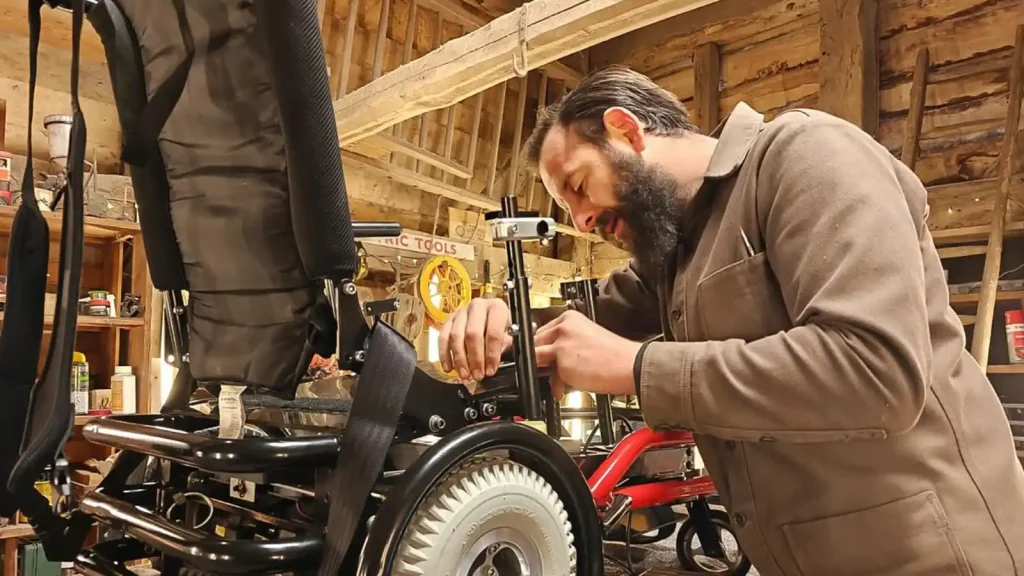
Dom Chinea leads the restoration of Bobby’s wheelchair, with mechanical support from David Burville. The chair presents a range of challenges. Its frame requires stripping back and rebuilding. Its electrics need refreshing. The combination of structural and technical work means this is a collaborative project from the outset — neither craftsperson can complete it alone.
Dom approaches the frame methodically, assessing where the damage is cosmetic and where it runs deeper. The scratches and surface marks are extensive but addressable. More demanding is the work required to ensure the rebuilt frame can withstand the rigours of competitive play once again. A restored chair that looks good but fails mechanically in its first match would represent a failure of the restoration’s core purpose. Dom holds that standard throughout.
David Burville’s mechanical contribution ensures that the chair’s functional systems are brought back to reliable working order. By the time the restoration is complete, the chair looks and performs significantly better than when it arrived. Bobby’s response underlines what the work has achieved — not just a refurbished piece of equipment but a renewed possibility, ready to open another young player’s world in the same way it once opened his.
The Glasgow Tigers Flag and a Love Story Born at White City Stadium
Pete and Eric McCready carry into the barn a fragile flag whose condition reflects the decades since it last flew above a stadium. The story behind it is extraordinary. In 1951, their parents — both teenagers, both passionate speedway fans — attended a race night at White City Stadium in Glasgow, home of the Glasgow Tigers. They met for the first time amid the noise and atmosphere of that event. That chance encounter shaped the rest of their lives.
When White City Stadium was threatened with demolition to make way for the M8 motorway, the brothers’ father took direct and memorable action. He climbed the flagpole and retrieved the flag that had flown above the referee’s box on the night he met his future wife. The act combined practicality with romantic determination — a refusal to allow a piece of personal and sporting heritage to be swallowed by infrastructure. The flag came down and has been held by the family ever since.
By the time it reaches The Repair Shop, the flag is stained, torn, and peppered with holes. It is fragile in the way that very old textiles are fragile — not simply worn but structurally vulnerable, at risk of further deterioration with every handling. The plan is to restore and conserve it before returning it to the Glasgow Tigers, where it will serve as a tribute both to the lost stadium and to the love story that began beneath it.
Rebecca Bissonnet’s Conservation Work on a Fragile Textile
Textile expert Rebecca Bissonnet takes on the flag, and the work demands exceptional care from the first moment. The fabric is too delicate for conventional cleaning methods. Every intervention carries risk. Rebecca must stabilise the existing damage before she can begin to address the staining and structural weakness — working in sequence, never forcing the material beyond what it can tolerate.
The conservation process involves cleaning the delicate fabric and then mounting it for display in a way that both protects it and allows its full visual impact to be appreciated. A flag displayed mounted and supported will deteriorate far more slowly than one folded and stored. The mounting decision is therefore not just aesthetic but protective — a long-term commitment to the object’s survival.
The finished result represents a significant achievement in textile conservation. The flag is stabilised, cleaned, and presented in a form that honours its history as a sporting object while preserving its function as a document of a family’s origins. When it is returned to the Glasgow Tigers, it will carry both its own history and the McCready family’s story into the club’s future. Memories that might otherwise have remained private now have a public home.
The Repair Shop 2026 Episode 14 and Debbie Lee’s Steel Charm Jewellery
Debbie Lee arrives from Southend-on-Sea in Essex with two pieces of jewellery unlike anything that typically arrives in the barn. A charm necklace and bracelet, both handmade by her father from stainless steel cutlery, they represent an act of exceptional paternal love expressed through engineering skill. Debbie’s father was an engineer with a gift for invention. He crafted pairs of miniature charms — including boots, guitars, and crosses — in two sizes, so that Debbie and her mother could wear matching sets. The craftsmanship involved in producing miniature steel forms from cutlery is remarkable by any measure.
Over time, many of the charms have become detached. Some have been lost altogether. The necklace and bracelet arrive incomplete, and the task Richard Talman faces is to recreate the missing pieces — not in precious metal, which he knows intimately, but in stainless steel, using Debbie’s late mother’s original cutlery as the source material. The emotional stakes are immediately clear. These are not decorative objects that can be approximated. They must match the originals precisely, because the originals were made by Debbie’s father with specific intention.
Richard Talman’s Struggle with Stainless Steel
Richard Talman is a master goldsmith, and his skills have been tested by difficult restoration projects before. Stainless steel, however, presents a category of difficulty that precious metals do not. It is extraordinarily hard. It resists cutting, shaping, and finishing in ways that gold and silver do not. The tools and techniques that define a goldsmith’s practice are calibrated for malleable materials. Stainless steel refuses to cooperate with them.
Richard’s attempt to recreate Debbie’s missing charms very nearly defeats him. The episode is candid about this. The process is gruelling — physically demanding in a way that goldsmithing rarely is, and technically unforgiving at every stage. The steel resists the fine detail work that the original charms require. Richard’s grit and determination become the story as much as his skill. He pushes through repeated setbacks to produce recreations that honour the originals’ precision.
The finished charms allow the necklace and bracelet to be worn again as complete sets. For Debbie, this means being able to carry her father’s craftsmanship and her mother’s memory together — matching pieces that speak of a family in which love was expressed through making things by hand. The restoration restores not just objects but a relationship expressed in miniature steel forms, and it stands as one of the most demanding single projects seen in The Repair Shop 2026 episode 14.
The Bagatelle Board and a Family’s Competitive Christmas Tradition
Sarah Weir arrives from Harrogate with a bagatelle board that has been at the centre of her family’s Christmas gatherings for as long as she can clearly remember. Originally owned by her great-uncle Dick, the game became a fixture of family life. The tradition was simple and consistent: Christmas lunch, then washing-up, then the bagatelle board. The annual champion’s name was recorded on the back. That record of winners is itself a kind of family archive — a list of Christmas afternoons preserved in pencil or ink.
The board’s significance deepened through Sarah’s mother’s deliberate use of it. Her mother was determined that her adopted children would always feel they belonged. The bagatelle board, with its inclusive, skill-based competition, served that ambition well. Everyone could play. Everyone could win. The ritual gave the family a shared identity at a time of year when belonging matters most. Even now, the board continues to bring people together, including Sarah’s autistic grandson, who joins in readily when it comes out — a detail that speaks to the game’s particular capacity for inclusive play.
Decades of enthusiastic use have left the board in poor condition. The frame is warped. The playing surface is faded. The structure is fragile. Several pins are missing. The board that arrives at The Repair Shop is still recognisably itself, but it cannot safely sustain another generation of competitive play without intervention.
David Burville Restores the Playing Surface and Structure
David Burville takes on the bagatelle board, working across its multiple areas of damage with methodical care. The warped frame requires reinforcement — structural work that must be completed before anything else can proceed, because a warped base affects the playing surface above it. David addresses this foundation first, ensuring the board has the stability it needs before he turns his attention to the surface itself.
The playing surface restoration involves both practical and aesthetic elements. The faded areas need refreshing so that the board looks as it should, but the surface must also function correctly — balls must run true, and the layout of pins, arches, and scoring areas must be precise. David replaces the missing pins, restores the visual coherence of the playing field, and ensures that the board’s mechanical behaviour matches what generations of family players have known.
The finished bagatelle board is structurally sound, visually restored, and ready for play. When Sarah sees it, the response is immediate and genuine. The object she thought might be beyond saving has been returned to her as something that can now realistically survive another generation of Christmas competition. The names on the back remain — the family archive intact — and the space for future champions’ names is ready to be filled.
The Repair Shop 2026 Episode 14 and the Meaning of Restoration
What this episode demonstrates, across all four of its stories, is that restoration is never a purely technical exercise. Every object that arrives in the barn carries a web of relationships — between people, between generations, between the person who made or used the object and the person who brings it for repair. The craftspeople at The Repair Shop are required to understand those relationships before they can begin their work, because the work itself must serve them.
Bobby’s wheelchair is a vehicle for sporting access and inherited opportunity. The Glasgow Tigers flag is a document of romance and civic history. Debbie’s steel charms are a father’s love expressed in the most demanding medium he could have chosen. Sarah’s bagatelle board is a family’s ritual distilled into a physical object. Each restoration must therefore succeed on both technical and human terms simultaneously. Getting the mechanics right but missing the emotional register would be a failure. This episode’s craftspeople achieve both, consistently.
The secondary concerns of heritage and craftsmanship run through every story. The Glasgow Tigers flag connects a family to a lost piece of Scottish sporting heritage that can never be physically rebuilt. Debbie’s father’s engineering craft — his ability to produce miniature steel jewellery from domestic cutlery — is itself a form of folk craftsmanship that deserves recognition. The bagatelle board’s great age places it in a tradition of domestic games stretching back well before the mid-twentieth century. These are objects with deep roots, and restoring them is an act of historical awareness as much as practical skill.
The Repair Shop 2026 Episode 14 as a Study in Human Connection
The episode closes, as The Repair Shop always does, with the returns. Each craftsperson brings their restored object back to the person who entrusted it to them, and the reveal is the emotional centre of the entire exercise. These moments work because the restorations are genuine and the feelings they prompt are proportionate. Nobody performs surprise or gratitude here — the responses are real, and the reasons for them are clear to anyone who has listened to the stories told earlier in the programme.
Bobby Williams receives a wheelchair that can now begin a new sporting life. Pete and Eric McCready receive a flag that can go back to the Glasgow Tigers carrying both family and civic history. Debbie Lee receives jewellery that she and her late mother once wore as matching sets, now complete again. Sarah Weir receives a bagatelle board ready for another generation of Christmas afternoons. Each return is distinct, but together they form a coherent statement about what repair means at its best — not merely the restoration of function, but the restoration of meaning, connection, and the particular kind of continuity that physical objects make possible when they are properly cared for.
FAQ The Repair Shop 2026 episode 14
Q: What happens in The Repair Shop 2026 episode 14?
A: The Repair Shop 2026 episode 14 features four restoration projects. Dom Chinea and David Burville rebuild a powerchair football wheelchair for Bobby Williams from Surrey. Rebecca Bissonnet conserves a fragile 1951 Glasgow Tigers stadium flag. Richard Talman recreates missing stainless steel charms for Debbie Lee’s handmade jewellery. Additionally, David Burville restores a beloved bagatelle board brought in by Sarah Weir from Harrogate.
Q: Who is Bobby Williams and why does he bring his wheelchair to the barn?
A: Bobby Williams is a powerchair football player from Surrey who discovered the sport after struggling to compete in non-disabled football as a child. His wheelchair sustained years of heavy match damage through spins, crashes and physical impacts. Now transitioning into coaching, Bobby wants the chair restored so he can pass it on to a young player, giving someone else the same life-changing sporting opportunity the sport gave him.
Q: What is powerchair football and why does it matter to Bobby’s story?
A: Powerchair football is a fast, physical and fiercely competitive sport played in powered wheelchairs. For Bobby, it provided independence, confidence and a team identity that mainstream football could not offer him. The sport gave him a genuine athletic career. His restored chair therefore represents far more than equipment — it is a symbol of access, belonging and the opportunity to compete on equal terms.
Q: What is the history behind the Glasgow Tigers flag in The Repair Shop 2026 episode 14?
A: In 1951, brothers Pete and Eric McCready’s parents met as teenagers at a speedway race night at White City Stadium in Glasgow, home of the Glasgow Tigers. When the stadium faced demolition for the M8 motorway, their father climbed the flagpole and rescued the flag that had flown above the referee’s box on the night he first met their mother. The flag is now stained, torn and fragile, but carries an extraordinary family heritage and history.
Q: How does Rebecca Bissonnet approach the conservation of the Glasgow Tigers flag?
A: Rebecca Bissonnet works with exceptional care throughout the restoration process. The flag’s fabric is extremely delicate, requiring stabilisation before any cleaning can begin. She cleans the stained textile using methods suited to fragile historic materials. She then mounts the flag for display, which both protects it from further deterioration and allows its full visual impact to be appreciated. The finished piece is returned to the Glasgow Tigers as a tribute to the lost stadium and the love story born there.
Q: What makes Debbie Lee’s jewellery so unusual as a repair project?
A: Debbie’s father, an engineer from Southend-on-Sea, handcrafted a matching charm necklace and bracelet from stainless steel cutlery. He produced miniature charms — including boots, guitars and crosses — in two sizes so Debbie and her mother could wear identical sets. Over time, many charms detached and some were lost. Furthermore, the source material was Debbie’s late mother’s original cutlery, making the restoration both technically demanding and deeply personal.
Q: Why does Richard Talman find the steel charm restoration so difficult?
A: Richard Talman is a master goldsmith whose skills are refined for precious metals such as gold and silver. Stainless steel, however, is extraordinarily hard and resists the cutting, shaping and finishing techniques that define his craft. The episode shows the restoration very nearly defeating him. However, his determination and grit carry him through repeated setbacks. The completed charms allow Debbie’s necklace and bracelet to be worn again as matching sets, honouring her father’s remarkable craftsmanship.
Q: What is the significance of the bagatelle board in The Repair Shop 2026 episode 14?
A: Sarah Weir’s bagatelle board originally belonged to her great-uncle Dick and became a central family tradition. Each Christmas, after lunch and washing-up, the board came out and the annual champion’s name was recorded on the back. Sarah’s mother used the game deliberately to help her adopted children feel they belonged. Additionally, Sarah’s autistic grandson joins in happily whenever the board appears, demonstrating its exceptional capacity for inclusive family play across generations.
Q: How does David Burville restore the bagatelle board?
A: David Burville addresses the board’s warped frame first, reinforcing its structure before working on the playing surface above. He replaces the missing pins and restores the faded playing field so that balls run true and the scoring layout functions correctly. The visual coherence of the board is also fully refreshed. The family archive of champions’ names recorded on the back remains intact throughout the process, preserving decades of family memories alongside the structural repair.
Q: What does The Repair Shop 2026 episode 14 reveal about the value of restoration?
A: This episode demonstrates that restoration is never purely technical. Every object carries a web of family relationships, memories and heritage that skilled craftspeople must understand before beginning their work. Bobby’s wheelchair will open doors for a new young athlete. The Glasgow Tigers flag reconnects a family to civic and sporting history. Debbie’s charms honour a father’s ingenuity. Sarah’s bagatelle board ensures a Christmas tradition continues. Consequently, each repair restores not just an object but the meaning and continuity it holds.