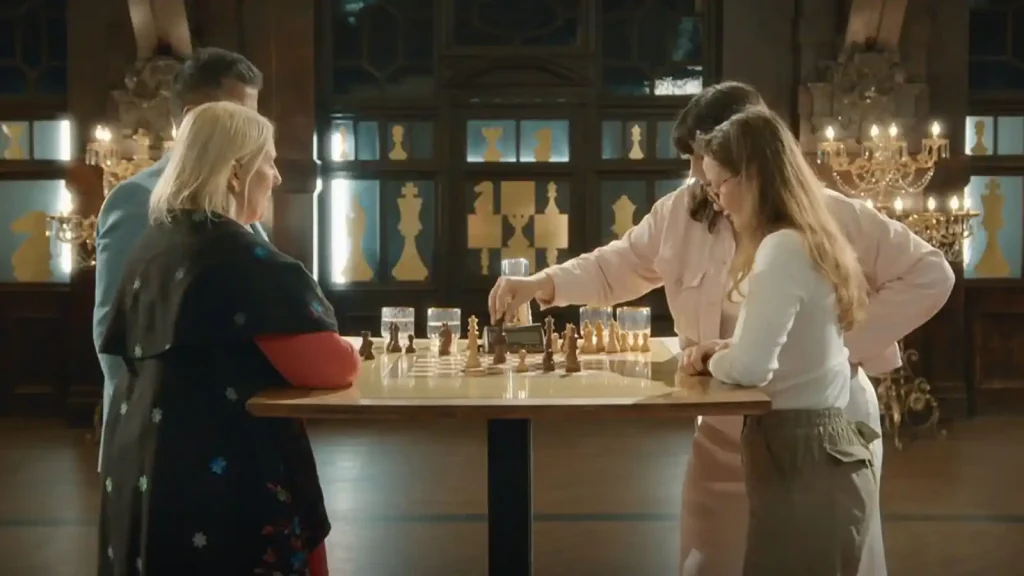
Chess Masters The Endgame episode 3
Tension fills the air in the Great Hall as the four remaining players from the first heat return, their faces etched with determination. Each competitor knows what’s at stake—a coveted place in the semi-finals that could change the trajectory of their chess careers forever. The atmosphere crackles with anticipation as they survey the room, immediately noticing something different.
Before them stands a massive projection screen, dominating the ancient stone walls of the hall. The contestants exchange nervous glances, realizing they’re about to face something unexpected. This isn’t the traditional chess challenge they’ve prepared for. Instead, the organizers have crafted an innovative test that will push their mental abilities beyond the sixty-four squares.
As the lights dim, a familiar face appears on the screen—none other than Magnus Carlsen, the world number one chess player and reigning champion. His presence alone elevates the significance of the challenge. With a confident smile, Carlsen begins to explain the task that awaits them.
“Chess is not just about calculation,” Carlsen explains, his voice resonating throughout the hall. “At the highest levels, memory becomes your greatest weapon. Today, I’ve designed a test that will challenge not just your understanding of chess, but your ability to recall complex positions under pressure.”

Scan smarter. Create faster. Free.
Download QR & Barcode Studio — Create and scan unlimited QR codes & barcodes.
No paywalls. No limits. 100% Free.

The contestants listen intently as Carlsen outlines the memory challenge. They will be shown a series of complex mid-game positions for just thirty seconds each. Afterward, they must recreate the exact piece placements from memory. Furthermore, they must identify the optimal move sequence that would lead to an advantage for either side.
One contestant, a young prodigy from Eastern Europe, nervously taps her fingers against her leg. Another, a seasoned grandmaster with decades of tournament experience, closes his eyes briefly, as if already practicing his visualization techniques. The remaining two players—an analytical mathematician turned chess professional and a creative tactician known for unorthodox play—sit perfectly still, their minds already preparing for the mental marathon ahead.
The first position appears on the screen, a dazzling complexity of pieces scattered across the board in what appears to be a chaotic arrangement. However, to the trained eyes in the room, each piece tells a story of potential energy and tactical opportunities. The thirty seconds feel like mere moments as they desperately commit every detail to memory.
When the screen goes blank, the real challenge begins. Each contestant sits at their own physical board, racing to recreate the position precisely. Their hands move with practiced efficiency, though occasional hesitations reveal the immense difficulty of the task. The judges watch carefully, noting every piece placement and the time taken.
After reproducing the position, the players must then suggest the optimal continuation—a sequence of moves that would exploit the hidden advantages within the position. This is where chess knowledge and memory intertwine, creating a comprehensive test of true mastery.
As the challenge progresses through multiple positions of increasing difficulty, sweat begins to bead on foreheads. The mathematician player excels at exact recall but struggles with finding the creative tactical solutions. Meanwhile, the creative tactician sometimes misplaces pieces yet identifies brilliant continuations that even surprise the judges.
Between rounds, cameras capture the intense concentration etched on their faces. The young prodigy mutters chess coordinates under her breath, a personal technique to reinforce her memory. The seasoned grandmaster sits with perfect posture, eyes closed, using visualization methods perfected over decades of competition.
The final position presented by Carlsen proves to be the most challenging—a complex endgame with subtle winning chances hidden beneath apparent equality. The projection disappears, and the contestants face their empty boards one last time. This position will likely determine who advances and who goes home.
When time expires, the judges begin their careful evaluation. They compare the recreated positions against the originals, assessing accuracy down to the last pawn. They analyze the suggested continuations against computer-verified optimal lines. Points are awarded for both memory accuracy and tactical insight.
Chess Masters The Endgame episode 3
As the scores are tallied, the contestants sit in anxious silence. Friendships formed during the competition are temporarily set aside as each player hopes to hear their name called for advancement. The competition director steps forward with the results in hand.
“Chess has always been a beautiful intersection of memory, calculation, and creativity,” the director announces. “Today’s challenge, designed by Magnus Carlsen himself, has pushed you all to your limits. We’ve seen remarkable displays of mental prowess, but only two of you will continue to the semi-finals.”
The director pauses, building dramatic tension before announcing the two advancing players. The mathematician and the young prodigy have edged out their competitors by the narrowest of margins. Relief and joy flood their faces, while disappointment shadows the others, though they offer congratulations with the sportsmanship that defines elite chess.
As the episode concludes, viewers are offered a preview of the semi-finals, where even greater challenges await. The advancing players know that they’ve survived one extraordinary test, but Magnus Carlsen’s involvement suggests that the competition will only grow more demanding as they approach the endgame.
The remaining contestants leave the Great Hall with newfound respect for the mental demands of high-level chess and the humbling experience of being tested by the world’s greatest player. For the viewers at home, this innovative memory challenge has revealed yet another fascinating dimension of what makes chess masters truly exceptional.
Chess Masters The Endgame episode 3: The Enduring Legacy of Chess Mastery
As the dust settles on this remarkable episode of Chess Masters: The Endgame, we’re left with powerful insights into the multidimensional nature of chess excellence. The memory challenge orchestrated by Magnus Carlsen illuminated a crucial yet often overlooked aspect of grandmaster-level play. Indeed, beyond calculation and strategy lies the extraordinary capacity to visualize and recall complex positions with perfect clarity.
The four contestants, each representing different approaches to chess mastery, demonstrated how various cognitive strengths contribute to success at the highest levels. Furthermore, their performances revealed that chess, at its core, remains a deeply human endeavor despite the rise of computer analysis.
What makes this competition particularly compelling is how it strips away the comfort zones of established players. Even seasoned grandmasters find themselves vulnerable when forced to compete outside traditional formats. Consequently, we witness raw talent and adaptability in their purest forms.
The young prodigy’s advancement to the semi-finals symbolizes the ever-renewing nature of chess excellence. Meanwhile, the mathematician’s success highlights how analytical thinking provides a formidable foundation for memory tasks. However, the elimination of the creative tactician reminds us that no single approach guarantees victory in such comprehensive tests of ability.
Chess, like life itself, rewards those who balance specialized expertise with adaptability. Additionally, the most successful players cultivate mental resilience alongside technical skill—a lesson applicable far beyond the sixty-four squares.
As we look ahead to the semi-finals, the remaining competitors face an increasingly steep climb. Nevertheless, they carry forward not just their own ambitions but also chess traditions refined over centuries of play.
For viewers and enthusiasts, this episode offers a rare glimpse into the psychological demands placed on elite players. The mental gymnastics performed under Carlsen’s watchful eye mirror the invisible work that underpins every brilliant move in tournament play.
Chess Masters: The Endgame continues to elevate our understanding of what constitutes true mastery. Through these innovative challenges, we celebrate not just the game itself but the remarkable human capabilities it develops and showcases. The journey toward crowning a champion unfolds like a masterfully played endgame—complex, beautiful, and rich with possibility.
FAQ Chess Masters The Endgame episode 3
Q: What is Chess Masters: The Endgame about?
A: Chess Masters: The Endgame is a competitive chess television series where elite players face innovative challenges beyond traditional chess formats. In Episode 3, four remaining contestants from the first heat compete in a memory challenge designed by world number one Magnus Carlsen, testing their ability to recall complex board positions and identify optimal move sequences under pressure. The competition takes place in the Great Hall, with only two contestants advancing to the semi-finals.
Q: What type of challenge did Magnus Carlsen create for the contestants?
A: Magnus Carlsen designed an innovative memory challenge where contestants must memorize complex mid-game positions shown for only thirty seconds each. After viewing, they must recreate the exact piece placements on physical chess boards and then suggest optimal move sequences that would give an advantage to either side. This comprehensive test combines visual memory, chess knowledge, and tactical insight. Furthermore, positions increase in difficulty throughout the challenge, culminating in a particularly complex endgame position that ultimately determines who advances to the semi-finals.
Q: Who are the four contestants competing in Episode 3?
A: The four contestants represent diverse approaches to chess mastery. First, there’s a young prodigy from Eastern Europe who mutters chess coordinates to reinforce her memory. Second, a seasoned grandmaster with decades of tournament experience uses visualization techniques perfected over years of competition. Third, an analytical mathematician turned chess professional excels at exact recall but struggles with creative tactical solutions. Finally, a creative tactician known for unorthodox play sometimes misplaces pieces yet identifies brilliant continuations that surprise even the judges.
Q: Which contestants advanced to the semi-finals?
A: After the challenging memory test concluded, the mathematician and the young prodigy advanced to the semi-finals by the narrowest of margins. Their success highlights how different approaches to chess—analytical thinking and natural talent—can excel in comprehensive tests of ability. Meanwhile, despite their impressive skills, the seasoned grandmaster and creative tactician were eliminated from the competition. Nevertheless, all contestants displayed remarkable sportsmanship, with those eliminated offering sincere congratulations to the advancing players, exemplifying the respect inherent in elite chess.
Q: Why is memory so important in high-level chess?
A: As Magnus Carlsen explains in the episode, “At the highest levels, memory becomes your greatest weapon.” Elite chess demands not just calculation but the ability to recall complex positions with perfect clarity under pressure. This cognitive skill allows grandmasters to recognize patterns, anticipate developments, and visualize potential futures many moves ahead. Moreover, memory intersects with chess knowledge to create a comprehensive understanding of tactical and strategic possibilities. Consequently, the memory challenge reveals a crucial yet often overlooked dimension of what constitutes true chess mastery.
Q: How were contestants evaluated during the memory challenge?
A: Judges evaluated contestants through a dual-criteria system focusing on both accuracy and insight. Initially, they compared recreated board positions against the originals, assessing precision down to the last pawn. Additionally, they analyzed suggested move continuations against computer-verified optimal lines to evaluate tactical understanding. Points were awarded for both memory accuracy and tactical insight, creating a balanced evaluation system. Throughout the challenge, judges carefully noted piece placements and time taken, ensuring a comprehensive assessment of each contestant’s performance under the pressure of this innovative format.
Q: What makes Chess Masters: The Endgame different from traditional chess competitions?
A: Unlike traditional chess tournaments that focus solely on match play, Chess Masters: The Endgame tests multiple dimensions of chess excellence through innovative challenges. The memory test in Episode 3, for instance, pushes players beyond their comfort zones and reveals capabilities that might remain hidden in standard formats. Furthermore, the competition strips away familiar routines, forcing even seasoned grandmasters to adapt quickly. This approach showcases raw talent, mental resilience, and adaptability alongside technical skill, offering viewers a rare glimpse into the psychological demands placed on elite players.
Q: What lessons can we learn from this episode about chess and life?
A: This episode illuminates profound parallels between chess mastery and life success. First, like the diverse contestants, we see how different cognitive approaches can lead to excellence when applied diligently. Furthermore, the challenge demonstrates how stepping outside comfort zones reveals true adaptability and resilience. The competition also shows that chess, despite technological advances, remains fundamentally human—filled with emotion, imperfection, and brilliance. Most importantly, the episode teaches that balance is crucial; just as the most successful players combine specialized expertise with adaptability, life rewards those who cultivate both depth and flexibility in their pursuits.