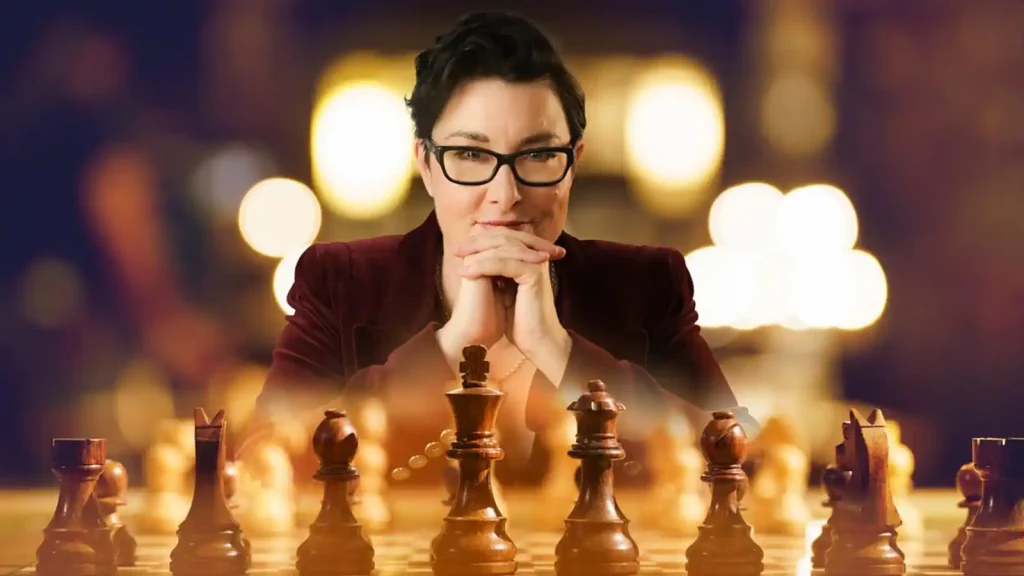
Chess Masters The Endgame episode 6: The air crackles with tension. We’ve reached a pivotal moment in Chess Masters: The Endgame. Only four players remain from the fierce battles of the second heat. Each contestant has navigated a labyrinth of strategy and psychological warfare. Now, they stand on the precipice of the next stage. However, their path forward involves an unexpected detour. It’s a challenge designed to test a different, yet crucial, aspect of chess brilliance.
Guiding us through this high-stakes journey is the ever-engaging Sue Perkins. She masterfully blends wit with genuine curiosity. Sue invites viewers into the complex world of competitive chess. She reminds us that this isn’t just about moving pieces. Instead, it’s a profound test of intellect, nerve, and mental fortitude. The ultimate prize? The coveted title of Chess Master. But winning demands more than strategic calculation; it requires nerves of steel.
Suddenly, the familiar rhythm of move and counter-move is broken. Episode six introduces a unique trial. It’s a mental gauntlet thrown down by none other than Magnus Carlsen. Yes, the reigning world number one, a true superstar of the chess world, makes his presence felt. His challenge isn’t over the board in a traditional sense. Instead, it targets the players’ powers of recall. This is a memory puzzle of fiendish design.
Imagine the scene. The four remaining competitors stand ready. Their journey so far has been demanding. They’ve faced intricate positions and relentless opponents. Yet, this new task isolates a single, vital skill. A chessboard, laden with 26 pieces, appears on a large projector. Its configuration is complex, a snapshot from a potential game. The players have just sixty seconds. One minute to burn this intricate pattern into their minds. Every piece, every square, every relationship must be captured.
The clock starts ticking. Instantly, silence descends, thick with concentration. Eyes dart across the projected image. Minds race, trying to create anchors, patterns, stories – anything to hold the position. It’s like trying to memorize a constellation in a fleeting glimpse of the night sky. Some might focus on pawn structures. Others might track the powerful queens and rooks. Perhaps some try to grasp the overall strategic picture. Nevertheless, the sheer volume of information is daunting. Twenty-six pieces, sixty-four squares, infinite possibilities reduced to one static image.

Scan smarter. Create faster. Free.
Download QR & Barcode Studio — Create and scan unlimited QR codes & barcodes.
No paywalls. No limits. 100% Free.

Then, just as quickly as it appeared, the image vanishes. The projector screen goes blank. A collective intake of breath might be heard, were the tension not so palpable. Now, the second phase begins immediately. Before them sits a physical chessboard, pieces waiting at the side. The players have another minute. Just sixty seconds more. They must now recreate the exact position they just saw from memory. It’s a frantic race against time. Fingers tremble slightly as they reach for pawns, knights, bishops.
This challenge cuts to the core of chess expertise. While strategy and calculation are paramount, memory forms the bedrock. Great players don’t just see the current board; they access a vast mental library. This library contains thousands of patterns, openings, and endgame structures. Recognizing these patterns allows for faster, more intuitive decision-making. It’s less about remembering every single game ever played. Rather, it’s about understanding the types of positions.
Think of it like learning a language. Initially, you memorize individual words. Soon, you start recognizing phrases and sentence structures. Eventually, you grasp grammar and context, allowing fluent conversation. Similarly, chess masters develop pattern recognition. They ‘chunk’ information, grouping pieces into meaningful units. A specific arrangement of king, rook, and pawns isn’t just three pieces; it’s a known fortress or attacking formation. Magnus Carlsen himself possesses an extraordinary ability to recall positions. His intuition often stems from this deep well of remembered patterns.
But this challenge adds a brutal twist: extreme time pressure. Memorizing a position is one thing. Doing it in sixty seconds is another level entirely. Replicating it perfectly in another sixty seconds? That introduces physical dexterity and intense pressure. The fear of misplacing a single pawn looms large. Each correctly placed piece earns a point. With 26 points available, the outcome of this memory test could significantly alter the standings. It’s a high-reward, high-risk scenario.
Chess Masters The Endgame episode 6
What techniques are swirling through the players’ minds during those frantic seconds? Some might employ the ‘method of loci’, associating pieces with familiar locations in their mind. Others might create a narrative, a story connecting the pieces’ positions. Perhaps they focus solely on the most critical pieces first. Maybe they try to imprint the visual pattern as a whole. Regardless of the technique, the mental effort is immense. It’s a cognitive sprint under immense scrutiny. The ticking clock sounds like a drumbeat, amplifying the stress.
Sue Perkins watches on, her expression a mixture of fascination and empathy. She articulates what many viewers might be feeling. How is this even possible? What separates these minds from the average person’s memory? Her commentary helps bridge the gap. She highlights the incredible mental conditioning required at this elite level. She reminds us that behind the intense concentration are human beings pushing their limits. Her presence ensures the show remains accessible and emotionally engaging.
This memory puzzle isn’t just a gimmick; it’s deeply relevant. It tests a skill fundamental to chess success, albeit in an accelerated, high-pressure format. It underscores the show’s central themes: psychology, strategy, and raw mental power. The ability to remain calm, focused, and accurate under duress is crucial. Players must summon their training, trust their instincts, and execute flawlessly. There’s no room for second-guessing. One misplaced knight or pawn could be the difference between victory and defeat in this crucial stage.
As the final seconds tick away on the replication phase, the suspense is almost unbearable. How accurate were they? Did the pressure cause critical errors? Who possesses the most formidable memory under fire? The reveal of their boards promises drama and potential heartbreak. This single challenge, set by the world’s best, encapsulates the multifaceted nature of chess mastery. It’s more than just logic; it involves intuition, pattern recognition, and, as demonstrated here, exceptional memory.
The journey continues. These rising stars face not only each other but also the towering legacy of the game itself. Magnus Carlsen’s challenge serves as a stark reminder of the heights they aspire to reach. It tests their recall, their composure, and their ability to perform when everything is on the line. Who will harness their mental power most effectively? Whose memory will prove to be their sharpest weapon? Make the first move, indeed. The challenge has been set. The minds are racing. And the endgame is rapidly approaching.
Chess Masters The Endgame episode 6: The Ultimate Test of Mind and Memory
As the dust settles on Magnus Carlsen’s memory challenge, we witness the true essence of chess mastery unfold. Furthermore, this pivotal moment reveals that excellence in chess extends far beyond tactical prowess. The contestants, now battle-tested through six grueling episodes, demonstrate that championship-caliber play requires a symphony of cognitive abilities working in perfect harmony.
Memory serves as the invisible architecture supporting every grandmaster’s decision-making process. Consequently, those who excel at pattern recognition gain a distinct competitive advantage. The pressure-cooker environment of this memory challenge mirrors the psychological intensity of tournament play. Meanwhile, Sue Perkins continues to bridge the gap between elite chess knowledge and audience accessibility.
Chess, at its core, resembles life itself—full of difficult choices, unexpected challenges, and moments that demand perfect recall under extreme pressure. Therefore, the remaining contestants must draw upon every mental resource at their disposal. Their journey through the competition parallels the evolution of a chess game, moving from opening theory through the middlegame complications to this critical endgame phase.
The memory test serves as a perfect metaphor for the entire competition. Additionally, it highlights how championship chess combines intellectual strength with emotional resilience. Each correctly placed piece represents not just a point scored but years of dedicated practice and mental conditioning. Nevertheless, a single misplaced pawn could alter the trajectory of a player’s tournament life.
Looking ahead, the final episodes promise to reveal who truly possesses the complete package of chess brilliance. Moreover, they will demonstrate which player can maintain focus through the mounting pressure of elimination. The combination of strategic depth, tactical alertness, memory recall, and psychological fortitude will ultimately crown the champion.
Chess remains eternally fascinating because it reflects human struggle in its purest form. Initially appearing as a simple board game, it transforms into a profound test of human potential. The remaining contestants stand at the threshold of greatness, their minds sharpened like weapons through countless hours of preparation.
As we eagerly anticipate the climactic episodes, one truth becomes abundantly clear: the ultimate chess master isn’t simply the person who calculates deepest or remembers most. Rather, it’s the individual who harmonizes all these abilities while maintaining composure in the face of extraordinary pressure.
FAQ Chess Masters The Endgame episode 6
Q: What is Chess Masters: The Endgame about?
A: Chess Masters: The Endgame is a competitive chess television series hosted by Sue Perkins that follows contestants through a tournament-style competition. Furthermore, the show features various challenges testing different aspects of chess mastery, including strategic thinking, psychological resilience, and memory recall. In episode 6, world chess champion Magnus Carlsen presents a special memory challenge to the four remaining contestants.
Q: Who hosts Chess Masters: The Endgame?
A: Sue Perkins hosts Chess Masters: The Endgame. She brings a unique blend of wit and genuine curiosity to the program. Additionally, Sue helps bridge the gap between elite chess knowledge and audience accessibility, making complex concepts understandable to viewers. Her commentary provides emotional context while highlighting the mental conditioning required at this elite level of competition.
Q: What special challenge appears in episode 6?
A: Episode 6 features a memory challenge designed by world chess champion Magnus Carlsen. The contestants must memorize a complex chess position with 26 pieces in just 60 seconds. Afterward, they have another minute to recreate the exact position on a physical board from memory. Each correctly placed piece earns one point, making this a high-stakes test of pattern recognition and recall under extreme time pressure.
Q: Why is memory important in chess?
A: Memory serves as the bedrock of chess expertise. Elite players develop pattern recognition by ‘chunking’ information into meaningful units. Consequently, they can access a vast mental library of positions, openings, and endgame structures. This ability enables faster, more intuitive decision-making during games. Therefore, memory isn’t just about recalling individual pieces but understanding position types and strategic patterns that inform optimal play.
Q: How do chess players memorize complex positions?
A: Chess players employ various memorization techniques to capture complex positions. Some use the ‘method of loci,’ associating pieces with familiar mental locations. Others create narratives connecting piece positions or focus on critical pieces first. Many players imprint the visual pattern as a whole. Nevertheless, these methods require immense mental effort, especially under time pressure. The process resembles learning a language, where players eventually recognize meaningful patterns rather than individual pieces.
Q: How many contestants remain in episode 6?
A: Four contestants remain in episode 6 of Chess Masters: The Endgame. These players have survived the fierce battles of the second heat. Moreover, each contestant has demonstrated exceptional strategic thinking and psychological resilience to reach this stage. The memory challenge represents a critical juncture in the competition, as its outcome could significantly alter the standings and determine who advances to the final rounds.
Q: What skills make a complete chess master?
A: A complete chess master possesses a symphony of cognitive abilities working in harmony. Strategic depth and tactical alertness form the foundation. Additionally, exceptional memory recall enables pattern recognition and intuitive play. Psychological fortitude allows maintaining composure under pressure. Furthermore, physical endurance supports lengthy competitive matches. The ultimate chess master isn’t simply the person who calculates deepest but rather someone who balances all these abilities while performing consistently at the highest level.
Q: How does Magnus Carlsen contribute to the show?
A: Magnus Carlsen, the reigning world chess champion, designs the memory challenge in episode 6. His participation adds prestige and legitimacy to the competition. Carlsen himself possesses extraordinary position recall abilities, which contribute to his intuitive gameplay. His challenge serves as a stark reminder of the heights contestants aspire to reach. By testing their recall, composure, and performance under pressure, Carlsen helps identify who might possess the complete package of chess brilliance.
Q: Why is the memory challenge considered high-risk and high-reward?
A: The memory challenge offers 26 possible points—one for each correctly placed piece. Therefore, a strong performance could significantly boost a contestant’s standing. Conversely, poor performance could jeopardize their tournament life. The challenge combines memory recall with physical dexterity and intense time pressure. Furthermore, a single misplaced pawn could alter the trajectory of a player’s competition journey, making it both extremely rewarding and potentially devastating.
Q: What metaphor does the article use to describe chess mastery?
A: The article compares learning chess to learning a language. Initially, players memorize individual pieces and moves, similar to memorizing vocabulary. Eventually, they recognize patterns and structures, like understanding grammar and context in language. This progression enables fluent, intuitive gameplay. Additionally, the article describes chess as reflecting human struggle in its purest form. Though appearing as a simple board game, chess transforms into a profound test of human potential, with players’ minds sharpened like weapons through countless hours of preparation.