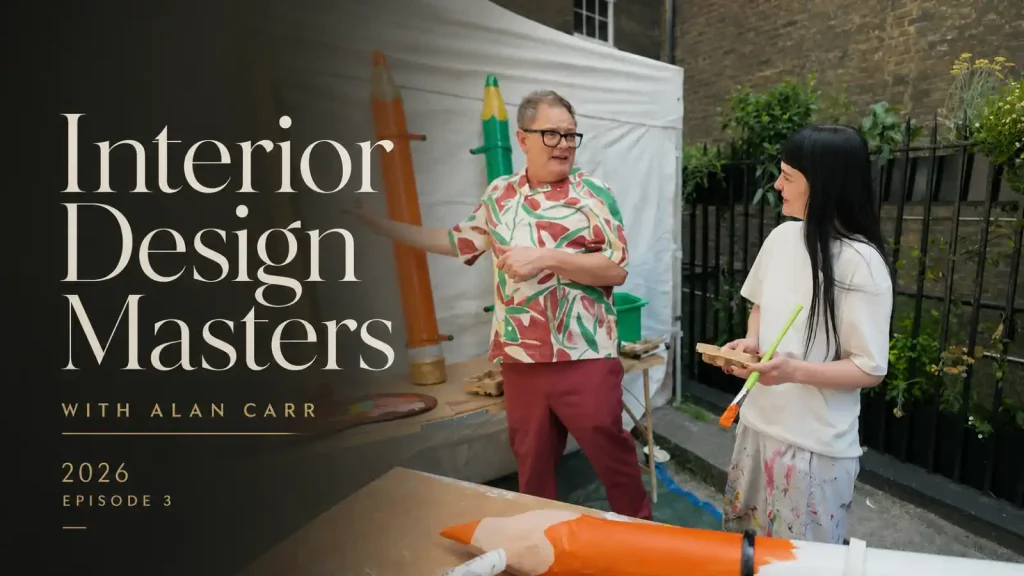
Interior Design Masters with Alan Carr 2026 episode 3 delivered one of the most emotionally charged challenges of the series so far, placing eight talented designers inside a real working homelessness charity in London and asking them to transform neglected, functional spaces into rooms that could genuinely change lives. The stakes could not have been higher. Unlike previous weeks, where the focus fell on creating impressive interiors for commercial or domestic clients, this episode demanded that design serve a deeply human purpose — uplifting vulnerable people at some of the most difficult moments of their lives.
The charity at the centre of the episode operates as a day centre for people experiencing homelessness in London, and the scale of what it does daily was immediately apparent. Designers who arrived expecting a creative brief quickly found themselves confronted by something far more meaningful: a place where rooms are not judged on aesthetic alone but on the dignity and comfort they offer to people who may have very little of either. Interior design, in this context, becomes an act of care. The challenge was to make that care visible without losing the designer’s individual voice.
Alan Carr arrived on location with his characteristic energy, immediately aware that the mood of this episode would differ from anything the competition had produced before. As host, Carr has always balanced humour with genuine warmth, and episode three required more of the latter. The designers were visibly affected by the environment from the moment they walked through the doors, and Carr acknowledged that reality without deflating the competitive spirit that keeps the series moving forward.
The pairs were announced early, and the room assignments quickly followed. Four distinct spaces needed transforming: an arts and crafts room, a group workshop room, a wellness area, and an employment suite. Each presented its own specific challenges and its own emotional weight. Interior Design Masters with Alan Carr 2026 episode 3 structured the challenge so that no two teams faced identical problems, which made for a genuinely varied and revealing hour of television.
Adding further weight to the episode was the arrival of Dara Ó Briain, the comedian and broadcaster who serves as an ambassador for the charity. His presence shifted the atmosphere perceptibly. Ó Briain is not a design professional, but his connection to the cause is real, and his perspective on what the spaces needed to achieve for the people who use them grounded the designers in something beyond aesthetics. He toured the rooms mid-challenge alongside Alan Carr, asking questions that cut through any tendency toward design self-indulgence.

Scan smarter. Create faster. Free.
Download QR & Barcode Studio — Create and scan unlimited QR codes & barcodes.
No paywalls. No limits. 100% Free.

The judging panel retained Michelle Ogundehin as lead critic, joined this week by guest judge Sophie Robinson, whose background in interiors journalism and bold use of colour made her a sharp and specific evaluator. Together they assessed not just visual quality but functional appropriateness — a harder standard to meet than usual, and one that exposed both strengths and weaknesses across the competing pairs with unusual clarity.
What unfolded across the day was a masterclass in how pressure, purpose, and limited resources interact in professional interior design. Some designers rose to the emotional register the brief demanded. Others allowed technical ambition to pull them away from the human core of what the spaces needed to be. The competition is in its third week, and the field is beginning to stratify in meaningful ways.
Interior Design Masters with Alan Carr 2026 episode 3 ultimately showed that good design is not a luxury reserved for beautiful homes or high-end hospitality. It can be a form of advocacy, a statement that the people who use a space deserve to feel seen, valued, and supported. That proposition was tested across four rooms over a single extraordinary day, and the results were as varied as the designers themselves.
Interior Design Masters with Alan Carr 2026 episode 3 review
Interior Design Masters with Alan Carr 2026 Episode 3: The Brief and the Charity Setting
The designers arrived to find a charity that operates a day centre for homeless people in London, providing practical support alongside safe, welcoming space. Understanding the purpose of the building before touching a single wall was essential, and the episode made clear that those who grasped this immediately had a significant advantage over those who treated the rooms as abstract design problems.
The four spaces allocated to the pairs each served a distinct function within the charity’s work. The arts and crafts room provides a creative outlet for service users, offering structured activity that supports mental wellbeing. The group workshop room hosts sessions where people can develop skills and share experiences collectively. The wellness area is designed for quieter, more restorative moments — a place to decompress and feel physically cared for. The employment suite supports practical steps back toward independence, hosting CV workshops, job application help, and formal interviews.
Each brief, therefore, carried specific requirements that pure aesthetic instinct could not satisfy alone. A wellness area that feels clinical fails its users. An employment suite that feels too relaxed undermines the confidence it is supposed to build. The designers had to think functionally, empathetically, and creatively at once — a combination of skills that interior design at its most serious always demands.
Pairs, Pairings, and the Dynamics of Collaborative Interior Design
Working in pairs introduced a layer of complexity that individual challenges do not. The pairing decisions were made by the show rather than by the designers themselves, which meant some combinations were natural creative partnerships and others were exercises in professional compromise. How each pair negotiated creative differences told the judges as much about individual potential as the finished rooms did.
Across the four pairings, a familiar pattern emerged: one designer in each pair tended to take a stronger lead on concept while the other contributed through execution and material selection. In some rooms, this division worked productively. In others, it created tension that surfaced in the final results — rooms that felt pulled in two directions, or spaces where a stronger vision had been diluted by compromise rather than enriched by collaboration.
The dynamic between pairs was one of the most revealing elements of Interior Design Masters with Alan Carr 2026 episode 3. Collaborative design is a professional reality, and the ability to hold your creative position while genuinely incorporating a partner’s ideas is a skill that not every talented individual designer possesses automatically. The episode tested that skill directly and produced some of the series’ most instructive moments.
The Arts and Crafts Room: Colour, Creativity, and Emotional Invitation
The arts and crafts room was always going to be the most visually expressive of the four spaces. Its function — encouraging creativity and providing joy through making — invited bold design choices. The pair assigned to this room had an opportunity to work with colour and pattern in ways that the other briefs did not permit, and they pursued that opportunity with evident enthusiasm.
The approach taken centred on creating a space that felt genuinely joyful from the moment someone entered it. The use of colour was deliberate and layered rather than arbitrary, with the palette drawing on warm, energising tones that communicate welcome without becoming overwhelming. The team understood that the people using this room would include individuals for whom colour and creative stimulus carry particular therapeutic value, and that understanding shaped every material and finish decision.
Storage was a practical priority that the pair handled thoughtfully. An arts and crafts room that functions well needs organised, accessible storage so that materials are easy to find and easy to put away. The design incorporated solutions that were visually integrated rather than institutional, keeping the room looking curated even when in full working use. Sophie Robinson responded positively to the colour work, recognising the confidence behind it, though the judging discussion also acknowledged areas where the execution did not fully match the ambition of the concept.
The Group Workshop Room: Function, Flexibility, and Shared Space
The group workshop room presented a different challenge altogether. It needed to serve multiple purposes and multiple group sizes, which demanded design thinking rooted in flexibility rather than fixed atmosphere. A room that works only for one type of session is a room that fails much of the time. The pair tasked with this space had to find a way to make it feel coherent and welcoming while remaining genuinely adaptable.
The chosen approach prioritised furniture arrangement and wall treatment as the primary tools of transformation. By considering carefully how chairs, tables, and surfaces would be configured for different activities, the team created a layout that could shift without the room losing its character. The wall treatment brought warmth to a space that could easily have read as neutral to the point of emptiness, establishing a visual identity that persisted regardless of what the room was being used for.
Dara Ó Briain’s comments during the mid-challenge walkthrough focused specifically on this room’s purpose: he wanted to understand whether a group of service users would feel genuinely comfortable there, or whether the design would feel imposed and unfamiliar. His question reflected the charity’s core concern — that design should serve users rather than impress observers. The pair’s response to that standard, and how well their finished room met it, became one of the episode’s more pointed discussions during the judging.
Interior Design Masters with Alan Carr 2026 Episode 3: The Wellness Area Brief
The wellness area was arguably the most psychologically demanding brief of the four. It asked designers to create a space that communicates calm, safety, and care to people who may be experiencing significant levels of stress, anxiety, or trauma. In this context, every design decision carries emotional meaning. The wrong texture, the wrong lighting level, or an awkward spatial arrangement can undermine the very atmosphere the room exists to create.
The pair assigned to the wellness area chose a palette that drew on natural, muted tones — an instinctively sensible choice for a space that needed to feel removed from the intensity of daily survival. The use of softer textiles and considered lighting choices reinforced the intended atmosphere. The room needed to feel like a step away from difficulty, a moment of genuine rest, and the designers understood that intellectually from the outset of the brief.
However, execution under time pressure created some challenges. Elements that worked individually did not always cohere in the final room, and the judges noted moments where the design had been stretched slightly beyond what the budget and timeline could fully support. Michelle Ogundehin’s assessment was measured and precise: she acknowledged the quality of the intention while being specific about the points where the room did not yet deliver on its promise. This kind of judging — recognising aspiration and execution separately — is one of the things that makes Interior Design Masters with Alan Carr 2026 episode 3 genuinely instructive as a programme about design thinking.
The Employment Suite: Dignity, Confidence, and Professional Space
The employment suite carried perhaps the most complex emotional brief of the four rooms. It needed to feel professional enough to function as a credible interview space — somewhere a prospective employer could be invited without the setting working against the candidate — while simultaneously feeling encouraging and non-intimidating to people who may have experienced long periods outside formal employment.
Getting that balance wrong in either direction would be a significant failure. A space that looks too corporate risks alienating service users who find formal environments stressful. A space that feels too casual risks undermining the practical purpose of preparing people for employment settings. The pair assigned to this room had to hold two apparently competing requirements in mind simultaneously and find a design language that satisfied both.
The solution they developed leaned on clean lines and a restrained palette, with carefully chosen accent elements that added warmth without sacrificing professionalism. The furniture selection was particularly important here: chairs and desks that look functional but feel comfortable communicate exactly the message the room needed to send. The judges examined how well the finished space would actually serve the charity’s employment programme, and the discussion reflected the genuine difficulty of the brief as much as it reflected the quality of the response.
Alan Carr and Dara Ó Briain: Host and Ambassador in Interior Design Masters with Alan Carr 2026
The presence of Dara Ó Briain as charity ambassador gave this episode a distinctive emotional register that separated it from the more straightforwardly competitive dynamics of earlier weeks. Ó Briain joined Alan Carr for the mid-challenge walkthrough, and together they moved between the four rooms at a point when the designs were taking shape but not yet complete — a moment when designers are particularly exposed and sometimes particularly honest.
Carr used the walkthrough effectively, drawing out the designers’ intentions without leading them toward easy answers. His questions focused on the relationship between what the designers were making and the people who would use it, which kept the conversation anchored to the charity’s actual needs rather than to competitive performance. This is one of Carr’s quiet strengths as a host: he manages to be warm and funny while consistently returning the designers to what matters most about any given brief.
Ó Briain’s contributions were specific and thoughtful. He did not offer design critique — that is not his role — but his questions about user experience and emotional impact were precisely the kind of perspective that professional designers need to hear from the people their work is meant to serve. His presence as ambassador rather than judge meant his comments carried advocacy weight rather than competitive pressure, which allowed the designers to engage with his questions genuinely rather than defensively.
Michelle Ogundehin and Sophie Robinson: The Judging Standard in Interior Design Masters with Alan Carr 2026 Episode 3
The arrival of Sophie Robinson as guest judge alongside Michelle Ogundehin created a panel with complementary strengths. Ogundehin’s evaluations are always rooted in design philosophy and functional rigour, examining whether a room’s concept has been realised with genuine coherence and whether it serves the people who will use it. Robinson’s particular expertise in colour and pattern gave the judging an additional layer of specificity for the rooms where those elements were most pronounced.
The judging of the arts and crafts room reflected this dynamic clearly. Robinson responded to the colour choices with the eye of someone who understands the difference between confident boldness and arbitrary decoration, identifying where the palette had been assembled with intention and where it had become slightly unfocused. Ogundehin looked beneath the surface finish to examine how well the room’s overall design concept held together as a unified whole.
Across all four rooms, the judges maintained a consistent evaluative standard that the charity brief required: was this a space that would actually work for homeless people trying to access support and rebuild their lives? That question filtered every aesthetic judgment, and it produced a level of critical engagement that felt meaningful rather than merely competitive. The scores and the critique that followed reflected genuine investment in the work, not just in the television.
The Elimination Decision and What It Revealed About the Competition
The elimination at the end of Interior Design Masters with Alan Carr 2026 episode 3 was one that reflected the cumulative assessment of the day’s work rather than a single catastrophic failure. The designer who left had shown flashes of genuine talent in previous weeks and continued to demonstrate creative instinct throughout this challenge. However, the judges’ decision ultimately rested on the gap between what had been attempted and what had been delivered — and in a challenge where the brief demanded both creative vision and human sensitivity, that gap mattered more than usual.
The designer who was named the week’s winner had approached the brief differently from the outset. Rather than beginning with a strong visual concept and then checking it against the charity’s needs, this designer began with the users and worked outward toward the aesthetic. That inversion of the usual design process produced a room that felt genuinely purpose-built, and the judges recognised it immediately. The win was deserved and the reasoning behind it instructive.
What the episode revealed most clearly about the wider competition was that technical design skill, while necessary, is not sufficient on its own. The ability to subordinate personal aesthetic preference to the genuine needs of a client — especially a non-commercial client with vulnerable users — separates the most rounded designers from those who are still developing that professional maturity. Several competitors showed signs of reaching that level of sophistication. Others have more work to do.
Interior Design Masters with Alan Carr 2026 Episode 3: What the Challenge Means for the Series
Interior Design Masters with Alan Carr 2026 episode 3 functions as a kind of moral and professional benchmark within the series. Charity briefs of this kind are not uncommon in design competitions, but this one was executed with unusual specificity and genuine care for the charity’s actual work. The four rooms were not props for a television programme — they will continue to be used by real people, and the designs will shape those people’s experiences for as long as the rooms stand.
That reality changes the viewer’s relationship to the programme in a way that purely commercial challenges do not. Watching designers struggle to meet a brief that carries real human stakes creates a different kind of investment. The emotional weight of the setting was handled by the production with restraint, letting the designers’ responses speak for themselves rather than editorialising around them. The result was a particularly resonant hour of home design television.
The competition itself enters its next phase with a clearer sense of who the serious contenders are. The pairings of this episode will have revealed creative tendencies that individual challenges sometimes obscure — specifically, how each designer handles creative disagreement, time pressure, and briefs that demand empathy as much as skill. Those tendencies will not disappear as the series continues, and the judges will carry their observations forward.
Sophie Robinson’s guest appearance was brief but substantive. Her specific eye for colour work enriched the judging of the more expressive rooms and added a different critical voice alongside Ogundehin’s more philosophical approach. The combination served the episode well, and the design competition benefits from guest perspectives that bring genuine expertise rather than merely adding a second opinion.
Interior Design Masters with Alan Carr 2026 continues to evolve as a programme that takes the craft of interior design seriously while remaining genuinely entertaining. This episode confirmed that the series at its best is not simply a competition but an argument — specific and sustained — for why design matters, who it should serve, and what it means to do it well.
FAQ Interior Design Masters with Alan Carr 2026 episode 3
Q: What happens in Interior Design Masters with Alan Carr 2026 episode 3?
A: The eight remaining designers pair up to transform four rooms inside a London homelessness charity. They tackle an arts and crafts room, a group workshop room, a wellness area, and an employment suite. Comedian and charity ambassador Dara Ó Briaîn joins Alan Carr for a mid-challenge walkthrough. Guest judge Sophie Robinson joins Michelle Ogundehin to assess the finished spaces.
Q: Which charity features in Interior Design Masters with Alan Carr 2026 episode 3?
A: The episode is set inside a London day centre that supports people experiencing homelessness. The charity provides practical assistance, creative activities, wellness support, and employment guidance. The designers must create rooms that genuinely serve vulnerable users, making the brief more demanding than a purely commercial interior design challenge.
Q: Who is Dara Ó Briaîn and why does he appear in this episode?
A: Dara Ó Briaîn is a comedian and broadcaster who serves as an ambassador for the homelessness charity featured in the episode. He joins Alan Carr to tour the rooms mid-challenge, asking designers how their work will benefit the people who use the spaces. His perspective focuses on user experience rather than aesthetic judgement.
Q: Who are the judges in Interior Design Masters with Alan Carr 2026 episode 3?
A: Michelle Ogundehin returns as lead judge, bringing her signature focus on design philosophy and functional coherence. Sophie Robinson joins as guest judge, contributing specialist expertise in bold colour and pattern. Together they assess all four charity rooms, evaluating both creative ambition and how well each space serves its intended users.
Q: What are the four rooms the designers transform in this episode?
A: The four spaces are an arts and crafts room, a group workshop room, a wellness area, and an employment suite. Each carries a distinct functional brief. The wellness area demands calm and safety, while the employment suite must balance professionalism with warmth. Furthermore, the arts and crafts room invites the boldest creative expression of the four.
Q: Why do the designers work in pairs during this interior design challenge?
A: The show assigns pairs to reflect the reality of professional interior design practice, where collaboration is standard. Working with a partner tests how each designer handles creative compromise and shared decision-making under pressure. Additionally, the judging considers how well pairs communicated and whether the finished room reflects a unified vision or a divided one.
Q: What makes the wellness area the most challenging room to design in this episode?
A: The wellness area must communicate calm, safety, and care to people who may be experiencing significant stress or trauma. Every design decision carries emotional meaning in this context. The wrong lighting level or an uncomfortable texture can undermine the room’s entire purpose. However, the designers also face practical constraints of budget and time that limit their options.
Q: What design approach wins the episode in Interior Design Masters with Alan Carr 2026 episode 3?
A: The winning designer began with the needs of the charity’s users and worked outward toward the aesthetic, reversing the process many designers apply by instinct. This user-first approach produced a room that felt genuinely purpose-built rather than visually imposed. The judges responded immediately to that quality, identifying it as evidence of real professional maturity.
Q: What does the employment suite need to achieve as an interior design brief?
A: The employment suite must function as a credible interview space while remaining encouraging to people who may find formal environments intimidating. Designers must balance professionalism with warmth, using furniture, palette, and layout to communicate both confidence and welcome simultaneously. Consequently, this brief demands the most careful balancing of competing emotional requirements among the four rooms.
Q: How does Interior Design Masters with Alan Carr 2026 episode 3 differ from earlier episodes in the series?
A: This episode raises the emotional and ethical stakes considerably by placing the competition inside a real working charity. The rooms will continue to serve homeless people long after filming ends, making the designs genuinely consequential. Furthermore, the pairing format reveals collaborative skills that individual challenges cannot test, providing judges with a richer picture of each designer’s professional range.