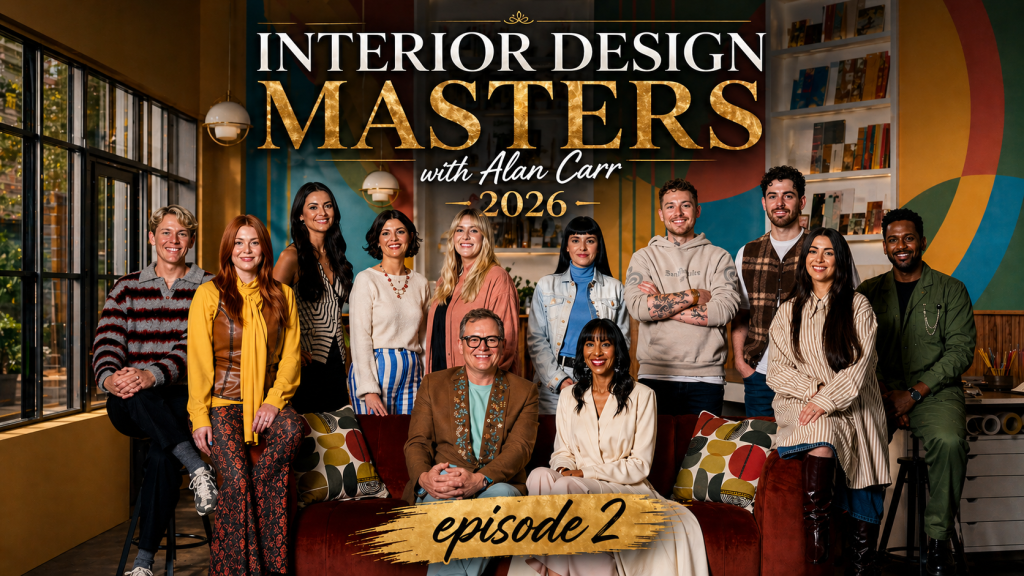
Interior Design Masters with Alan Carr 2026 episode 2 brought one of the most dramatically staged challenges in the show’s history, sending nine competing designers into a genuine medieval-style castle to transform hotel bedrooms into convincing romantic retreats. The setting alone raised the stakes considerably. Stone walls, vaulted ceilings, and the inherent atmosphere of a historic fortress created both an extraordinary opportunity and a genuinely difficult design problem. Romance is, by its nature, a deeply personal register, and translating personal feeling into a professionally executed hotel space requires a particular kind of creative confidence.
The brief was specific: design a hotel bedroom that functions as a love nest. Designers were instructed to draw on their own understanding of romance, their personal aesthetic instincts, and their ability to read a space. Crucially, they were required to reuse and repurpose existing furniture already present in the rooms. This condition transformed the challenge from a straightforward styling exercise into a test of resourcefulness, upcycling skill, and editorial restraint. Not every piece in the room could be changed, so every decision about what to keep, what to reinvent, and what to introduce carried additional weight.
Interior design as a discipline sits at the intersection of function and emotion. A hotel bedroom must work practically — it must accommodate guests comfortably and efficiently — but a romantic hotel bedroom must do something more. It must create a mood, sustain an atmosphere, and make the occupant feel something specific. That dual requirement was at the heart of this challenge, and it pushed several designers into territory they found uncomfortable, revealing both strengths and limitations that a more neutral brief might not have exposed.
The competition format brings together designers at different stages of their careers, with different stylistic backgrounds and different natural tendencies. Interior Design Masters with Alan Carr uses these differences productively, pairing individual creative visions against a shared standard of professional execution. The judges, Michelle and guest judge Linda Boronkay — a hotel design specialist — were evaluating not just aesthetic preference but whether each room genuinely worked as a hospitality product. That professional lens shaped every critique delivered during the judging walkthrough.
Alan Carr, as host, provided continuity and energy throughout the episode, moving between designers during the build phase and surfacing the tensions, uncertainties, and moments of creative breakthrough that defined the day. His presence gave the episode its rhythm, and his conversations with the competitors revealed the thinking behind each design decision, adding context that the finished rooms alone could not fully communicate.

Scan smarter. Create faster. Free.
Download QR & Barcode Studio — Create and scan unlimited QR codes & barcodes.
No paywalls. No limits. 100% Free.

The castle’s existing architecture proved both a gift and a constraint. Its stone character offered instant atmosphere, but it also imposed a visual language that not every designer’s instincts were naturally aligned with. Several competitors embraced the setting directly, allowing the medieval context to inform their romantic vision. Others attempted to work against it, introducing contemporary or maximalist aesthetics that stood in deliberate contrast to the stone surroundings. Both strategies carried risk, and the results varied significantly.
What emerged across the nine rooms was a portrait of how differently designers understand romance as a visual concept. Some reached for the overtly sensual — deep colours, layered textiles, candlelight-adjacent warmth. Others pursued a quieter, more refined version of intimacy, built on proportion, considered material choice, and restrained colour palette. A small number struggled to move beyond decoration into atmosphere, producing rooms that looked dressed but did not feel inhabited by any particular emotional intention.
Interior Design Masters with Alan Carr 2026 episode 2 demonstrated that the romantic brief, more than most design challenges, demands genuine self-knowledge from the designer. It is not enough to know what looks good. The designer must understand what they find moving, what they find seductive in a space, and then make that legible to a stranger. That is a sophisticated creative act, and the episode traced the varying degrees to which each competitor was capable of it.
Interior Design Masters with Alan Carr 2026 episode 2
The Castle Setting and Its Influence on Interior Design Decisions
Sutton Park, the castle used for the challenge, established an immediate design context that was impossible to ignore. Its stone architecture, formal proportions, and sense of historical weight created a baseline atmosphere that every designer had to respond to, whether consciously or not. The building had an inherent character — cool, grand, slightly theatrical — and the question of whether to work with that character or against it became one of the episode’s defining creative tensions.
Designers who engaged directly with the castle’s atmosphere tended to produce rooms with strong internal coherence. By accepting the stone, the height, and the formal geometry of the spaces, these competitors could layer warmth and intimacy on top of an already-established mood, using textiles, lighting, and colour to soften what the architecture made dramatic. This approach required confidence in restraint — knowing when the room had enough and stopping there.
Conversely, those who attempted to impose a completely foreign aesthetic on the castle spaces faced a harder task. The building resisted neutrality. A very contemporary or very minimal room looked uneasy within walls that had centuries of visual presence, and several judges’ comments during the walkthrough reflected that tension. Linda Boronkay, speaking from professional hotel design experience, was particularly attentive to whether each room felt like it belonged in the building.
How Interior Design Masters with Alan Carr 2026 Episode 2 Tested Upcycling Skills
The upcycling requirement was not incidental to the challenge — it was central. Designers were told they must demonstrate their ability to repurpose the hotel’s existing furniture, and the way each competitor approached this instruction revealed a great deal about their wider design thinking. Upcycling in a professional context is not simply repainting an old chair. It involves assessing what an existing piece contributes, deciding how its form or function might be reframed, and executing that reframing to a standard that holds up against purpose-bought alternatives.
Several designers used paint confidently, transforming dated or neutral furniture into pieces that felt intentional within their chosen colour story. Others reupholstered headboards or side tables, introducing new textiles that connected existing furniture to fresh design directions. The most inventive responses found ways to change the perceived function of a piece entirely — repositioning furniture to serve unexpected purposes, or combining existing elements in configurations the room had not previously suggested.
The judges assessed upcycling not simply as a technical accomplishment but as an indicator of design intelligence. A beautifully executed paint finish on a piece that did not belong in the room conceptually was not praised. What drew genuine approval was the combination of skilled execution and conceptual justification — the ability to explain, through the finished room, why that piece had been worth saving and transforming.
Romantic Vision and Personal Inspiration in the Competition
Each designer was asked to draw on their own understanding of romance, and the diversity of responses made clear that this brief resisted any single interpretation. Romance in interior design can mean richness — velvet, candlelight, deep saturated colour, the visual language of seduction. It can equally mean stillness, natural materials, and the kind of quiet that allows two people to feel present with each other. Both readings are legitimate, and the episode presented both across its nine rooms.
One designer drew on a specifically personal romantic memory, using that emotional reference point to drive every material and colour choice in the room. This approach produced a space with unusual intensity of feeling, where the design logic extended from a genuine emotional core rather than a generalised idea of what romance looks like. The judges recognised this quality. Michelle noted that the room felt authored — that it had a point of view — and that distinction between personal vision and generic execution was a consistent thread in the feedback given throughout the walkthrough.
Other competitors struggled when their romantic concept was too abstract or too broadly defined. A room that sets out to be “romantic” without specifying what kind of romance, whose romance, or what emotional state it aims to create tends to produce safe, unexciting results. The episode underlined this repeatedly: the designers who came in with a specific story to tell were the ones whose rooms provoked the strongest response, positive or negative.
Linda Boronkay’s Judging Standard and the Hotel Design Framework
The presence of Linda Boronkay as guest judge introduced a specific professional framework to the evaluation. As a hotel design expert, Boronkay assessed each room not only as a visual composition but as a product — something that would need to deliver a consistent experience to paying guests, maintain its impact over time, and function effectively within the logic of a hospitality operation. This perspective added rigour to the judging process and introduced criteria that a purely aesthetic evaluation might have overlooked.
Boronkay was attentive to the distinction between styling and design. Styling dresses a room; design makes it work. A room can look beautiful in a photograph while failing as a usable space, and a hotel room must be both. Several competitors received feedback that acknowledged strong visual instincts but noted practical shortcomings — a lighting scheme that was atmospheric but insufficient, a furniture arrangement that prioritised appearance over accessibility, or a textile choice that would not wear well in a hotel context.
Her most instructive comments addressed spatial logic. In hotel design, the arrangement of furniture must serve the guest’s behaviour — how they move through the room on arrival, how they use the bed, how the bathroom relates to the sleeping area. Boronkay brought this behavioural understanding to each room, and it pushed the judges’ conversation beyond decoration into genuine design analysis. Interior Design Masters with Alan Carr 2026 episode 2 was richer for that professional depth.
The Strongest Rooms and What They Achieved
The top-performing rooms in this episode shared several characteristics, though they achieved their results through distinctly different means. Each had a clear conceptual anchor — a specific idea about what kind of romantic experience the room should provide. Each demonstrated controlled use of colour, with a palette that felt chosen rather than accumulated. And each showed evidence of design decisions that extended beyond the obvious, into the details of lighting, texture, and spatial arrangement that distinguish a memorable room from a merely attractive one.
The winner of the challenge produced a room that the judges described as genuinely transporting. The colour work was bold but considered, using a deep, enveloping tone on the walls and ceiling to create a sense of enclosure that felt intimate rather than oppressive. The upcycled furniture had been transformed convincingly, with the paint finish and new textile elements integrating seamlessly into the overall scheme. Crucially, the lighting had been handled with real care — not simply adding lamps, but thinking about the quality and direction of light at different times of day and in different modes of use.
The second strongest room took a more restrained approach, relying on texture and layering rather than colour drama to create its sense of romance. Natural linens, considered placement of softer furnishings, and a spare but warm use of decorative objects produced a room that felt genuinely inhabitable — a space that invited lingering rather than merely impressing on entry. Boronkay singled this room out for its understanding of how guests actually experience a hotel space over time, rather than in a single moment of arrival.
Rooms That Fell Short and the Design Lessons They Offered
Not all nine rooms succeeded, and the episode was candid about where and why certain designers fell short. The most common failure mode was decoration without concept — rooms that had been dressed carefully but lacked an underlying idea strong enough to organise the choices into a coherent whole. These rooms looked busy on inspection, with elements that individually might have worked but collectively produced no clear emotional effect.
One competitor produced a room that was technically accomplished but emotionally inert. The craftsmanship was evident — the upcycling was well executed, the colour was handled competently — but the space did not feel like a romantic destination. The judges noted the absence of warmth, both literal and atmospheric. Good lighting was missing, and the furniture arrangement created a formal, almost utilitarian quality that worked against the romantic brief entirely. The competitor acknowledged in conversation with Alan Carr that they had struggled to locate a personal connection to the concept of romance and had instead worked from research rather than feeling — a distinction the room made visible.
Another room suffered from overcrowding. The designer, ambitious in their intentions, had introduced too many elements and failed to edit. Every surface carried something, every wall had been treated, and the cumulative effect was visual fatigue rather than seductive richness. Interior design at the level this competition demands requires as much skill in removing as in adding, and this room illustrated what happens when the editing impulse is absent.
Interior Design Masters with Alan Carr 2026 Episode 2 and the Question of Risk
Risk-taking was a recurring theme in judges’ feedback throughout the episode. Michelle, consistent with her approach in earlier episodes, valued ambition — the willingness to commit to a strong idea even when that idea might not land safely. Several times during the walkthrough she distinguished between rooms that had played it safe and rooms that had genuinely attempted something. Even where a risky design had not fully succeeded, the ambition was acknowledged as professionally important.
This position reflects a genuine tension in design competition. Safety produces rooms that avoid failure but also avoid distinction. Risk produces rooms that might be extraordinary or might miss entirely, but that at least demonstrate the designer’s willingness to take a position. For professional development, the judges seemed to regard the capacity for risk as more valuable than the habit of safety, even accounting for the competitive consequences of a poorly executed gamble.
One designer who had been cautious in the first episode took a significant creative leap in this challenge, introducing a colour scheme and furniture arrangement that were genuinely unexpected for the castle setting. The room divided opinion — Boronkay found certain elements at odds with the hospitality function — but Michelle responded strongly to the commitment and the internal logic of the vision. The result was a room that generated the most sustained critical discussion of the walkthrough, which in itself suggested the designer had achieved something worth engaging with.
Alan Carr’s Role in Interior Design Masters with Alan Carr 2026 Episode 2
Alan Carr’s function in the episode went beyond hosting in the conventional sense. During the build phase, his conversations with individual designers served as a mechanism for drawing out the thinking behind each design decision — not in a way that directed those decisions, but in a way that helped competitors articulate and sometimes clarify their own intentions. Several designers visibly used their conversations with Carr to work through uncertainty, and more than one moment suggested that being asked to explain a choice aloud helped a competitor recognise that the choice needed revisiting.
His sense of humour kept the atmosphere of the episode buoyant during the more pressurised moments, but it was deployed without diminishing the seriousness of the competition. Carr consistently signalled genuine interest in the creative process, and the designers responded to that interest with unusual candour about their doubts and their aspirations. This quality of disclosure gave the episode a texture that purely technical competition coverage would have lacked.
During the judging walkthrough, Carr’s presence as a viewer — someone experiencing the rooms without specialist knowledge — also served a useful function. His instinctive responses to the finished spaces provided a counterpoint to the more analytical assessments of Michelle and Boronkay, and occasionally his unfiltered reaction identified something that the technical critique had not yet named.
Upcycling as a Professional Skill in Home Design and Hotel Contexts
The episode’s emphasis on upcycling had implications that extended beyond this single challenge. In professional interior design and home design practice, the ability to assess and transform existing furniture is a commercially significant skill. Clients frequently have pieces they are attached to, rooms they do not want to completely clear, or budgets that make full replacement impossible. A designer who can work creatively within those constraints delivers far greater value than one who requires a blank canvas.
Boronkay’s feedback repeatedly addressed this dimension. In hotel design specifically, the economics of renovation mean that furniture replacement is expensive and operationally disruptive. Designers who can refresh and recontextualise existing pieces — changing their function, their finish, or their placement — provide solutions that are both cost-effective and sympathetic to the building’s existing identity. The castle challenge was, in this sense, a realistic simulation of professional hotel design conditions.
The competitors who approached the upcycling requirement with genuine enthusiasm tended to produce the most coherent rooms. Treating the existing furniture as a problem to be worked around produced hesitant, slightly apologetic results. Treating it as an opportunity — as material that already carried history and character and that could be redirected rather than replaced — produced rooms with depth and a sense of earned belonging in the space.
What Interior Design Masters with Alan Carr 2026 Episode 2 Reveals About Design Competition
Interior Design Masters with Alan Carr 2026 episode 2 illustrated how much a single thematic brief can reveal about a designer’s range and self-knowledge. The romantic hotel bedroom challenge was not technically the most complex brief a design competition could set. But it was emotionally demanding in a way that purely technical challenges are not, and the emotional demand separated competitors in ways that raw skill alone would not have done.
The episode confirmed that the competition’s most consistent thread is not any particular aesthetic preference — neither the judges nor the format favour one design language over another. What the competition consistently rewards is conviction. A room built on a clear idea, executed with commitment and professional rigour, and calibrated to serve the specific function of the space it occupies, will always be evaluated more favourably than a technically accomplished room that lacks a point of view.
Home design at its best is always an argument — an assertion that this material, this colour, this arrangement of objects creates a specific experience of space. The nine rooms in this episode made nine different arguments about what romance looks like when you translate it into walls, furniture, light, and texture. Some of those arguments were more persuasive than others, but the episode’s lasting impression was of nine designers grappling honestly with one of the most personal questions interior design can pose.
FAQ Interior Design Masters with Alan Carr 2026 episode 2
Q: What is the main challenge set for designers in Interior Design Masters with Alan Carr 2026 episode 2?
A: In this episode, nine competing designers are sent to a medieval-style castle to transform hotel bedrooms into romantic retreats. Additionally, they must reuse and repurpose the hotel’s existing furniture, demonstrating upcycling skill alongside their broader interior design abilities.
Q: Who judges the designers in Interior Design Masters with Alan Carr 2026 episode 2?
A: The rooms are judged by Michelle, the show’s resident judge, and guest judge Linda Boronkay, a specialist in hotel design. Boronkay brings a professional hospitality perspective, evaluating each room not only for visual appeal but also for how well it functions as a usable hotel product.
Q: Why is the upcycling requirement important in this episode’s design competition?
A: The upcycling requirement tests a commercially vital interior design skill. In real hotel renovation projects, full furniture replacement is expensive and disruptive. Designers who can creatively transform existing pieces — through repainting, reupholstering, or repositioning — deliver practical, cost-effective solutions. Furthermore, the judges assess upcycling as a measure of design intelligence, not merely technical craft.
Q: How does the castle setting affect the designers’ interior design choices?
A: The castle’s stone walls, vaulted ceilings, and historical atmosphere create a powerful visual context that every designer must address. Those who embrace the setting tend to produce more coherent rooms. However, designers who impose a foreign aesthetic risk creating spaces that feel at odds with the building’s inherent character.
Q: What do the judges look for when evaluating romantic hotel bedroom designs in this home design challenge?
A: Judges prioritise rooms with a clear conceptual anchor, a considered colour palette, and thoughtful lighting. Linda Boronkay additionally assesses spatial logic — how furniture serves the guest’s movement and behaviour. Michelle consistently rewards conviction and ambition, valuing rooms that argue a specific point of view over those that play it safe.
Q: What is the most common reason designers fail the romantic bedroom brief in Interior Design Masters with Alan Carr 2026 episode 2?
A: The most frequent failure is decoration without concept — rooms that are carefully dressed but lack an underlying idea strong enough to unify the choices. Additionally, overcrowding surfaces with too many elements creates visual fatigue rather than intimacy. Successful home design requires as much editorial discipline in removing elements as in adding them.
Q: How does Alan Carr contribute to the competition beyond his hosting duties?
A: Alan Carr actively draws out the thinking behind each designer’s decisions during the build phase, helping competitors articulate and sometimes reconsider their intentions. His instinctive, non-specialist responses to finished rooms also provide a valuable counterpoint to the technical critiques offered by Michelle and Linda Boronkay during the judging walkthrough.
Q: What distinguishes the winning room from the other entries in this interior design competition?
A: The winning room combines bold, enveloping colour with carefully handled lighting and convincingly transformed upcycled furniture. Crucially, it creates a sense of enclosure that feels intimate rather than oppressive. The judges describe it as genuinely transporting — a space where every decision, from palette to textile, serves a single coherent emotional purpose.
Q: How does Linda Boronkay’s hotel design expertise shape the judging in Interior Design Masters with Alan Carr 2026 episode 2?
A: Boronkay draws a firm distinction between styling and design. She assesses whether each room would function effectively for real guests over time, not simply look impressive on arrival. Her feedback highlights practical shortcomings — insufficient lighting, poor furniture arrangement, or textiles unsuitable for a hotel environment — adding professional rigour to the evaluation process.
Q: What broader lesson about interior design does this episode demonstrate through the romantic brief?
A: The episode demonstrates that successful interior design requires genuine self-knowledge. A designer must understand what they personally find moving in a space before they can make that feeling legible to others. Furthermore, the competition consistently rewards conviction over technical safety — a room built on a specific, committed idea will always outperform a polished but viewpoint-free alternative.