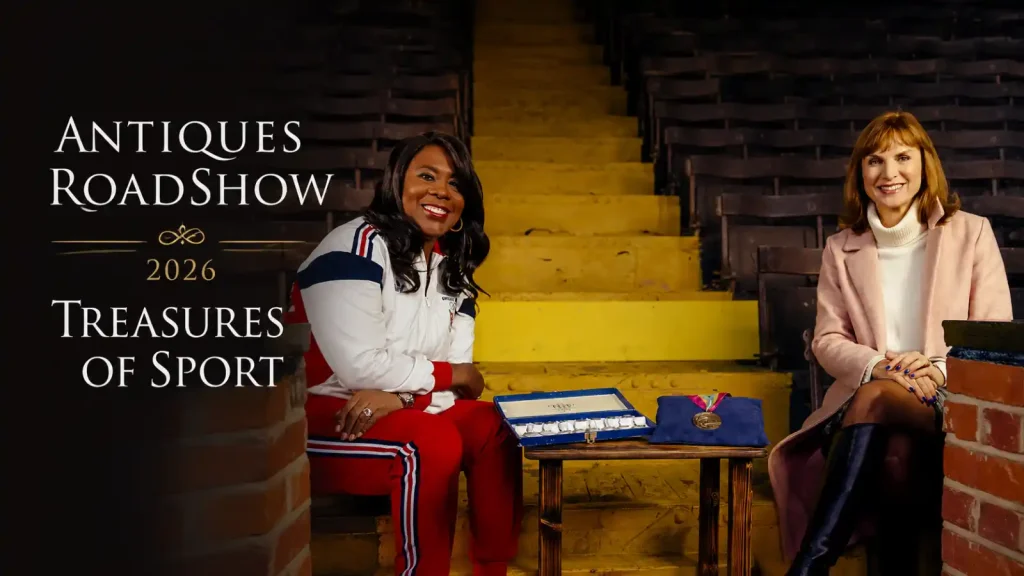
Antiques Roadshow 2026 – Treasures of Sport delivers one of the most ambitious specials the programme has ever attempted, trading antique china and country-house heirlooms for football shirts, Olympic medals and the oldest written rules of cricket. Timed to coincide with the World Cup, this sport-themed edition sends Fiona Bruce and the roadshow team across some of Britain’s most storied sporting venues, from Craven Cottage to Lord’s, Wimbledon to the StoneX Stadium. The result is a celebration of football, rugby, cricket, tennis and the Olympics that uncovers relics most fans never knew survived, alongside human stories that reshape how we understand British sporting history.
This is an episode built on objects that carry enormous emotional and historical weight. A jersey worn during England’s 1966 World Cup triumph. The actual coin tossed before kick-off in that final. An Olympic gold medal won in a race with only one competitor. Each treasure opens a door onto a larger story, and the experts treat them with the reverence usually reserved for fine art.
What lifts Antiques Roadshow 2026 – Treasures of Sport above a simple valuation showcase is its commitment to the people behind the objects. Olympic javelin champion Tessa Sanderson appears in the clothes she wore four decades ago. Trailblazing Paralympian Caz Walton reflects on a career spanning five Games. And the long-buried story of the ‘Lost Lionesses’ finally receives the national stage it was denied for half a century.
The episode opens at the historic home of Fulham FC, Craven Cottage, where football takes centre stage as the nation’s favourite sport. Fiona Bruce meets a collector whose holdings read like a shrine to the single greatest day in English football history. Among them sits the jersey worn by Nobby Stiles during England’s World Cup-winning campaign, a garment soaked in the memory of that summer.
The shirt alone would justify the visit. Stiles became one of the defining figures of the 1966 tournament, and the survival of his match-worn jersey connects modern fans directly to the players who lifted the trophy. Holding it transforms an abstract historical event into something tangible and immediate.

Scan smarter. Create faster. Free.
Download QR & Barcode Studio — Create and scan unlimited QR codes & barcodes.
No paywalls. No limits. 100% Free.

Yet the collector’s second treasure proves even more astonishing. He owns the coin tossed by the referee at the start of the 1966 World Cup final, the match England won 4-2 against West Germany. That small object decided which side chose ends before a ball was kicked. Few relics capture a pivotal sporting moment so precisely, and its presence at Craven Cottage sets the tone for everything that follows.
Antiques Roadshow 2026 – Treasures of Sport
The Oldest Rules of Cricket and a £300,000 Valuation at Lord’s
From football the team travels to Lord’s Cricket Ground, the spiritual home of the sport, where sports memorabilia expert David Convery encounters a document of genuine national importance. He is shown the oldest-known written rules of cricket, dating back to 1727, a survival so rare that it rewrites assumptions about how early the modern game was formalised.
These rules predate the codified laws most enthusiasts associate with cricket’s origins. They reveal a sport already organised enough to require agreed conditions of play, recorded nearly three centuries ago. Convery recognises immediately that he is handling something extraordinary, and his valuation reflects it. He places the document at upwards of £300,000, a figure that underlines how cultural heritage and sporting history can carry value far beyond ordinary memorabilia.
Cricket’s deep past continues to surface throughout the visit. Fiona Bruce turns her attention to the Ashes urn, perhaps the most mythologised trophy in the sport, investigating the story behind an object whose fame far exceeds its modest size. Together these segments position Lord’s as a custodian of treasures that connect contemporary cricket to its earliest recorded form.
England Rugby Caps and the Players Who Never Came Home
The roadshow then moves to the StoneX Stadium, home of Saracens Rugby Club, where expert Adam Schoon examines a selection of England caps awarded to some of the first men ever to represent their country. These embroidered caps were the original symbol of international selection, handed to players in the formative years of the sport.
Each cap represents a pioneer. They belonged to athletes who helped establish rugby as a national game long before stadiums filled with tens of thousands. Schoon treats them not merely as collectibles but as records of individual lives bound up in the history of English rugby.
One cap carries particular weight. Among the players honoured was a man who tragically lost his life during the First World War, his sporting achievement forever overshadowed by the conflict that claimed him. That detail transforms a piece of embroidered cloth into a memorial, a reminder that early international rugby produced not only champions but a generation swept into war. It is among the most quietly moving moments of Antiques Roadshow 2026 – Treasures of Sport.
Sir Gareth Edwards and the Welsh ‘Groggs’ Surprise in Swansea
The episode also revisits an unseen clip recorded in Swansea in 2025, where expert Ben Rogers Jones examines two rugby statues known affectionately as ‘Groggs’. These hand-crafted Welsh figurines have long celebrated the heroes of the Welsh game, capturing players in caricature form with deep regional affection.
One of the Groggs depicts Gareth Edwards, widely regarded as one of the greatest rugby players who ever lived. As Rogers Jones and the statue’s owner discuss the likeness, the segment delivers an unscripted gift. Sir Gareth Edwards himself emerges from the crowd to offer his own verdict on how faithfully the figure resembles him.
Moments like this explain why the programme endures. The Welsh rugby legend’s surprise appearance turns a routine valuation into a genuine event, blending humour, nostalgia and the unmistakable thrill of meeting a sporting icon in person. For Welsh rugby supporters in particular, the encounter carries enormous emotional resonance and roots the episode firmly in living memory.
Inside the Wimbledon Archives and the Evolution of Tennis
Tennis receives equally privileged treatment when Hilary Kay is granted exclusive access to the archives beneath Centre Court at Wimbledon. Few people ever see this collection, which charts the journey of a game that grew from a genteel pastime into a global spectacle watched by millions every year.
Kay traces tennis from its early roots in the gardens of country estates, where it began as a leisurely diversion for the privileged, to the high-performance sport recognised worldwide today. The archive reveals how dramatically equipment changed across the decades, particularly the materials used for rackets. The episode highlights the first metal tennis racket, a turning point that signalled the end of the wooden era and the arrival of modern competitive play.
The visit also explores one of Wimbledon’s most enduring traditions: its strict association with white clothing. Kay explains how the tournament came to demand predominantly white attire, a convention that remains one of the most recognisable features of the Championships. By moving from early estate games to the polished modern event, the Wimbledon segment offers a complete portrait of how tennis evolved.
Olympic and Paralympic Champions Reunited With Their Golden Moments
Some of the episode’s most powerful encounters come when the team turns to the Olympics and Paralympics, meeting four gold medal winners whose stories span generations. The breadth of achievement on display reflects the programme’s ambition to honour the full sweep of British sporting excellence.
Among them are husband and wife Hugh and Anita Porter, whose love story is as remarkable as their medals. Hugh competed in cycling and Anita in swimming, and the couple first met on the plane carrying them to the 1964 Tokyo Games. Their shared history binds personal romance to Olympic triumph in a way that feels almost cinematic.
The episode also features one of the most extraordinary Paralympic careers in British history. Caz Walton attended five Summer Games as a multi-discipline champion, winning 17 separate medals across that span. Her achievements helped define the early decades of Paralympic competition, and her reflections offer a vital reminder of how far disability sport has travelled. As a trailblazing Paralympian, Walton stands among the genuine pioneers of the movement.
Tessa Sanderson’s Javelin Gold and a Curious Olympic Record
Olympic javelin champion Tessa Sanderson provides one of the episode’s most joyful highlights. She shares the story of her gold medal win at the 1984 Los Angeles Olympics, a landmark moment in British athletics that made her one of the country’s most celebrated field athletes.
What makes her appearance unforgettable is her willingness to wear the very clothes she competed in more than 40 years earlier. Slipping back into the kit she wore on that triumphant day collapses the distance between past and present, allowing viewers to share in a piece of living Olympic history. Few guests embody the spirit of the episode so completely.
The Olympic segments also surface one of sport’s stranger curiosities: a gold medal awarded to a runner who was the only competitor to take part in his race. With no rivals to beat, he still claimed the honour, producing one of the most peculiar entries in Olympic record-keeping. It is exactly the kind of unexpected detail that gives Antiques Roadshow 2026 – Treasures of Sport its texture, balancing grand achievement with delightful oddity.
The Lost Lionesses and the Forgotten 1971 Women’s World Cup
The episode saves its most emotionally charged story for its return to Craven Cottage, where Siobhan Tyrrell meets the players known as the ‘Lost Lionesses’. These women took part in the unofficial Women’s World Cup held in Mexico in 1971, an event that has been largely written out of mainstream football history until recent years.
Leah Caleb and Gill Sayell were only teenagers when they travelled with the England team to compete in front of more than 90,000 supporters. The scale of that crowd is staggering, especially given that back home they had played in front of mere handfuls of spectators. For young girls accustomed to playing in near anonymity, the experience must have been overwhelming and exhilarating in equal measure.
What followed casts a long shadow. On returning to England, the players were banned from competing for months because of the unofficial status of the tournament. Their achievement was effectively suppressed, and for years they did not speak about what they had done. The silence lasted decades. As Tyrrell examines their surviving kit and equipment, she hears how this remarkable story has finally come to be told, restoring these women to their rightful place in the history of women’s football.
Why Treasures of Sport Becomes a Landmark Episode for Cultural Heritage
What makes this edition so compelling is the way it reframes sporting memorabilia as serious cultural heritage. The relics gathered here, from Betty Snowball’s blazer worn by the record-breaking cricketer to the caps of the first rugby internationals, are not curiosities. They are primary records of how British sport developed and who shaped it.
The episode also restores balance to a history too often told through men alone. By celebrating women’s football, the achievements of pioneering female cricketers and the courage of the Lost Lionesses, it gives long-overdue recognition to athletes whose contributions were ignored in their own time. That corrective impulse runs throughout, deepening the programme’s purpose well beyond entertainment.
Ultimately, Antiques Roadshow 2026 – Treasures of Sport succeeds because it understands that the objects matter only because of the people attached to them. A coin, a shirt, a cap, a medal: each becomes a vessel for memory, ambition, loss and triumph. By visiting Lord’s, Wimbledon, Craven Cottage and beyond, Fiona Bruce and her team turn a single special into a moving tour through the soul of British sport, proving once again why the roadshow remains essential viewing for anyone who values history, heritage and the treasures that connect us to it.
FAQ Antiques Roadshow 2026 – Treasures of Sport
Q: What is the Antiques Roadshow 2026 Treasures of Sport special about?
A: It is a sport-themed episode timed to coincide with the World Cup, celebrating the history of football, rugby, cricket, tennis and the Olympics. Fiona Bruce and the team visit famous venues including Lord’s, Wimbledon and Craven Cottage, examining rare relics and meeting champions whose objects connect viewers directly to British sporting history.
Q: How much is the 1966 World Cup coin worth on Antiques Roadshow?
A: The episode does not place a single fixed figure on the coin, but its significance is immense. A collector at Craven Cottage owns the actual coin tossed by the referee before the 1966 World Cup final, the match England won 4-2 against West Germany. Few relics capture such a pivotal sporting moment so precisely.
Q: Why are the oldest rules of cricket valued at over £300,000?
A: Sports memorabilia expert David Convery values them at upwards of £300,000 because they are extraordinarily rare. Dating to 1727, these are the oldest-known written rules of cricket and predate the codified laws most people associate with the sport’s origins. They prove the game was formally organised nearly three centuries ago.
Q: Who are the Lost Lionesses and what happened to them?
A: The Lost Lionesses were England players in the unofficial 1971 Women’s World Cup in Mexico. Teenagers Leah Caleb and Gill Sayell played in front of over 90,000 supporters, despite having played before mere handfuls at home. On returning, they were banned for months due to the tournament’s unofficial status and stayed silent for years.
Q: Did Sir Gareth Edwards really appear on Antiques Roadshow?
A: Yes. In an unseen clip from Swansea in 2025, expert Ben Rogers Jones discussed two rugby statues known as ‘Groggs’, one depicting Gareth Edwards. The Welsh rugby legend surprised both the expert and the statue’s owner by emerging from the crowd to give his own verdict on the figure’s likeness.
Q: What sporting venues does the Treasures of Sport episode visit?
A: The roadshow travels to several iconic grounds. These include Craven Cottage, home of Fulham FC, where the episode opens with football; Lord’s Cricket Ground for cricket history; the StoneX Stadium, home of Saracens Rugby Club; and Wimbledon, where the team gains exclusive access to the archives beneath Centre Court.
Q: Why did Tessa Sanderson wear her old Olympic kit on the show?
A: Tessa Sanderson chose to wear the clothes she competed in over 40 years ago to share the story of her 1984 Los Angeles Olympics javelin gold. Slipping back into that kit collapses the distance between past and present, letting viewers share directly in a landmark moment of British athletics.
Q: How did Wimbledon become associated with all-white clothing?
A: Hilary Kay explores this tradition inside the Wimbledon archives. The segment explains how the Championships came to demand predominantly white attire, a convention that remains one of the tournament’s most recognisable features. The archive also traces tennis from genteel country-estate gardens to the global event watched by millions today.
Q: Who are the gold medal winners featured in the Olympics segment?
A: The episode meets four champions. Husband and wife Hugh Porter (cycling) and Anita Porter (swimming) met on the plane to the 1964 Tokyo Games. Paralympian Caz Walton attended five Summer Games, winning 17 medals. Tessa Sanderson shares her 1984 javelin gold, alongside a curious medal won in a one-runner race.
Q: What rare rugby and cricket relics appear in the episode?
A: Expert Adam Schoon examines England caps from the first players to represent their country, including one who died in the First World War. The episode also features the blazer worn by record-breaking cricketer Betty Snowball, the first metal tennis racket, Nobby Stiles’s 1966 shirt and the famous Ashes urn.