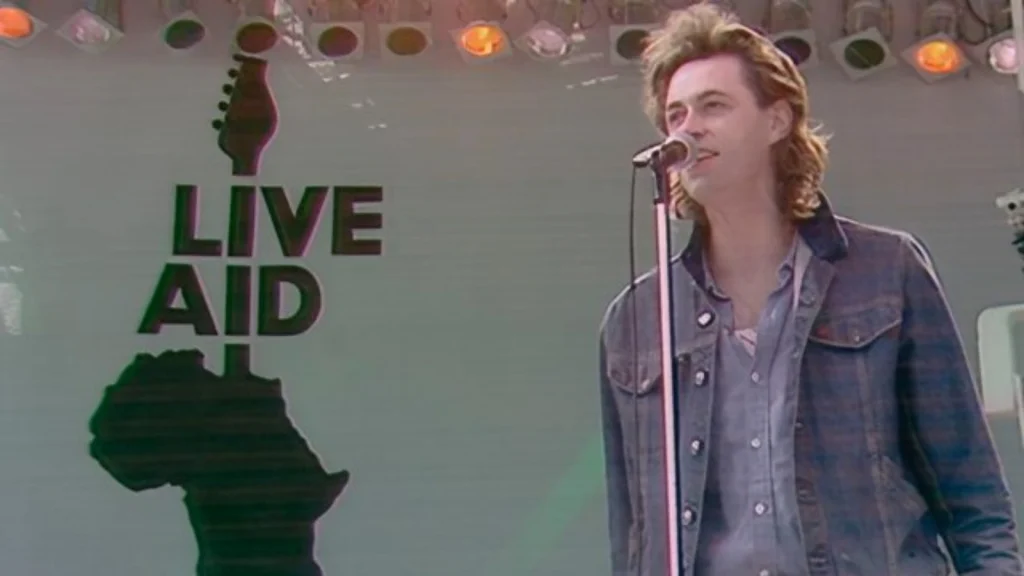
The documentary Live Aid at 40 episode 1 charts the extraordinary journey from a shocking news report to a global music phenomenon. In late 1984, the world was jolted by Michael Buerk’s BBC broadcast from Ethiopia. His report depicted a “biblical famine” in the 20th century, lighting up the television screen with images so horrific they felt like “the closest thing to hell on Earth.” This powerful footage acted as a catalyst, sparking a movement that would unite the music world and capture the attention of millions. It set the stage for an unprecedented response, driven by the conscience of a handful of rock stars.
The context of the mid-1980s was one of stark contrasts and deep divisions. In Britain, Margaret Thatcher’s government championed the deregulation of the city, while a bitter miners’ strike polarized the nation. It was an era of go-go rock shows and a focus on style, a world away from the starvation plaguing Ethiopia. The global political climate was equally fraught, with the Cold War at its peak. Ethiopia’s Marxist military government, backed by the Soviet Union, was viewed with suspicion by Western powers, which complicated and often prevented humanitarian aid from reaching those who desperately needed it. This political standoff meant that while governments were aware of the crisis, their actions were paralyzed by ideology.
The scope of the response, as detailed in Live Aid at 40 episode 1, began not with a grand plan, but with a simple, visceral reaction. It started with a song, an idea to raise a modest £100,000. This seed of an idea grew into Band Aid, a supergroup of British and Irish musical talent. Subsequently, it inspired a parallel movement in the United States, USA for Africa. The episode chronicles this rapid evolution, showing how a single charity record transformed into a transatlantic cause, laying the groundwork for the legendary Live Aid concert. It’s a story of naive energy, raw emotion, and the surprising power of pop music to effect change.
This story begins with Irish rock star Bob Geldof. One dreary October evening, he found himself at home, a measure, he noted, of his band’s waning success. He was transfixed by the news report, watching scenes of such profound suffering that his partner, Paula, fled the room with their child. The images of bewildered children and the impossible choices faced by aid workers—who had only 60 or 70 feeding spots for thousands of starving people—left an indelible mark. This jarring juxtaposition between his world and theirs became a source of deep-seated anger and frustration.
Later that night, Geldof attended a stylish book launch party. Surrounded by free champagne and conversations about fashion, he felt disgusted. The hollowness of the scene, coming directly after witnessing such immense suffering, ignited a fury within him. He found himself angrily telling people, “Have you seen this? It’s terrible.” The experience solidified his resolve that passive sympathy was not enough. His partner’s simple gesture of placing a charity bowl in their kitchen felt completely inadequate. He knew something much bigger was required.

Scan smarter. Create faster. Free.
Download QR & Barcode Studio — Create and scan unlimited QR codes & barcodes.
No paywalls. No limits. 100% Free.

Geldof recognized that the only real power he possessed was the ability to write tunes. However, he also knew that his band, The Boomtown Rats, were no longer guaranteed to have hits. A new wave of polished pop acts had taken over the charts. His initial thought was to raise about £100,000 through song royalties.
The business side of his brain kicked in, realizing that a Christmas release was the best way to maximize record sales. He quickly enlisted Midge Ure of Ultravox, and after chance encounters on the King’s Road, brought Gary Kemp of Spandau Ballet and Sting from The Police into the fold. The initial plan was small, but with these names attached, the foundation for Band Aid was laid.
The Making of a Christmas Anthem
The creation of “Do They Know It’s Christmas?” was a frantic and inspired process. When Bob Geldof first presented the song idea to Midge Ure, he arrived with a guitar missing some strings and sang what Ure described as a “demented Bob Dylan” impression. The melody was inconsistent, and Ure felt he was trying to make “a silk purse out of a sow’s ear.”
Nevertheless, they pressed on, aiming to create a simple pop song designed to last just three minutes in 1984. The first proper demo was recorded at Ure’s house, with Sting providing the initial harmony vocal. This demo became the template used to teach the song to the dozens of artists who would later join the project.
The day of the recording was fraught with anxiety. Geldof and Ure stood outside the studio surrounded by cameras, unsure who would actually attend. The entire project was built on a “wing and a prayer,” with no contracts, no payments, and only the verbal commitments of the artists. Geldof nervously quipped to Ure, “If it’s just The Boomtown Rats and Ultravox, we’re fucked.” To their immense relief, the stars arrived.
Duran Duran showed up exhausted, Spandau Ballet flew in directly from Japan, and a who’s who of 80s pop royalty filled the studio. The atmosphere was a mix of nerves, egos, and a shared sense of purpose, with Paula Yates acting as what one participant called “the lovely glue,” keeping everyone entertained and at ease.
Assigning vocal lines was an improvisational affair. Ure and Geldof had a lyric sheet but admitted they hadn’t written enough lines for everyone. The process became about matching parts to the unique strengths of each singer. George Michael’s stunning vocal performance left everyone in awe.
However, it was Bono, the frontman of U2, who was given the song’s most controversial and powerful line: “Well, tonight thank God it’s them instead of you.” Bono was deeply uncomfortable with the lyric, which he called a “cruel prayer.” Geldof explained the bluntness came from an Irish folk memory of famine; it was meant to be a shocking, unsentimental statement. Bono ultimately delivered the line with a raw intensity that took the song to another level, hitting a high octave that made the track soar. This moment of raw, emotional power is a key feature of Live Aid at 40 episode 1.
The final piece of the musical puzzle was the percussion. Phil Collins of Genesis arrived with his drum kit, much to the surprise of Midge Ure, who had already prepared a backing track. After waiting patiently for hours, Collins was finally given his chance. He delivered a powerful, ambient drum track that added immense weight and gravitas to the song. His contribution was so impactful that everyone in the studio was in awe, watching a master at work. The song, a hastily written pop tune, was transformed into something more: a hymn-like anthem for a generation. It was the product of working-class kids who, through naive energy and raw talent, were trying to change the world.
From Vinyl to a National Movement: The Rise of Band Aid
With the song recorded, the next challenge was ensuring it reached the public. The promotional strategy was as audacious as the recording itself. They begged David Bowie, a cultural icon, to introduce the video on the BBC’s flagship music program, Top Of The Pops. Bowie agreed, delivering a heartfelt plea to the show’s 18 million viewers. He urged everyone to buy the record, even suggesting they club together if they couldn’t afford it alone. His endorsement was a massive coup, lending the project immense credibility and reaching a vast audience. This broadcast was the moment the single truly exploded into the national consciousness.
The public response was immediate and overwhelming. The record became the fastest-selling single in UK history. People were reportedly buying dozens of copies and returning them to be resold. The phenomenon transcended traditional music retail. A butcher in Plymouth famously displayed the Band Aid single in his window next to geese and turkeys. High-end London department store Fortnum & Mason called for advice on “how exactly does one sell a pop record?” To meet the unprecedented demand, every vinyl manufacturing plant in Europe was enlisted to press copies of the single. In just one week, the song raised over £1 million.
This success, however, hit a bureaucratic wall: the government insisted on collecting Value Added Tax (VAT) from the charity single’s sales. The public was outraged. Many felt it was unconscionable for the government to profit from a record created to fight famine. The media, including the right-wing press, took up the cause. Bob Geldof seized an opportunity at a newspaper awards ceremony to publicly confront Prime Minister Margaret Thatcher. Though the initial exchange was tense and seemingly unproductive, the public pressure worked. The Chancellor of the Exchequer later called Geldof to inform him the government would make a “donation” equivalent to the VAT collected, with the caveat that Geldof not announce it as a government U-turn.
The Band Aid project became more than just a charity single; it transformed into a social movement. Cynicism melted away as the British public embraced the record as their own act of empowerment. Schools collected money in sacks, and children expressed their belief that the government should do more. The song gave people a tangible way to respond to the horror they had seen on their televisions. It channeled the nation’s collective shame and anger into a positive, unified force. The overwhelming success set the stage for an even larger endeavor, one that would eventually lead to the Live Aid concert.
Navigating Politics and Perceptions in Ethiopia
While the song was climbing the charts in Europe, the situation in Ethiopia remained dire and intensely complicated. The country was ruled by a Marxist military tyrant, Haile Mariam Mengistu, and was embroiled in raging civil wars that made delivering aid nearly impossible. Mengistu’s government, an ally of the Soviet Union, was celebrating the tenth anniversary of its rise to power and viewed the international focus on the famine as unwelcome news. One official told his colleagues it was the “wrong time to talk about this thing.” The government felt it was being punished by the West for its political ideology.
Bob Geldof’s eventual trip to Ethiopia was a collision of cultures and a harsh political education. He was initially reluctant to go, fearing it would look like he was climbing onto a “bandwagon” of dead babies for publicity. A photographer neighbor convinced him his presence was the only “peg” the media could use to continue covering the story. When Geldof arrived, unshaven and with uncombed hair, he shocked Ethiopian officials who were expecting a polished diplomat. His very appearance was a stark contrast to the formal world of international politics he had just entered.
The visit immediately highlighted cultural and factual inaccuracies in the song he had co-written. Ethiopian officials were offended by the title, “Do They Know It’s Christmas?” They pointed out that Ethiopians are among the oldest Christians in the world. Furthermore, the lyrics describing a land “where nothing ever grows, no rain or rivers flow” were a gross oversimplification of a vast and geographically diverse country that is a source of the Nile River. This experience was a lesson in the dangers of simplifying complex realities for a three-minute pop song.
The most dramatic moment of the trip was Geldof’s meeting with Mengistu himself. The encounter took place in a palatial marble room, and the atmosphere was thick with tension. When Mengistu, through an interpreter, asked Geldof for £1 million, the rock star’s anger boiled over. He confronted the dictator directly, using a string of expletives that caused the interpreter to stop translating. Geldof was horrified by the government’s resettlement program, which moved people from the barren north to the fertile south.
To Western eyes, the images of starving people being herded onto massive Russian planes by armed guards bore a chilling resemblance to scenes from the Holocaust. Geldof’s raw, emotional response clashed sharply with the cold realities of geopolitical maneuvering, an experience deeply explored in Live Aid at 40 episode 1.
The American Response: “We Are the World”
The incredible success of Band Aid sent ripples across the Atlantic, where it caught the attention of American singer and activist Harry Belafonte. He was moved by the initiative but also posed a critical question: “Why are white people saving black people when black people can’t save black people?” Belafonte decided to mobilize the biggest stars in the American music industry. He started at the top of the charts, reaching out to Lionel Richie, Quincy Jones, and Michael Jackson to create an American response. The plan was to gather the artists in one place after the American Music Awards on January 28th, a night when most would already be in town.
Bob Geldof was an essential part of this new project. He received a call from Belafonte and Michael Jackson, who asked him to come to the recording session and help. His role was not musical but moral. Quincy Jones, the producer, asked Geldof to speak to the assembled artists before they began singing. These weren’t just any artists; they were his “bedroom wall come alive,” icons like Stevie Wonder, Diana Ross, Bruce Springsteen, and Tina Turner.
He stood before them and described his recent trip to Ethiopia, recounting in stark detail the corrugated-iron huts filled with the dead and dying. He told them that the price of a life that year was a “piece of plastic, seven inches wide with a hole in the middle,” hoping to instill the gravity of the situation into their performance.
Geldof’s speech had a profound impact. He came in “breathing fire,” and the artists listened intently. His first-hand experience provided a visceral connection to the cause that transcended a simple recording session. It grounded the glamour of the event in the grim reality of the famine. This powerful moment of testimony helped shape the tone of “We Are the World.” The effort was also supported by official channels, including USAID, demonstrating a growing synergy between grassroots activism and governmental aid. This transatlantic collaboration showcased the global reach of the movement and paved the way for the ambitious concert that would follow.
The recording session for “We Are the World” was meticulously organized by Quincy Jones. He had a choirmaster pair voices and even placed tape on the floor with names on it to direct the stars where to stand. The result was a polished, powerful anthem that, like its British predecessor, became a global sensation. It was played on radio stations worldwide, and its accompanying video, T-shirts, and posters generated millions more for the cause.
The song represented a massive expansion of the initial effort, proving that the spirit of Band Aid could be replicated on an even grander scale. This American chapter was a critical step, demonstrating that the entire music world was now mobilized, setting the stage for the ultimate expression of this movement: a global concert to be broadcast around the world.
The Echoes of a Simple Idea: What Band Aid Taught Us About Changing the World
Looking back at those frantic weeks in 1984, it’s remarkable how a single evening’s television viewing could reshape the cultural landscape forever. Bob Geldof’s journey from angry rock star to reluctant diplomat illustrates something profound about how change actually happens—not through grand institutional plans, but through raw human emotion colliding with creative possibility.
The Band Aid phenomenon revealed the surprising alchemy that occurs when celebrity meets genuine crisis. These weren’t seasoned activists or policy experts; they were pop stars armed with nothing but recording equipment and righteous fury. Yet their naive energy accomplished what diplomatic channels couldn’t: they made an entire generation care about Ethiopian famine. Phil Collins didn’t need to understand geopolitics to deliver those thunderous drums, and Bono’s discomfort with his controversial lyric somehow made it more powerful, not less.
Perhaps most striking is how the movement exposed the gap between our capacity for empathy and our mechanisms for action. Millions of people had watched those devastating BBC reports, but it took a three-minute pop song to transform their horror into something tangible. The record became what Geldof called “a piece of plastic, seven inches wide with a hole in the middle”—the price of a life, and the catalyst for unprecedented generosity.
The political complications Geldof encountered in Ethiopia—from the song’s cultural insensitivity to his explosive confrontation with dictator Mengistu—serve as a crucial reminder that good intentions collide messily with complex realities. The very lyrics that moved millions in the West inadvertently insulted the people they aimed to help. Yet this collision of naivety with nuance didn’t derail the movement; it educated it, forcing a more sophisticated understanding of the challenges ahead.
The transatlantic expansion to “We Are the World” demonstrated how powerful ideas replicate and evolve. Harry Belafonte’s pointed question—”Why are white people saving black people when black people can’t save black people?”—didn’t diminish the movement’s impact but sharpened its focus. When Geldof stood before America’s biggest stars, breathing fire about corrugated-iron huts filled with dying children, he wasn’t just requesting their participation; he was demanding they grapple with their own privilege and responsibility.
Today, as we navigate an era of social media activism and celebrity causes, the Band Aid story offers both inspiration and caution. It shows us that cultural moments can indeed shift political realities—but only when raw emotion is coupled with sustained commitment. The lesson isn’t that pop stars should solve the world’s problems, but that when they authentically engage with those problems, they can unlock public engagement in ways that traditional channels cannot.
The movement that began with one man’s fury at the contrast between champagne parties and starving children ultimately proved that individual action, amplified by collective creativity, can still move mountains. In our current age of global challenges and digital connectivity, perhaps we need fewer grand strategies and more moments of simple, devastating clarity—the kind that transforms a missing-stringed guitar and a “demented Bob Dylan” impression into a movement that changed the world.
FAQ Live Aid at 40 episode 1
Q: What was Band Aid and how did it lead to Live Aid?
A: Band Aid was a charity supergroup formed in 1984 by Bob Geldof and Midge Ure to combat Ethiopian famine. Additionally, it began as a simple response to Michael Buerk’s shocking BBC report depicting the crisis as “biblical famine.” The project started with the goal of raising £100,000 through a Christmas single, but ultimately evolved into the massive Live Aid concert that would captivate global audiences.
Q: Why was Bob Geldof motivated to create Band Aid?
A: Geldof was profoundly affected by BBC footage showing Ethiopian children starving while aid workers faced impossible choices with limited resources. Furthermore, attending a champagne-filled book launch party immediately after viewing the report created a jarring contrast that ignited his fury. He realized that his only real power was “the ability to write tunes,” transforming his anger into actionable change.
Q: Which major artists participated in the original Band Aid recording?
A: The recording featured 80s superstars including Bono from U2, George Michael, Sting, Phil Collins, and members of Duran Duran and Spandau Ballet. However, the session was built on “a wing and a prayer” with no contracts or payments—only verbal commitments. Notably, Paula Yates served as “the lovely glue” keeping everyone entertained during the tense recording process.
Q: What was controversial about the lyrics in ‘Do They Know It’s Christmas?’
A: Ethiopian officials were offended by the title since Ethiopians are among the world’s oldest Christians. Moreover, lyrics describing “where nothing ever grows, no rain or rivers flow” grossly oversimplified a geographically diverse country that’s actually a source of the Nile River. Bono’s line “thank God it’s them instead of you” was particularly uncomfortable, which he called a “cruel prayer.”
Q: How successful was the Band Aid single commercially?
A: The record became the fastest-selling single in UK history, raising over £1 million in just one week. Remarkably, people bought dozens of copies and returned them for resale to maximize donations. The phenomenon transcended traditional retail—even Fortnum & Mason called for advice on “how exactly does one sell a pop record,” while every European vinyl plant worked to meet unprecedented demand.
Q: What political obstacles did Band Aid face in delivering aid?
A: Ethiopia was ruled by Marxist dictator Haile Mariam Mengistu, whose Soviet-backed government viewed Western aid efforts with suspicion during the Cold War. Additionally, the UK government initially insisted on collecting VAT from charity single sales, sparking public outrage. Geldof’s confrontation with Mengistu, featuring explosive expletives that stopped translation, highlighted the complex geopolitical realities humanitarian workers faced.
Q: How did ‘We Are the World’ expand the movement to America?
A: Harry Belafonte organized the American response after questioning “Why are white people saving black people when black people can’t save black people?” Furthermore, he mobilized stars like Michael Jackson, Lionel Richie, and Quincy Jones to create the US version. Geldof spoke to assembled artists about his Ethiopian experience, describing “corrugated-iron huts filled with the dead and dying” to ground their glamorous recording session in harsh reality.
Q: What role did David Bowie play in Band Aid’s success?
A: Bowie provided crucial credibility by introducing the Band Aid video on BBC’s Top of the Pops, reaching 18 million viewers with a heartfelt plea. His endorsement was “a massive coup” that launched the single into national consciousness. Additionally, he suggested viewers “club together” if they couldn’t afford copies alone, demonstrating how celebrity influence could amplify grassroots charitable efforts.
Q: What lessons does Band Aid offer for modern activism?
A: The movement demonstrated that cultural moments can shift political realities when raw emotion meets sustained commitment. However, it also revealed dangers of oversimplifying complex issues for mass consumption. The collision between naive good intentions and nuanced realities didn’t derail progress—rather, it educated participants about sophisticated approaches to global challenges while maintaining public engagement.
Q: How did Band Aid transform from charity single to social movement?
A: The project transcended music when cynicism melted away and the British public embraced it as their own empowerment tool. Schools collected money in sacks while children demanded government action, channeling collective shame into unified force. Consequently, the song provided tangible response mechanisms to televised horror, proving that individual action amplified by collective creativity could indeed “move mountains” and reshape cultural landscapes permanently.