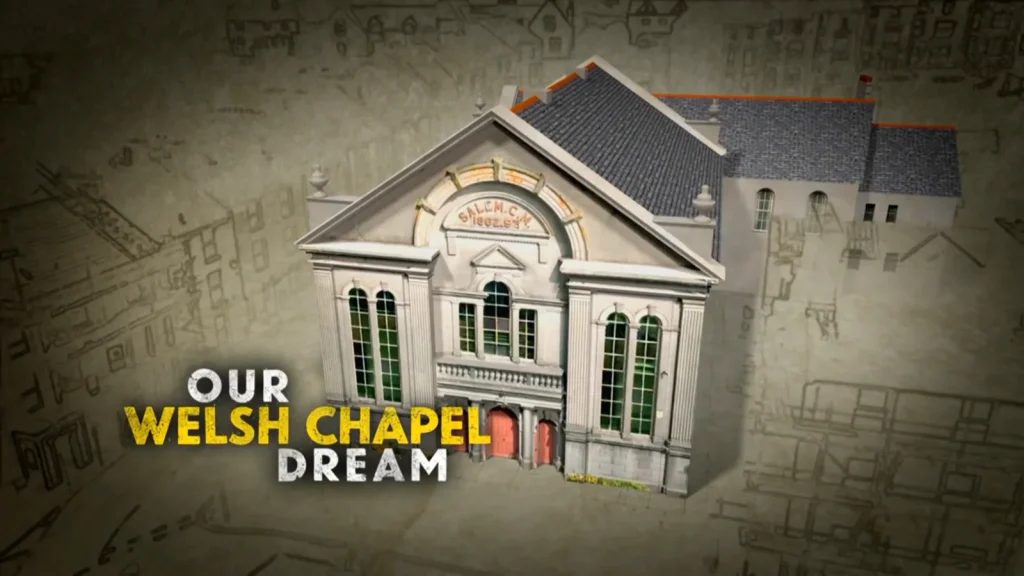
Our Welsh Chapel Dream episode 8: In the heart of Northwest Wales, a land woven with myth and legend, Keith and Marj continue their extraordinary journey. They are breathing new life into a magnificent 19th-century chapel, Capel Salem. This Grade 2 listed building, along with its adjoining Sunday school, has captured their hearts and savings. Consequently, after 18 long months, their ambitious dream is finally taking tangible shape. They are transforming the downstairs of the Sunday school into their unique forever home, a space that reflects their creativity and spirit.
Their nights spent in temporary container accommodation, however, are nearing an end. Although listening to Keith snore might have kept Marj awake, the real anticipation lies elsewhere. Indeed, the final piece of their living quarters puzzle is about to fall into place: the master bedroom. This crucial space, once the chapel’s vestry and the minister’s office, holds the promise of real comfort and a sense of permanence. To achieve this, a dividing wall must come down, uniting the two rooms into one harmonious whole.
Keith and Marj envision a bedroom unlike any they have had before. For the first time in a decade, they will finally have space. Imagine the simple luxury of getting out of bed on your own side, or walking around the bed to make it. It sounds simple, yet for them, it feels like a dream realised. Furthermore, their storage solutions promise to be equally unconventional. Instead of traditional wardrobes, they plan freestanding clothes rails, offering flexibility and a touch of boutique chic. Additionally, a beautiful, glass-fronted haberdashery counter will take pride of place, though its placement requires careful thought to ensure accessibility.
Local builder Hill eagerly tackles the demolition, clearly enjoying the satisfying task of knocking down the dividing wall. As the dust settles, an unexpected discussion arises. Initially, Keith and Marj had planned a new wall to create a corridor. Yet, seeing the space open up reveals a lovely natural curve where a door could lead directly into the parlour bathroom. Consequently, they embrace the change, deciding against closing the space up. Marge aptly notes, “I just love the idea that the building’s revealing itself”. This bedroom truly completes the ground floor transformation, joining the snug, parlour bathroom, shower room, and the upstairs kitchen.
The room’s design will feature a restful pink on the walls, thoughtfully chosen to complement the adjacent shower room and unify the spaces. More importantly, it will become a sanctuary filled with their unique treasures and cherished memories, collected over a lifetime together. As the wall comes down, another piece of the chapel’s history emerges – an old safe hidden within the minister’s office. This discovery thrills them; the safe likely held the chapel’s Sunday collections, playing a quiet but vital role in its past. It’s a brilliant, tangible link to the building’s heritage.

Scan smarter. Create faster. Free.
Download QR & Barcode Studio — Create and scan unlimited QR codes & barcodes.
No paywalls. No limits. 100% Free.

Amidst the construction, the poignant task of unpacking familiar belongings begins. One van holds many of Marj’s childhood memories, including items from her late father Nigel’s home. Unpacking a dresser promised to her years ago brings a mix of joy and sorrow. Marj reflects on the bittersweet process: “We’re kind of deconstructing my parents’ life while we try and construct our own”. Holding her father’s banjo, which he never learned to play, she considers learning it herself, keeping his memory alive within these historic walls. It is, as Keith notes, the circle of life.
To connect the new bedroom seamlessly with the Victorian parlour bathroom, builder Hill carefully removes an old window, creating a new doorway. Meanwhile, Keith and Marj turn their attention outdoors. They envision a wild meadow on the car park bank. As a first step, they plant a hydrangea cutting from Marj’s late parents’ garden, a living symbol of growth and remembrance. Planting it on the Welsh slope proves a slightly comical challenge, prompting thoughts of relaxing with Mai Tais – eventually. Marj tearfully reflects on her parents, imagining their mixed reactions to this grand, perhaps slightly “ridiculous,” undertaking.
Back inside, the rediscovered safe becomes a focal point. Though left unloved for 14 years before Keith and Marj arrived, its ornate details and robust construction speak volumes. Made by the Midland Safe Company of Birmingham, it’s a beautiful piece of late 19th-century craftsmanship. While they didn’t get running water initially, they did get this remarkable safe, a free fixture brimming with history. Mindful of its significance, they plan only to clean it, preserving its authentic character.
Simultaneously, the chapel’s exterior is receiving much-needed attention. Restoring the 39 windows, with their 198 panes of glass, is a painstaking job for builder Huw. He carefully replaces the glass while preserving the original frames. Soon, the fascias and guttering will also be repaired, banishing the tufts of grass that once sprouted from the roof. This visible progress hasn’t gone unnoticed by the Pwllheli residents, who are curious and supportive of the chapel’s revival.
Keith and Marj remain committed to preserving original features whenever possible. Although the Sunday School’s parquet flooring succumbed to dry rot, they plan to repurpose the salvaged wood for an outdoor seating area, letting it weather naturally. Keith can clearly visualize the finished project, a vision that excites him despite the challenges. For Marj, home is simply wherever Keith is, their partnership grounding the entire endeavour. Keith wholeheartedly agrees, calling meeting Marj the best thing he’s ever done, with restoring the chapel a close second. This place allows them to truly express themselves, a freedom they cherish.
Their shared love story brought them here, to Pwllheli and Capel Salem, the place they intend to put down permanent roots. To honour their Welsh future, they seek a special decorative piece for the bedroom. Therefore, they travel south to Tenby in Pembrokeshire, visiting renowned love spoon carvers, father and son Thomas and Dai. The tradition of carving intricate wooden spoons as tokens of affection dates back centuries, with the oldest known example from 1667. Thomas himself has carved a commemorative spoon every year since 1969, the first marking his proposal to his now-wife.
Love spoons tell stories through symbols unique to the lovers. Thomas explains the symbolism on his own wedding spoon, representing the “rough and smooth of married life”. He shares a favourite saying: being with the right person makes good times twice as good and bad times only half as bad. Inspired, Keith and Marj design their own spoon. They decide on symbols representing their journey: two pigeons (a recurring chapel motif), an anchor (for their love of the sea), a thistle (for Keith’s Scottish roots), and a leek (for their Welsh home).
Dai sketches a template, combining the elements beautifully – the anchor intertwined with the thistle, resting on a lucky horseshoe. After gluing the template to oak, Keith and Marj are invited to make the first ceremonial cuts. Keith carefully finds the cutting angle, while Marj discovers she’s definitely a “mallet girl,” tapping the chisel with satisfying precision. Dai estimates the intricate carving will take him 15 to 20 hours to complete. Leaving their spoon in his capable hands, they return to Pwllheli.
Back at Capel Salem, progress continues apace. Builder Huw works on the roof, stripping slates to install solar panels, boosting the chapel’s sustainability despite his dislike of heights. Inside, the bedroom walls receive their final coat of plaster, creating the perfect canvas for that soft pink hue. Meanwhile, in their Whitstable studio, Marj lovingly restores a vintage mirror destined for the bedroom.
A section of the gesso frame is missing, so she cleverly decides to cover the area with inexpensive metal leaf, embracing the mirror’s aged character rather than striving for perfection. Applying the size (PVA glue solution) and then the delicate gold sheets is a satisfying process. Marj muses on the history held within old objects, especially mirrors that have reflected countless faces over time.
Our Welsh Chapel Dream episode 8
Nearby, Keith undertakes his own annual tradition: crafting the trophy for ‘The Great Pottery Throwdown’. He makes the bottle kiln-shaped base, while his colleague Rich creates the top. This year, however, marks the last time he’ll make it in Whitstable. Next year, the trophy will be born in Wales, in his new pottery studio. He holds onto the visualization of that future moment – enjoying tea by the door after a productive throwing session – as his motivating goal.
Finally, in Pwllheli, the bedroom nears completion. The walls glow with fresh pink paint. Keith assembles the freestanding clothes rails, a practical and stylish alternative to bulky cupboards. He playfully imagines presenting Marj with her clothing options each morning. They’ve kept a section of the exposed steel beam where the dividing wall once stood, a tangible reminder of the room’s transformation. Next, the magnificent haberdashery counter arrives. This heavy, fragile piece, reportedly from a 1940s Regent Street gentleman’s outfitters, requires careful maneuvering with handyman Robert’s help. Getting such unique items into the chapel is often a challenge in itself.
Outside, the restored window frames are painted a dramatic black. Inspired by their container living, the Sunday School’s gable end now sports a striking black and yellow scheme. While the scaffolding is up, they seize the chance to touch up paint and clean the new windows, a task always requiring a ladder due to the building’s sheer scale. Keith marvels, “It’s starting to become the thing that we’ve had in our heads for three years”. Even simple routines like brushing teeth outdoors mark the transition phase before full domesticity.
The final push involves bringing in furnishings. Quirky additions, like an ice cream cone sign from a former Whitstable shop, find their place. The haberdashery counter, now positioned, reveals charming details like its original brass measure and the ghosts of old labels on the drawers. Keith suggests making ceramic labels, adding another personal touch. Realising how many long-desired items they now possess brings Marj immense joy. Then comes the centerpiece: the bed. Moving their French-style bed from the container heralds a new era. Keith takes a moment to simply walk around it – a novelty they deeply appreciate.
With the bed in place, clothes hung on rails, and Marj’s gilded mirror mounted, the room feels complete. Just then, a special delivery arrives: their finished Welsh love spoon. It’s beautiful, perfectly capturing their story in carved wood. The symbols – pigeons, anchor, thistle, leek – are all there, a tangible representation of their journey and love. They find the perfect spot for it on a glass shelf within the haberdashery unit.
Looking around their finished bedroom, Keith and Marj reflect on the transformation. The formerly dark, spooky vestry and office are now a spacious, light-filled master suite. The exposed steel beam serves as a proud reminder of the removed wall and the building’s history. They acknowledge the strong possibility that no one has ever slept in this part of the building before, adding another layer of significance. A playful moment sees Keith almost break the bed with an enthusiastic leap, a testament to their newfound comfort.
The room perfectly blends their personalities – quirky, colourful, and full of history. Having an ice cream cone on the wall where chapel funds were once kept feels like a fitting symbol of the building’s necessary evolution. They’ve created distinct spaces throughout the Sunday school, defined by bold colour choices – the red kitchen, the blue room, the pink room, the black bathroom. Marj embraces their non-conformist approach, stating, “You sometimes forget as an adult, you can do whatever you want”. They stand confidently by their choices, celebrating individuality.
This milestone marks the completion of the first major stage: making the Sunday School habitable. The exterior boasts new solar panels and restored windows, securing a sustainable future for the 19th-century structure. The transformed gable end is a vibrant testament to their vision. Yet, as Keith and Marge know, this is just the beginning. Next steps involve tackling Keith’s pottery studio and turning the main chapel hall into a creative hub. Although there’s still much to do, they’ll approach it as they always have: breaking it down into manageable chunks, room by room. Now truly living in the building, they face the next chapter with excitement and just a touch of healthy anxiety.
FAQ Our Welsh Chapel Dream episode 8
Q: What are the main challenges when converting a historic chapel into a home?
A: Converting a historic chapel involves numerous challenges including structural repairs, addressing issues like dry rot, and navigating preservation requirements for listed buildings. Additionally, you’ll face the complex task of creating modern living spaces while preserving original architectural features. Furthermore, the scale of such buildings often presents logistical difficulties when moving furniture and fixtures into place. Most importantly, balancing modern comfort needs with historical integrity requires thoughtful planning and sometimes creative compromise.
Q: How can you honor the history of a chapel during conversion?
A: Honoring a chapel’s history starts with preserving original features whenever possible, such as window frames, decorative elements, and unique fixtures like historical safes. Moreover, repurposing original materials that cannot be kept in place—like using damaged parquet flooring for outdoor seating—maintains a connection to the building’s past. You can also incorporate symbolic elements relevant to the building’s heritage, similar to how Keith and Marj displayed chapel motifs in their decor. Above all, researching and documenting the building’s history creates a meaningful narrative that connects your new home to its community roots.
Q: What sustainable elements can be incorporated into chapel conversion projects?
A: Chapel conversions offer excellent opportunities for sustainability through measures like installing solar panels on expansive roof areas. Additionally, restoring rather than replacing original windows improves energy efficiency while preserving character. Furthermore, repurposing materials from necessary demolition reduces waste and adds authentic character to new spaces. Rainwater harvesting systems can also be incorporated, taking advantage of large roof areas. Consequently, these historic buildings can be transformed into surprisingly eco-friendly homes that combine heritage character with modern sustainability practices.
Q: How should you approach interior design in a converted chapel space?
A: Interior design in converted chapels works best when embracing the building’s unique character rather than fighting it. For instance, using bold color choices can help define different functional areas within large, open spaces. Furthermore, incorporating furniture with history and character complements the building’s heritage, while freestanding pieces often work better than built-ins for flexibility in unusual spaces. In fact, unexpected decorative elements—like Keith and Marj’s ice cream cone sign near the historic safe—can create delightful juxtapositions that celebrate both past and present. Most importantly, allow your personal style to shine through rather than adhering strictly to conventional design rules.
Q: What professional help is essential for chapel conversion projects?
A: Chapel conversion projects typically require a team of professionals, starting with architects experienced in heritage buildings who understand structure and preservation requirements. Additionally, specialized builders familiar with historic construction methods are essential for addressing unique challenges like window restoration and roof repairs. Furthermore, depending on the building’s listed status, conservation officers or heritage consultants may need to approve major changes. Skilled craftspeople, such as stained glass restorers or stonemasons, might also be necessary for specialized restoration work. Consequently, budgeting for this expertise is crucial to avoiding costly mistakes and ensuring the building’s longevity.
Q: How can you manage the scale of a chapel conversion project without feeling overwhelmed?
A: Managing a chapel conversion becomes more feasible when breaking the project into clearly defined phases, such as creating a habitable living space first before tackling additional areas. Moreover, establishing priorities based on structural necessity and creating a realistic timeline prevents burnout. Additionally, celebrating small milestones—like completing a bedroom or installing new windows—provides motivation during the lengthy process. In fact, some chapel converters find temporary accommodations on-site (like Keith and Marj’s container) helpful for monitoring progress while maintaining some separation from construction chaos. Above all, maintaining a clear vision of the end result helps sustain momentum through inevitable challenges.
Q: What unique storage solutions work well in converted chapel spaces?
A: Converted chapels often benefit from creative storage solutions that complement their unique architecture. For example, freestanding furniture like clothes rails and vintage shop counters offers flexibility while adding character, unlike built-in wardrobes that might seem at odds with the space. Additionally, repurposing architectural elements—such as using pulpits for display or pew seating with storage beneath—honors the building’s history while adding functionality. Open shelving can highlight high ceilings while providing practical storage. Furthermore, unusual vintage pieces like haberdashery counters combine display and storage functions beautifully. Most importantly, visible storage solutions can become decorative elements that enhance the conversion’s distinctive character.
Q: How do local communities typically respond to chapel conversion projects?
A: Local communities often show genuine interest in chapel conversion projects, especially when the building has stood empty for years. Initially, curiosity may be the primary reaction as residents observe exterior changes taking shape. Furthermore, preserving visible historic elements typically earns community approval, as residents appreciate efforts to maintain the local architectural heritage. In fact, many converters find that locals share valuable historical information about the building once they see preservation efforts underway. Consequently, taking time to engage with neighbors and honor the building’s community significance can generate goodwill and support for your project.
Q: What unexpected discoveries commonly occur during chapel conversions?
A: Chapel conversions frequently yield surprising discoveries, from hidden architectural features revealed during demolition to historical artifacts like Keith and Marj’s chapel safe. Additionally, removing walls or ceilings often uncovers original details that had been concealed by previous modifications. Furthermore, unexpected structural issues can emerge, requiring adaptive solutions rather than rigid adherence to initial plans. Sometimes, the building itself suggests better design approaches as the space opens up, leading to improvements on original concepts. Above all, successful chapel converters maintain flexibility and view these discoveries as opportunities to enhance their connection with the building’s history.
Q: How can personal elements be incorporated into a chapel conversion project?
A: Personal elements add soul to chapel conversion projects through meaningful touches like Keith and Marj’s Welsh love spoon that symbolized their journey. Additionally, incorporating family heirlooms and treasured collections creates continuity between your past and your new home. Furthermore, plants with significance—such as cuttings from family gardens—can establish emotional connections to the landscape. Creative projects that reflect your skills, like Keith’s planned pottery studio, transform the space into a true expression of your passions. Most importantly, these personal elements transform historic buildings from impressive architectural specimens into authentic homes that tell your unique story alongside the chapel’s heritage.