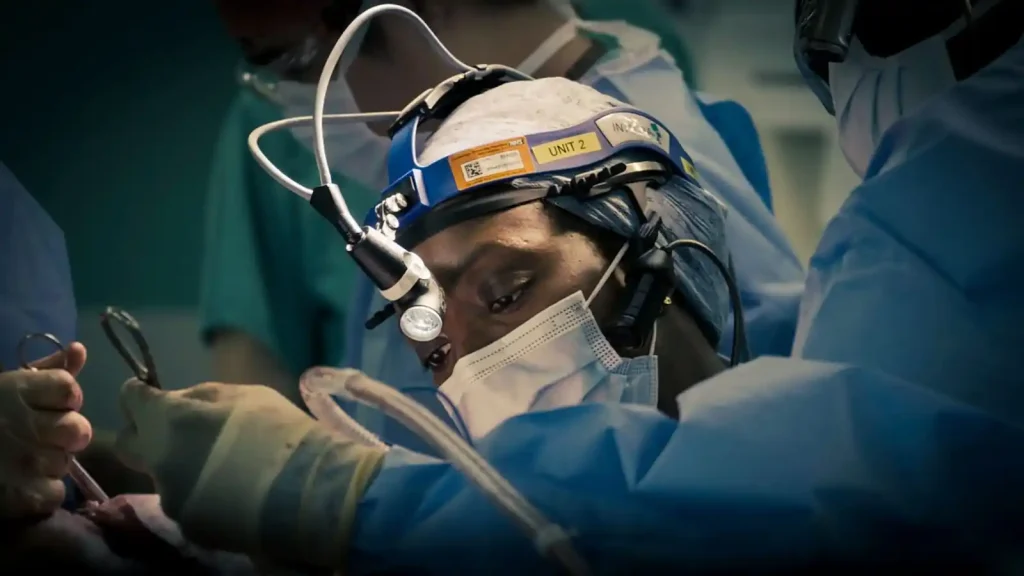
Surgeons: At the Edge of Life – Episode 11: The Finest Margins
In the pristine corridors of NHS Lothian’s Royal Infirmary, the department of clinical neurosciences stands as a sanctuary where life-altering decisions unfold daily. Here, skilled surgeons navigate the delicate landscape of the human brain, where the difference between triumph and tragedy lies within mere millimeters.
The air in the operating theater carries a particular weight on this day. Consultant neurosurgeon Imran Liaquat prepares for a procedure that exemplifies the precarious nature of his profession. Alongside his colleague, consultant Drahoslav Sokol, he faces the formidable challenge of removing a recurring brain tumor from their young patient, 25-year-old Weronika.
This is not their first encounter with Weronika’s condition. Previous attempts have fallen short of complete tumor removal, leaving behind microscopic remnants that refused to surrender to medical intervention. Therefore, today’s operation represents a critical juncture—their final opportunity to achieve complete excision and significantly enhance Weronika’s prospects for survival.
The gravity of the situation is palpable as the surgical team methodically prepares. Every instrument, every movement, every decision must be executed with unwavering precision. The brain, unlike other organs, offers little forgiveness for error. Its intricate network of neurons, each responsible for essential functions, demands nothing less than perfection from those who dare to intervene.

Scan smarter. Create faster. Free.
Download QR & Barcode Studio — Create and scan unlimited QR codes & barcodes.
No paywalls. No limits. 100% Free.

Imran and Drahoslav work in harmonious synchronicity, their years of specialized training evident in their deliberate actions. They navigate through brain tissue with the delicacy of artists, distinguishing between healthy cells and malignant invaders that threaten Weronika’s future. The boundary between these territories represents the finest margin—a line invisible to the untrained eye but unmistakable to these seasoned specialists.
Meanwhile, in another wing of the same institution, a different kind of precision work unfolds. The cardiothoracic unit houses its own brand of medical marvels, where consultant cardiothoracic surgeon Vipin Zamvar prepares for an exceptional procedure.
His patient, 71-year-old Sandy from the picturesque town of Aberfoyle, suffers from severe coronary artery disease. The condition has progressively restricted blood flow to his heart, transforming simple activities into exhausting endeavors. Today, however, offers a beacon of hope through an unconventional approach—an “off pump” coronary artery bypass.
This rare technique presents its own set of challenges. Unlike standard bypass procedures, the off-pump approach requires Vipin to operate on a beating heart rather than one temporarily stilled by a heart-lung machine. Furthermore, this method demands exceptional manual dexterity and spatial awareness, as the surgeon must compensate for the heart’s natural movements while performing intricate vascular connections.
Sandy’s case highlights the evolving nature of surgical innovation. The off-pump technique potentially offers significant advantages: reduced risk of certain complications, shorter recovery time, and decreased trauma to the body. Nevertheless, the procedure walks its own tightrope of precision, where success and failure remain separated by the thinnest of margins.
As both operations progress simultaneously within different departments, they tell a unified story of modern medical intervention. These procedures represent the culmination of decades of scientific advancement, countless hours of training, and the unwavering dedication of healthcare professionals who routinely venture into territories where most would fear to tread.
For Weronika, the neurosurgical intervention represents more than just tumor removal—it embodies hope for a future that extends beyond the shadow of recurring illness. At 25, she stands at the threshold of life’s most promising chapter, her aspirations temporarily suspended by medical necessity. The skilled hands of Imran and Drahoslav work diligently to restore not just her neurological function, but the trajectory of her interrupted dreams.
Similarly, Sandy’s procedure carries implications that extend far beyond the operating room. His improved cardiac function could mean reconnection with simple joys: playing with grandchildren without fatigue, walking through Aberfoyle’s scenic landscapes, or simply experiencing daily life unburdened by the constant reminder of physical limitation.
These parallel journeys—Weronika’s neurological battle and Sandy’s cardiac challenge—illustrate the profound impact of surgical intervention. Moreover, they highlight the remarkable privilege and responsibility bestowed upon those who practice at medicine’s most demanding frontiers.
The surgeons featured in this episode embody the unique combination of scientific knowledge, technical skill, and human compassion that defines their profession. They operate not merely on organs but on lives, families, and futures. Each incision, each suture, each decision carries consequences that ripple far beyond the confines of the operating theater.
As the procedures conclude, the surgeons step back from their work—exhausted yet vigilant. The outcomes remain uncertain, as healing follows its own timeline and pathway. Nevertheless, these medical professionals have offered their patients something beyond physical intervention: they have provided the opportunity for renewed hope.
“Surgeons: At the Edge of Life” captures these dramatic moments where science, skill, and humanity converge. The episode reminds viewers that behind the sterile environments and technical terminology lie stories of remarkable courage—both from those who place their lives in surgical hands and from those who accept the profound responsibility of holding the scalpel.
The Delicate Dance Between Life and Death: Where Skill Meets Hope
In the realm of surgical excellence, few specialties demand the precision and courage exemplified in this episode of “Surgeons: At the Edge of Life.” The parallel journeys of Weronika and Sandy illuminate the extraordinary intersection of medical science and human resilience. Indeed, these operations represent not merely technical procedures but profound human stories unfolding in real time.
The neurosurgical team’s determination to eliminate Weronika’s recurring tumor reflects the unwavering commitment that defines modern medicine. Meanwhile, Vipin’s innovative approach to Sandy’s cardiac condition demonstrates how surgical techniques continue to evolve, offering new possibilities for patients previously facing limited options.
What emerges most vividly from these narratives, however, is the remarkable balance surgeons must maintain. They operate within the finest of margins, where millimeters determine outcomes and split-second decisions carry lifelong consequences. Moreover, they must simultaneously embrace both scientific detachment and profound empathy—a challenging duality few professions require.
For patients like Weronika and Sandy, these operations represent watersheds in their life journeys. Beyond the immediate medical objectives, these interventions offer something infinitely more valuable: the restoration of possibility and the rekindling of hope for futures once threatened.
The technological marvels of modern surgery, therefore, remain secondary to the human element at its core. Behind every successful procedure stands a convergence of dedication, knowledge, and compassion that transforms technical expertise into healing artistry.
As viewers witness these dramatic medical encounters, they glimpse a world where ordinary humans perform extraordinary feats daily. Furthermore, they’re reminded that beneath the surgical gowns and behind the masked faces work individuals who have dedicated their lives to standing at the precarious edge between life and death.
In this delicate space, where the finest margins separate tragedy from triumph, “Surgeons: At the Edge of Life” captures the essence of what makes modern medicine both a scientific discipline and a deeply human endeavor. Ultimately, these surgical narratives remind us that in our most vulnerable moments, we place our trust in those rare individuals willing to navigate the narrowest pathways between despair and possibility.
FAQ Surgeons: At the Edge of Life episode 11
Q: What medical conditions are addressed in Episode 11 of Surgeons: At the Edge of Life?
A: Episode 11 focuses on two critical medical conditions. Firstly, it follows the case of 25-year-old Weronika, who has a recurring brain tumor requiring complex neurosurgery. Additionally, the episode documents 71-year-old Sandy from Aberfoyle, who suffers from severe coronary artery disease necessitating an innovative “off pump” coronary bypass procedure. Both cases illustrate the exceptional precision required in modern surgical interventions.
Q: Who are the main surgeons featured in this episode?
A: The episode highlights three primary surgical specialists. Consultant neurosurgeons Imran Liaquat and Drahoslav Sokol collaborate on Weronika’s complex brain tumor removal. Meanwhile, consultant cardiothoracic surgeon Vipin Zamvar performs the rare “off pump” heart procedure on Sandy. These highly skilled professionals work at NHS Lothian’s Royal Infirmary, where they regularly tackle some of medicine’s most challenging cases.
Q: Why is Weronika’s brain surgery particularly challenging?
A: Weronika’s case is especially challenging because previous surgical attempts failed to completely remove her brain tumor. Consequently, this operation represents the final opportunity to achieve complete excision of the recurring tumor. Furthermore, brain surgery inherently demands extraordinary precision since even millimeter-scale errors can cause permanent neurological damage. The surgeons must navigate through healthy brain tissue to access and remove malignant cells without disrupting essential neural functions.
Q: What makes the “off pump” coronary bypass procedure unusual?
A: The “off pump” coronary bypass procedure is exceptional because it requires the surgeon to operate on a still-beating heart. In contrast, standard bypass surgeries typically use a heart-lung machine to temporarily stop cardiac activity. Therefore, this technique demands remarkable manual dexterity and spatial awareness since the surgeon must compensate for the heart’s natural movements while performing precise vascular connections. Despite these challenges, the approach potentially offers significant advantages including reduced complications, faster recovery times, and decreased physical trauma.
Q: How does the episode illustrate the concept of “the finest margins”?
A: The episode’s title “The Finest Margins” refers to the incredibly small difference between surgical success and failure. For instance, in neurosurgery, just millimeters separate vital brain structures from areas that can be safely manipulated. Similarly, in cardiac surgery, the precise placement of bypass grafts determines their functionality. Throughout the documentary, viewers witness how surgeons work within these narrow parameters, where the slightest deviation could dramatically alter patient outcomes, illustrating medicine’s most challenging balancing act.
Q: What does the episode reveal about the emotional aspects of surgical care?
A: Beyond technical excellence, the episode reveals the profound emotional dimensions of surgical care. The surgeons demonstrate remarkable empathy while maintaining necessary professional detachment. Moreover, we see how these operations represent watersheds in patients’ lives, offering hope beyond immediate medical intervention. For young Weronika, surgery promises to restore her interrupted dreams, while for Sandy, it may reconnect him with simple joys like playing with grandchildren without exhaustion. Consequently, the narrative illuminates how surgeons must balance technical precision with deep human compassion.
Q: Where is the medical facility featured in this episode located?
A: The medical procedures take place at NHS Lothian’s Royal Infirmary in Scotland. Specifically, Weronika’s neurosurgery occurs in the department of clinical neurosciences, which is portrayed as a sanctuary for life-altering medical decisions. Meanwhile, Sandy’s cardiac procedure is performed in the hospital’s dedicated cardiothoracic unit. The Royal Infirmary serves as a major Scottish healthcare center where specialized teams routinely perform advanced surgical interventions requiring extraordinary skill and precision.
Q: How does the episode portray the relationship between technology and human skill in surgery?
A: The episode illustrates how modern surgery represents a delicate balance between technological advancement and irreplaceable human expertise. While sophisticated medical technologies enable increasingly complex interventions, the narrative emphasizes that surgical success ultimately depends on the surgeons’ judgment, dexterity, and experience. Indeed, the documentary suggests that behind every successful procedure stands a convergence of dedication, knowledge, and compassion that transforms technical expertise into healing artistry. Therefore, technology serves the surgeon rather than replacing human skill.
Q: What broader themes about medical practice does the episode explore?
A: Beyond individual cases, the episode explores several profound themes about modern medicine. Firstly, it examines the extraordinary responsibility shouldered by surgeons who regularly make life-altering decisions. Additionally, it portrays how medical professionals balance scientific detachment with deep empathy—a challenging duality uncommon in other professions. Furthermore, the narrative highlights how surgical interventions impact not just physical health but entire life trajectories. Ultimately, the documentary reveals medicine as both a scientific discipline and a deeply human endeavor.
Q: How does the episode conclude regarding patient outcomes?
A: The episode concludes with surgeons completing their procedures but acknowledges that outcomes remain uncertain as healing follows its own timeline. Nevertheless, the doctors have provided something beyond physical intervention: the opportunity for renewed hope. Rather than focusing solely on immediate medical results, the conclusion emphasizes how these surgeons have offered their patients possible futures that were previously threatened. This perspective frames surgical intervention as not merely a technical process but as a profound restoration of possibility in patients’ lives.