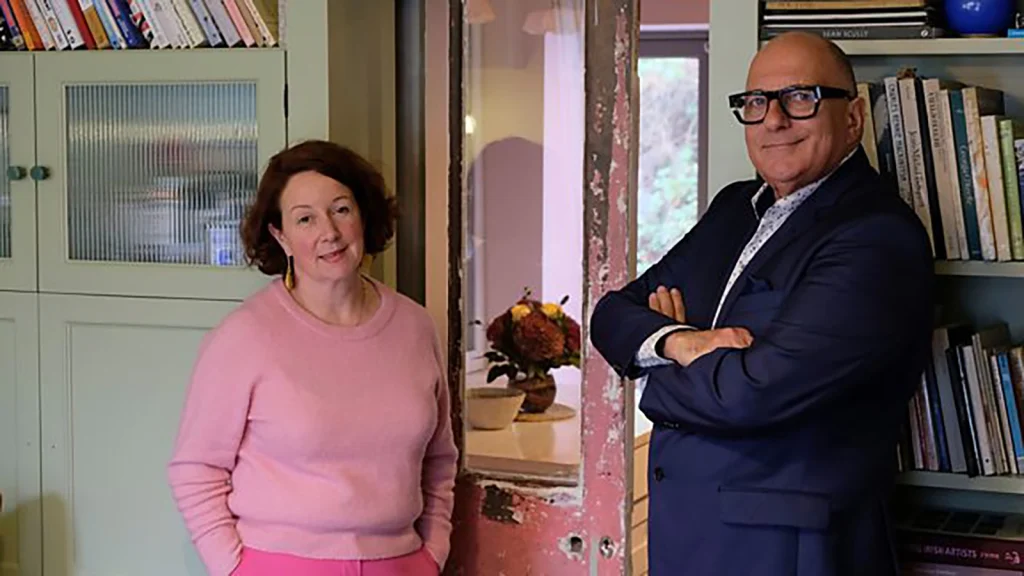
In The Great House Revival episode 3 2025, a journey into the woods of County Roscommon reveals a remarkable architectural transformation. On the banks of Lough Key, Dublin-based architects Fiona Brugha and Paddy Dunne took on the quest to revive a ruined 19th-century cow byre, aiming to convert its stark, crumbling walls into a modern family home. This project showcases how our past, embodied in old buildings, can offer solid solutions for contemporary housing needs. Their story is one of battling the immense challenges of rebuilding a ruin to create a home fit for the future.
The setting for this ambitious undertaking is the historic Rockingham Estate, a place of fairy-tale forests and ghostly ruins. Fiona and Paddy, along with their children Mary and Grace, embarked on a radical adventure, relocating from Dublin to this unusual setting. They were captivated by the curious building, a structure once described as a high-quality milking parlour for very special cows, and saw the potential within its four crumbling walls. The project represents a significant trend in sustainable living, where architectural restoration breathes new life into forgotten structures.
The initial state of the cowhouse presented a formidable challenge. When Fiona and Paddy purchased the property in late 2018, it was on its last legs. A portion of the roof had already collapsed during the buying process, and trees were growing right up against its stone walls. The focus of The Great House Revival episode 3 2025 is their meticulous process of turning this derelict structure into a functional, beautiful, and warm home. They envisioned a design that celebrated the building’s most prominent feature: its 11 elegant stone arches.
The couple, who are both architects, acquired the ruin and its surrounding acre of forest for under €100,000. Their personal connection to the area, with Paddy having previously worked in the adjacent forest park, deepened their commitment to the project. The building is a protected structure, which added another layer of complexity to their restoration efforts. Before work could truly begin, they had to fight back the overgrowth, remove the ruined roof, and repair two arches that had been robbed of their stone and filled with concrete blocks years prior.
Their initial architectural plans were both ambitious and respectful of the original structure. The vision for the 130-square-metre building included glazing the 11 arches to create large, metal-framed windows and doors. Internally, the layout proposed a corridor running along the arches, leading to three bedrooms, a family bathroom, and an open-plan living, dining, and kitchen area. This open-plan space would open out to a courtyard, making it an integral part of the home. A separate prefabricated cabin would serve as a home office.

Scan smarter. Create faster. Free.
Download QR & Barcode Studio — Create and scan unlimited QR codes & barcodes.
No paywalls. No limits. 100% Free.

With a starting budget of approximately €350,000, they planned to install underfloor heating powered by an air-to-water heat pump. However, from the outset, a key debate emerged regarding insulation. While the architects wanted to preserve the exposed interior stone walls, there were concerns that without insulation, the home would be cold and damp, causing the heating system to work overtime and negating any potential savings. This tension between aesthetic purity and practical comfort became a recurring theme in their cowhouse restoration.
The Great House Revival episode 3 2025
Navigating Design and Delays in The Great House Revival episode 3 2025
The project’s complexity quickly led to significant delays. The new pitched roof, a hybrid of steel and timber, was designed to feature a continuous rooflight running the entire length of the building to combat the lack of light in the woods. Although the steel for this new roof was scheduled to arrive in November 2022, three months passed with no delivery.
The delay stemmed from the building itself; what appeared to be a perfectly rectangular structure was, in fact, full of discrepancies. After the old roof came off, new measurements revealed that the building was not symmetrical, which required a lengthy process of recalculation to ensure the new steel frame would align properly with the old stone walls and gutters.
This delay left the roofless walls exposed to the elements for months, which took a significant toll. The internal face of the stone walls, never intended to be exposed to weather, began to degrade. Timber lintels, already weakened by woodworm and rot, started to fail, causing the stone above them to come loose. Paddy had to perform emergency repairs, carefully piecing together stones from the floor to shore up weak points in the walls. They planned for a stonemason to conduct more thorough repairs and repoint all the mortar joints once the new roof was on and the interior was dry.
The intricate nature of the architectural restoration meant that Fiona and Paddy were deeply involved in every detail, from the design of their own ventilation system to the precise specifications for lead flashing. While their passion for perfection was admirable, it was also time-consuming and costly. The initial budget estimate of €350,000 faced pressure from inflation, but the availability of heritage grants proved to be a “game-changer.” These grants helped to offset the rising costs, allowing them to proceed with their original vision. The couple also moved their architectural practice into the prefabricated cabin on-site, enabling them to oversee the build while continuing their paid work.
A Vision for Light and History at the Rockingham Estate
A central element of Fiona and Paddy’s design was the quest to bring the surrounding forest into the house. This was most dramatically realised through their bespoke rooflight. Rejecting standard small windows, they designed a 23-metre-long, frameless triangular prism that would run along the roof’s apex. This feature was intended to mirror the forest surroundings and flood every room with dappled light. Its installation was a moment of high tension, with the heavy glass sections clearing the new steel frame by only a few millimetres. The successful placement of the stunning rooflight sealed the building from above and marked a major milestone.
Their connection to the site deepened with the discovery of its rich history. The Rockingham Estate itself was a grand 19th-century parkland, originally designed by Buckingham Palace architect John Nash for its wealthy Anglo-Irish owners. While their specific building does not appear in history books, they learned of a significant event that likely involved it. In 1918, during the run-up to the War of Independence, local Republican volunteers planned a raid on the main house to seize weapons. This act of revolution was made possible by key information provided by James Flanagan, a herdsman on the estate.
A statement from one of the men involved in the raid confirmed that Flanagan gave them details about the layout of the house. It is believed that Flanagan would have been intimately connected to the cowhouse, and evidence suggests a section of the building was divided off, possibly as a residence for the herder.
This connection was particularly poignant for Fiona, whose great-grandfathers were Republican leaders Cathal Brugha and Terence MacSwiney. The discovery that their future home was tied to a herdsman who played a role in the revolution added a profound new layer of meaning to the project. In a nod to this history, they decided to preserve the historic limewash found on a wall in what is now their main bedroom.
Another central tenet of their philosophy was the reuse of materials. A western red cedar, a tree ideal for construction timber, fell during a winter storm, perfectly timed for them to use it in the house. This fortuitous event allowed them to fulfill their wish of incorporating timber from the woods directly into their home, specifically for a feature on the ceiling and in the kitchen. They also painstakingly removed the original cobbled strip and other stones from the floor, sending them to local specialists to be cleaned before being reset over the new underfloor heating system.
The Meticulous Finish: Windows, Floors, and Budgeting in The Great House Revival episode 3 2025
The final stages of the build were defined by meticulous and challenging finishing work. The 11 stone arches, being hand-built, had no regular curves or straight lines, making the window installation exceptionally difficult. Instead of modern lasers, the joinery team had to go back to basics, creating individual cardboard templates for each of the 11 bespoke windows. This process led to a 14-week wait for the custom windows to be fabricated.
The installation itself was unforgiving, requiring a tight fit against the uneven stone and the use of a hairdryer to make the sealing tape expand in the cold, wet weather. The process suffered a major setback when an entire custom-cut glass pane shattered during installation, a disappointing delay for the project.
Despite the challenges, the final result is a triumph of design and perseverance. The 20-month project transformed the ruin into a home of unexpected elegance, with the glazed arches resembling an “Italianate colonnade.” Inside, the space is filled with light and warmth, defying earlier concerns that it might feel austere. The timber from the fallen cedar creates a stunning light feature on the ceiling and is used as a veneer on the kitchen doors, bringing a soft, natural element into the cathedral-like living space. The flooring is a unique highlight, featuring hand-selected fossils in the stone, including 380-million-year-old oysters chosen by their daughters.
Attention to detail is evident everywhere, from the decision to place the windows further out to express the arches internally, to the cleaning and powder-coating of the black electrical conduit. A glass wall and door were used to separate the living areas from the bedrooms, a clever solution that preserves the continuous view down the line of arches.
The final cost of the project was just over €400,000, in addition to the initial purchase price. While inflation pushed up the original budget, this was largely offset by heritage grants that became available during the build. The couple also made savvy savings by sourcing an ex-display kitchen and secondhand furniture, proving that high-end looks can be achieved through time and effort. The home, which started with no energy rating, is projected to achieve a C1, with the potential to improve further if they decide to add insulation to the walls in the future.
Where Ruins Become Radiance: A Blueprint for Living with the Past
What Fiona Brugha and Paddy Dunne achieved on the shores of Lough Key is more than a compelling episode of The Great House Revival—it’s a quiet revolution in how we imagine the future of housing. Their restoration of a crumbling 19th-century cowhouse is a reminder that buildings long forgotten can become the anchors of modern life, marrying heritage with innovation, and proving that architectural sustainability begins not with new materials, but with new mindsets.
At its heart, this project was a love letter to place—both in the physical and historical sense. From the challenges of hand-built arches to the precise installation of a 23-metre rooflight, Fiona and Paddy didn’t just preserve the structure—they listened to it. They allowed its imperfections to guide their design, treated every stone as a chapter of a story worth telling, and found purpose in salvaged timber and fossil-laden floors. It’s a masterclass in respectful restoration, but also in resilience: how a family, facing delays, decay, and budget strains, found strength in creativity and conviction.
More than just a design triumph, the Roscommon cowhouse is a symbol of what’s possible when past and present are allowed to coexist. Here, you have not only a beautifully lit home, but also a structure steeped in untold histories—from milking parlour to revolutionary hideaway. The project doesn’t erase that past; it reveals it, making the old walls sing again through thoughtful design choices like retaining the original limewash and showcasing the now-glazed arches as frames to the outside world.
What stands today is not just a home, but a philosophy. One that suggests sustainability isn’t always about sleek new builds or futuristic materials, but about seeing value where others see ruin. For anyone dreaming of restoring an old building—whether it’s a barn, chapel, or Victorian terrace—this project is both inspiration and instruction: start with respect, be ready for setbacks, and don’t be afraid to get your hands dirty.
So, the next time you pass a derelict stone shell on a backroad or stare at your own renovation blueprint with a mix of dread and hope, think of that forest cowhouse. Think of what it became—and what it preserved. Because sometimes, the best way forward isn’t to build from scratch, but to look back, listen deeply, and build again with love.
FAQ The Great House Revival episode 3 2025
Q: What is The Great House Revival episode 3 2025 about?
A: The Great House Revival episode 3 2025 follows architects Fiona Brugha and Paddy Dunne as they convert a ruined 19th-century cow byre in County Roscommon into a sustainable family home. Additionally, the episode highlights how forgotten buildings can be transformed into architectural landmarks that respect history while embracing modern needs.
Q: Where is the cowhouse restoration project located?
A: The project is located on the historic Rockingham Estate beside Lough Key in County Roscommon. Moreover, the site is rich in natural beauty and connected to Ireland’s revolutionary history, adding emotional and cultural depth to the renovation.
Q: What architectural features define the restored building?
A: Key features include 11 hand-built stone arches that were glazed with metal-framed windows, a 23-metre frameless rooflight for natural illumination, and restored limewash walls that preserve historical texture. Consequently, the home balances elegance and authenticity.
Q: What were the biggest challenges during the renovation?
A: The team faced collapsing roof structures, delayed material deliveries, structural asymmetry, and the degradation of internal stonework due to exposure. Furthermore, custom window fittings for irregular arches added time and complexity.
Q: How did sustainability factor into the design?
A: Sustainability was central to the project. Reused materials included cobbled flooring and a storm-fallen red cedar tree. In addition, underfloor heating powered by an air-to-water heat pump helped lower the home’s environmental impact.
Q: What historical discoveries influenced the design?
A: The cowhouse may have housed James Flanagan, a herdsman who aided a 1918 Republican raid. This connection resonated with Fiona Brugha’s family legacy, prompting the couple to preserve historic limewash and respect the building’s revolutionary past.
Q: How was the family involved in the restoration process?
A: Fiona and Paddy lived and worked onsite, running their architectural practice from a prefab cabin during the build. Meanwhile, their daughters participated by helping select fossil-embedded stones for the final floor, deepening the family’s emotional connection.
Q: How did the couple manage rising construction costs?
A: Although the budget exceeded €400,000, they reduced expenses by sourcing an ex-display kitchen, using secondhand furniture, and securing heritage grants. As a result, they maintained high standards without compromising vision or financial feasibility.
Q: What was the purpose of the 23-metre rooflight?
A: Designed as a triangular prism, the 23-metre frameless rooflight mirrors the forest canopy and channels soft light throughout the house. Furthermore, it creates a dynamic visual connection to the woodland setting.
Q: What is the home’s projected energy performance rating?
A: Initially unrated, the restored home is expected to achieve a C1 energy rating. However, this could improve further with future wall insulation, balancing heritage preservation with thermal efficiency.