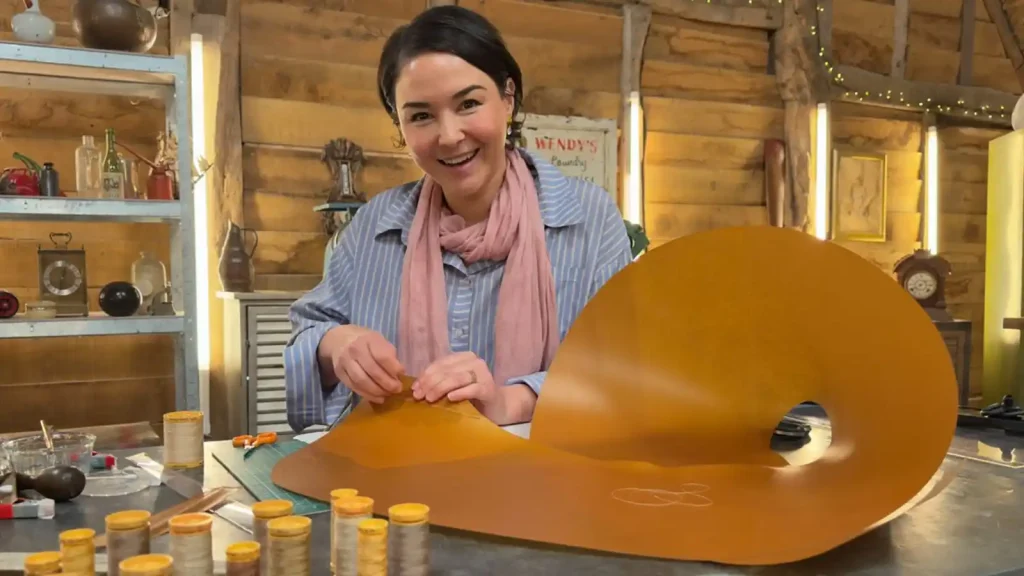
The Repair Shop 2026 Episode 12: Memories Restored, Stories Retold
Some objects carry more than sentimental value. They carry entire lives within them. In The Repair Shop 2026 episode 12, four remarkable visitors bring their most precious heirlooms to the barn. Each piece holds a story of love, loss, and the enduring power of human connection. Together, they remind us why repair and restoration matter so deeply.
First through the barn doors is John Wilson, travelling from London with a fragile but extraordinary lamp. At first glance, it looks like damaged antique glassware. But to John, it represents something far more precious — a friendship that shaped his life.
The lamp belonged to John’s close friend Brian, a vibrant, larger-than-life character who hosted lavish cocktail parties in his Soho flat during the 1980s. Brian designed his entire bijou apartment around this single lamp. It was the centrepiece of a world full of laughter, creativity, and connection. Those were heady, joyful times in London.
Then the AIDS epidemic arrived, casting a long shadow over an entire generation. Tragically, Brian was diagnosed as HIV-positive, and John stepped up without hesitation. He became Brian’s devoted carer and closest companion through the darkest of days. Brian passed away in the mid-1990s, leaving behind grief — and this fragile lamp as a final gift to John.

Scan smarter. Create faster. Free.
Download QR & Barcode Studio — Create and scan unlimited QR codes & barcodes.
No paywalls. No limits. 100% Free.

Over the decades, the lamp grew brittle. Cracks appeared, and pieces broke away. Now, upholsterer Sonnaz and paper conservator Angelina join forces to bring it back. They carefully source a compatible material to fill the missing sections and repair the fractures. Their craftsmanship honours not just the object itself, but the extraordinary friendship it represents. When the lamp finally switches on again, it glows with more than light.
Next into the barn is Chris Gosling from Surrey, carrying a pair of worn-out shoes that quietly witnessed one of sport’s greatest moments. To most people, they look like tired old plimsolls. To Chris, they are a profound piece of family heritage — and of British history.
Chris’s father George was a gifted runner. Remarkably, he served as a training partner for Roger Bannister during the pace-setting runs that led to the legendary breaking of the four-minute mile. George himself ran a mile in four minutes and twelve seconds — an outstanding achievement by any measure.
Yet George never spoke about it. He kept his athletic passion entirely secret, and Chris only discovered the truth after his father’s death. That revelation must have felt like finding a hidden chapter in a book you thought you already knew.
Wear and time have brought the shoes to a complete standstill. But Chris — now a multiple marathon runner himself — refuses to let that be the final word. He brings them to cobbler Dean, who carefully repairs the tears, restores the stitching, and buffs the leather back to its former glory. Thanks to Dean’s skill and craftsmanship, George’s shoes are ready to stand proud once more. Sometimes, the most important stories are the ones we almost never hear.
Sisters Sara and Simone travel together from Somerset, united by a shared story of inherited memory and quiet grief. They carry brooches that once belonged to their step-grandmother, Jean Bull — a woman they sadly never had the chance to meet.
In 1973, Jean joined a group of women from Somerset on a shopping day trip to Switzerland. The plane crashed, and Jean lost her life alongside 107 other victims. It was a tragedy that devastated communities across the region. All that remains of Jean for these sisters are two small brooches — a red one for Simone and a green one for Sara.
Despite never meeting Jean, they have worn these brooches with great pride. In fact, they wore them on a visit to Switzerland for the 50th anniversary of the crash — a deeply moving act of remembrance. However, when Sara returned home, an accident placed her brooch through the washing machine. The result was devastating: bent metal and missing gems.
Jewellery specialist Richard Talman takes on the delicate task of restoration. He works tirelessly to reshape the brooch and replace the lost stones, restoring its sparkle with painstaking care. When Richard finishes, Sara’s brooch shines just as brightly as her sister’s. These small pieces of costume jewellery now carry something immeasurable — a connection across time to a grandmother neither sister ever knew.
The Repair Shop 2026 episode 12
Finally, Michael Whitehead arrives from Lancashire with a reel-to-reel tape recorder that holds something irreplaceable inside it. His father Alan was a singer who performed in pubs and clubs across Greater Manchester. Alan used this very machine to record songs and memorise lyrics before his performances. It was the heartbeat of his musical life.
When Alan died, the music stopped. The recorder fell silent, and with it, the sound of a voice the family deeply missed. Michael hopes that electronics wizard Mark Stuckey can change that.
What Mark finds inside is daunting. Broken belts, a melted transformer, a faulty motor, and a damaged circuit board greet him — a major technical catastrophe. Nevertheless, Mark refuses to give up. He works through each problem methodically, driven by the knowledge of what success would mean to Michael.
Eventually, Mark pulls off something close to a miracle. The reel-to-reel recorder stirs back to life, and Alan’s voice fills the barn once more. For Michael, it is an emotional moment beyond words. The repair shop has given him back something no money could buy — the sound of his father singing again.
Each story in The Repair Shop 2026 episode 12 reminds us of something important. Objects are never just objects. They are vessels of memory, history, and family. Through expert restoration and extraordinary craftsmanship, the barn’s talented team breathes new life into the things we cherish most. And in doing so, they help us reconnect — with our loved ones, our heritage, and ourselves.
The Repair Shop 2026 episode 12
The Repair Shop 2026 episode 12 opens a window into four lives shaped by grief, secrecy, catastrophe, and love — each object arriving in the barn carrying a weight far greater than its physical form. In a series that has long understood the emotional architecture of the things people keep, this episode delivers some of its most resonant work, pairing technical challenges of genuine complexity with human stories that span decades, continents, and the quiet devastation of loss. The barn at Beamish becomes, once again, a place where the past is handled with uncommon care.
The objects brought through the doors this episode are not conventionally valuable. There is no gilded furniture, no porcelain of obvious provenance. Instead, what arrives is a lamp from a Soho flat that survived an epidemic, a pair of running shoes worn within seconds of a world record, a brooch washed by accident and bent out of shape after a journey to honour the dead, and a reel-to-reel recorder holding the unreleased songs of a man who performed across Greater Manchester’s pubs and clubs. Each object is, in its way, a document — a piece of physical evidence that certain people existed, loved, and were loved in return.
What The Repair Shop 2026 episode 12 captures so precisely is the way memory attaches itself to matter. The lamp is not a lamp; it is a portal to 1980s Soho. The shoes are not shoes; they are a father’s secret athletic life, kept from his own children for decades. The brooch is not simply broken jewellery; it is a point of connection to a woman who died in a Swiss mountainside in 1973. The recorder holds voices. These are the kinds of objects that cannot be replaced, only repaired, and the episode treats that distinction with absolute seriousness.
The craftspeople who receive them — upholsterer Sonnaz, paper conservator Angelina, cobbler Dean, jewellery restorer Richard Talman, and electronics specialist Mark Stuckey — face not only the technical demands of their respective disciplines but the moral weight of the work. To fail here is not merely to produce an unsatisfactory result; it is to leave someone without a piece of their history. That pressure is palpable throughout, and it shapes every decision made at every workbench.
The four stories in this episode also form a kind of collective statement about the recent past. The Aids epidemic, Roger Bannister’s four-minute mile, the 1973 Invicta Airlines crash, and the working men’s entertainment culture of mid-century Manchester — these are all moments from British and social history that are not widely taught or consistently commemorated. The Repair Shop 2026 episode 12 performs its own kind of preservation work by giving these histories a public platform, embedding them within the lives of the people who carry them forward.
There is also a structural intelligence to this episode that rewards attention. The four stories move from metropolitan grief to suburban secrecy to communal tragedy to familial silence. Together, they trace a range of emotional registers — intimate, proud, sorrowful, hopeful — without any single story overpowering the others. The pacing is carefully managed, and the barn itself functions as a kind of neutral, containing space in which these very different experiences can coexist without competition.
Each repair, furthermore, is technically illuminating in its own right. The collaboration between Sonnaz and Angelina on the lamp demonstrates the value of cross-disciplinary work when an object resists simple categorisation. Dean’s work on the running shoes illustrates the precise demands of period footwear restoration. Richard’s approach to the brooch reveals the patience required by costume jewellery of this type. And Mark’s battle with the reel-to-reel recorder is, by any measure, one of the most technically demanding challenges the barn has seen this series.
The result is an episode that earns its emotional conclusions. The reveals at the end of each repair are not manufactured sentiment; they are the natural outcome of sustained, skilled attention paid to objects that matter. The Repair Shop 2026 episode 12 does what the best episodes of this series always do — it demonstrates that the act of repair is, in itself, an act of respect.
The Lamp from Soho: Memory, Loss, and the AIDS Crisis in The Repair Shop 2026 Episode 12
John Wilson travels to the barn from London carrying a lamp that once stood at the centre of a particular kind of life. It belonged to his close friend Brian, who during the 1980s hosted lavish cocktail parties in his flat in Soho. Brian’s apartment was small — a bijou space, as John describes it — but everything within it was designed around the lamp. It was the focal point, the defining object of an era defined by glamour, sociality, and excess.
John’s account of those years is vivid with affection. The parties were events of real style, and Brian was a host of genuine flair. Soho in the 1980s was a place of cultural intensity, and Brian’s flat existed at its centre. The lamp represented something of the spirit of those times — confident, decorative, and unapologetically theatrical. For John, it is a direct material link to a friendship and a world that no longer exists.
The reason that world ended is the Aids epidemic. Brian was diagnosed as HIV-positive, and John became his carer and companion as his health declined. Brian died in the mid-1990s, and before he died, he gave the lamp to John. It has been with John ever since, but the years have not been kind to it. The material has become brittle, cracks have formed, and pieces have been lost. The lamp that once illuminated Brian’s parties has deteriorated into something fragile and incomplete.
Sonnaz and Angelina collaborate on the repair, bringing together upholstery expertise and paper conservation skills. The challenge is material: the lamp’s surface has cracked and sections are missing, requiring a suitable filler to be sourced and applied. This is not straightforward work. The surface must be matched in texture and tone, and the repair must hold without drawing undue attention to itself. Angelina’s conservator background proves particularly relevant here, since paper conservation involves precisely this kind of careful gap-filling and surface stabilisation.
The collaboration between the two specialists is a quiet example of the barn’s working ethos. No single craftsperson holds all the answers; the best outcomes emerge from pooled expertise. Together, they work through the problem methodically, sourcing materials, testing approaches, and applying their combined knowledge to an object that has been waiting decades for this intervention. The finished lamp, ready for the switch-on, represents not just a technical success but the restoration of a memorial object to something approaching its original dignity.
Running Shoes and a Hidden Record: The Bannister Connection Explored in The Repair Shop 2026
Chris Gosling arrives from Surrey with a pair of running shoes that carry a remarkable and entirely private piece of athletic history. His father George was a training partner for Roger Bannister during the preparation for the historic sub-four-minute mile run. George paced Bannister’s training sessions and wore these shoes when running the mile himself, achieving a time of four minutes and twelve seconds. In the context of competitive athletics, that is a genuinely elite performance — a time that would place any runner at the forefront of the sport.
Yet George kept this entirely secret. He never spoke of it. Chris knew nothing of his father’s athletic life until after George’s death, when the shoes and the story behind them were discovered. This revelation transformed an ordinary pair of old running shoes into something extraordinary — evidence of a life lived with unusual modesty, and a direct material connection to one of the most celebrated moments in British sporting history.
Roger Bannister broke the four-minute mile on 6 May 1954 at Oxford’s Iffley Road track. The achievement was understood at the time as a boundary of human physical capability, and Bannister’s preparation was meticulous. The fact that George played a role in that preparation, pacing those training runs, places him in an important supporting position in that story. It also places the shoes in a lineage of objects that witnessed history, even if no one knew it.
Chris is himself a multiple marathon runner, which gives the shoes an additional personal resonance. The athletic tradition that his father quietly embodied has, in some form, passed to the next generation — even without George ever making the connection explicit. Chris brings a runner’s understanding of what these shoes represent, and his investment in the repair is both filial and athletic.
Dean, the barn’s cobbler, takes on the work. The shoes show significant wear, with torn sections and failing stitching. His task is to repair the tears, restore the stitching, and bring the leather back to something close to its best through buffing and careful treatment. Antique athletic footwear presents its own set of challenges — the materials and construction methods are different from modern shoes, and the goal is conservation as much as repair. Dean works through each stage with the attention the shoes deserve, restoring them to a condition that honours both their history and the man who wore them.
A Swiss Tragedy Remembered: The Brooch Repair in The Repair Shop 2026 Episode 12
Sara and Simone travel from Somerset carrying a story that connects their family to one of the most significant civilian air disasters in British aviation history. Their step-grandmother, Jean Bull, was among the passengers on an Invicta Airlines flight that crashed in Switzerland in 1973. Jean was part of a group of women from Somerset who had taken a shopping day trip to Switzerland. The plane crashed, and Jean lost her life along with 107 other victims. She was one of 108 people who died in the accident.
The sisters never met Jean. She died before they had the chance, and she exists for them as a figure known through stories, photographs, and the brooches she left behind. Each sister inherited one: Simone received a red brooch and Sara a green one. These small pieces of costume jewellery became the most tangible form of connection available to them — objects that Jean had owned, worn, and presumably valued.
The emotional significance of the brooches deepened further when the sisters visited Switzerland on the fiftieth anniversary of the crash. They wore the brooches for the occasion, using them as a form of tribute and presence — carrying Jean into the commemoration of the event that took her. It was a meaningful act, and the brooches performed precisely the function that heirlooms are meant to perform: they made a lost person present.
The difficulty arose on the return. Sara accidentally put her brooch through the washing machine. The damage was significant: the piece was bent out of shape and several gems were dislodged or lost. An object that had survived half a century and been worn at a memorial event was suddenly damaged, and the guilt and distress that came with that accident brought Sara and Simone to the barn.
Richard Talman, whose specialism includes the careful restoration of decorative and costume jewellery, takes on the repair. His task involves reshaping the brooch’s frame, sourcing replacement stones to match those lost, and restoring the overall appearance to something that can again be worn with pride. Costume jewellery of this era requires specific attention — the materials are not precious in the conventional sense, but they are fragile and the settings can be unforgiving.
Richard works with precision and care, treating the object as the heirloom it is rather than the inexpensive piece it might superficially appear to be. The restoration of the brooch is also, in a sense, the restoration of Sara’s relationship with Jean — the accidental damage undone, the connection re-established.
Mark Stuckey and the Reel-to-Reel: The Repair Shop 2026’s Most Complex Technical Challenge
Michael Whitehead arrives from Lancashire with a reel-to-reel recorder that belongs to a category of object the barn rarely sees: not an antique or an heirloom in the traditional sense, but a piece of mid-century audio technology that holds something irreplaceable. His father Alan was a performer — a singer who worked the pubs and clubs of Greater Manchester. The reel-to-reel recorder was his professional tool. He used it to record songs and to learn the words before his performances, building a private archive of his own voice and repertoire.
When Alan died, the music stopped. Nobody in the family took up the tradition, and the recorder sat in silence with the reels still loaded. Michael carries with him the hope that the recorder can be made to play again — that somewhere on those reels is the sound of his father’s voice, singing the songs he performed across Greater Manchester’s entertainment venues. It is a hope shaped by grief and a need for one more encounter with someone irretrievably lost.
The recorder is presented to Mark Stuckey, the barn’s electronics specialist. What Mark finds when he examines the machine constitutes, in his own assessment, a major catastrophe. The belts have broken. The transformer is melted. The motor is damaged. The circuit board is faulty. These are not minor problems to be addressed one by one; they are a cascade of failures that collectively render the machine entirely non-functional. To restore it to working order requires addressing every single one of these faults, often in sequence, since some cannot be assessed until others are resolved.
Mark’s approach to the work is systematic and determined. Belt replacement in reel-to-reel recorders requires sourcing appropriate components, since modern equivalents are not always directly compatible with vintage machines. The transformer and motor issues require more significant intervention — sourcing replacement parts for equipment of this age is not straightforward, and in some cases components must be adapted or rebuilt rather than simply swapped. The circuit board fault adds an additional layer of diagnostic complexity.
Throughout the repair, the pressure of what is at stake is evident. This is not a machine being restored for display or for historical interest. It is being restored so that a man can hear his father’s voice. The emotional stakes transform what might otherwise be a technical exercise into something far more charged. Mark does not lose sight of this, and his commitment to the repair carries the weight of the family history it serves.
The Craft of Emotional Restoration: Heritage and Memory Across The Repair Shop 2026 Episode 12
What distinguishes the best episodes of The Repair Shop 2026 is not simply the quality of the craftsmanship, though the craftsmanship in episode 12 is uniformly high. It is the way the programme understands that restoration is always, at its deepest level, an act performed for people rather than objects. The objects are the medium; the people are the purpose. Every decision at every workbench is ultimately directed toward a human being waiting outside the barn.
This episode makes that relationship unusually explicit. John Wilson lost his closest friend to an epidemic that defined a generation. Chris Gosling discovered his father’s secret life only after it was too late to ask about it. Sara and Simone carry the only connection they will ever have to a woman taken from the world before they were old enough to know her. Michael Whitehead wants to hear a voice he will never hear again in any other way. The repairs are not restorations of objects; they are restorations of relationships.
The craftsmanship required to honour these relationships is itself a form of heritage work. Sonnaz and Angelina’s material sourcing and application, Dean’s treatment of period athletic footwear, Richard’s handling of mid-century costume jewellery, Mark’s systematic dismantling and reconstruction of a complex audio machine — these are skills that have been developed over years and applied with unusual intensity in this episode. The barn functions as a space in which craft, history, and memory converge, and episode 12 makes that convergence feel entirely natural.
The Four Stories as a Collective Portrait in The Repair Shop 2026 Episode 12
Taken together, the four repairs in The Repair Shop 2026 episode 12 form a portrait of British life across roughly seven decades. The Soho cocktail parties of the 1980s, the athletic culture of the 1950s, the post-war aviation expansion that brought tragedy to a group of Somerset women in 1973, and the working men’s club entertainment world of mid-century Manchester — these are all distinct social worlds, and the objects that represent them carry their specific textures and values.
What connects them is the way each object survived its owner. Brian’s lamp outlasted Brian. George’s shoes outlasted George. Jean’s brooches outlasted Jean. Alan’s recorder outlasted Alan. The people are gone, but the objects remain, imperfect and in need of attention, carrying within their damage the evidence of time passed and use lived. The repairs do not erase that damage entirely; they integrate it, stabilise it, and make the objects functional again without pretending that nothing happened.
This is one of the programme’s most important aesthetic principles. Restoration does not mean the erasure of history; it means the management of it. A repaired object is not a new object. It is the same object, now able to continue performing its function — which is, in each of these cases, the function of keeping memory alive. The heirlooms that leave the barn at the end of episode 12 are not identical to the heirlooms that arrived. They are better — more stable, more complete, more able to carry the weight placed upon them.
The Repair Shop 2026 episode 12 demonstrates, with quiet authority, why this kind of work matters. In an era of disposability and digital documentation, the physical object that connects a person to their past retains a value that cannot be replicated. The lamp, the shoes, the brooch, the recorder — each one is a singular thing, shaped by a particular life, and the care taken to restore each one is a direct act of respect for that life. The craftspeople of the barn understand this, and in episode 12, they deliver work worthy of everything the objects represent.
FAQ The Repair Shop 2026 episode 12
Q: What objects were brought to The Repair Shop Series 15 Episode 12 for restoration?
A: Four objects arrived in the barn: a decorative lamp from a 1980s Soho flat, a pair of running shoes connected to Roger Bannister’s four-minute mile training, a costume jewellery brooch linked to a 1973 Swiss air disaster, and a reel-to-reel recorder belonging to a Greater Manchester club singer. Each item carried deep personal and historical significance for its owner.
Q: Who was Brian, and why was his lamp so significant to John Wilson?
A: Brian was John Wilson’s close friend who hosted lavish cocktail parties in his bijou Soho flat during the 1980s. His entire apartment was designed around the lamp. Tragically, Brian was diagnosed HIV-positive during the AIDS epidemic and passed away in the mid-1990s. Before he died, he gifted the lamp to John. It therefore represents not only a cherished friendship but also a painful chapter of recent history.
Q: Which craftspeople repaired John Wilson’s lamp, and what techniques did they use?
A: Upholsterer Sonnaz and paper conservator Angelina collaborated on the repair. The lamp’s surface had become brittle, cracked, and partially lost over the decades. Together, they sourced a suitable filling material, stabilised the damaged areas, and carefully matched the surface texture and tone. Their cross-disciplinary approach proved essential, as the object defied straightforward categorisation and required both upholstery and conservation expertise to restore successfully.
Q: What is the connection between Chris Gosling’s father George and Roger Bannister?
A: George Gosling served as a training partner for Roger Bannister during the preparation for his historic sub-four-minute mile. George paced those training runs and wore the same shoes when running the mile himself, achieving a time of four minutes and twelve seconds. However, George never disclosed this remarkable history to his family. Chris only discovered his father’s athletic past after George died, making the shoes an unexpected and moving family revelation.
Q: How did cobbler Dean restore George Gosling’s running shoes?
A: Dean addressed significant wear throughout the shoes, repairing torn sections and restoring failing stitching with careful, period-appropriate technique. He then buffed the leather to bring the uppers back to their finest condition. Restoring vintage athletic footwear demands a conservative approach, prioritising the original materials and construction methods. Additionally, Chris Gosling is a multiple marathon runner himself, giving the restoration a personal athletic resonance beyond its historical importance.
Q: What was the 1973 Swiss air disaster, and how does it connect to the brooch brought in by Sara and Simone?
A: In 1973, an Invicta Airlines flight carrying a group of Somerset women on a shopping day trip to Switzerland crashed, killing 108 people. Sara and Simone’s step-grandmother, Jean Bull, died in the accident. The sisters inherited brooches from Jean — a red one for Simone and a green one for Sara. They wore both brooches during a visit to Switzerland on the fiftieth anniversary of the crash, using them as a tangible tribute to a woman they never had the chance to meet.
Q: How was Sara’s brooch damaged, and how did Richard Talman restore it?
A: After returning from Switzerland, Sara accidentally put her brooch through the washing machine. The damage was considerable: the frame bent out of shape and several gems were dislodged or lost entirely. Richard Talman worked to reshape the frame, source replacement stones to match those missing, and restore the brooch’s overall appearance. Furthermore, Richard treated the piece as a precious heirloom throughout, recognising that its emotional value far exceeded its material worth as costume jewellery.
Q: Who was Alan Whitehead, and why did his reel-to-reel recorder matter so much to his son Michael?
A: Alan Whitehead was a singer who performed regularly in pubs and clubs across Greater Manchester. He used his reel-to-reel recorder to capture songs and learn lyrics before his performances. When Alan died, the family’s musical tradition ended with him. Michael brought the recorder to the barn hoping to hear his father’s voice again on the loaded reels. For Michael, the machine represents the only remaining possibility of one final encounter with his father.
Q: What faults did Mark Stuckey find in the reel-to-reel recorder, and how did he address them?
A: Mark discovered a cascade of serious faults: broken belts, a melted transformer, a damaged motor, and a faulty circuit board. He described the situation as a major catastrophe. Each fault required individual diagnosis and resolution, with some only becoming assessable once earlier problems were fixed. Sourcing compatible components for vintage audio equipment of this age proved particularly challenging. However, Mark worked systematically through every failure, ultimately restoring the recorder to full working order so Michael could hear his father’s voice.
Q: What broader themes does The Repair Shop Series 15 Episode 12 explore through its four restorations?
A: The episode examines grief, secrecy, communal tragedy, and the enduring power of physical objects to preserve memory. The four items span roughly seven decades of British social history, connecting to the AIDS epidemic, 1950s competitive athletics, 1970s aviation disaster, and mid-century working men’s entertainment culture. Additionally, the episode demonstrates that skilled restoration is always an act performed for people rather than objects. Each repaired item leaves the barn capable of continuing its true function: keeping the memory of a lost person alive.