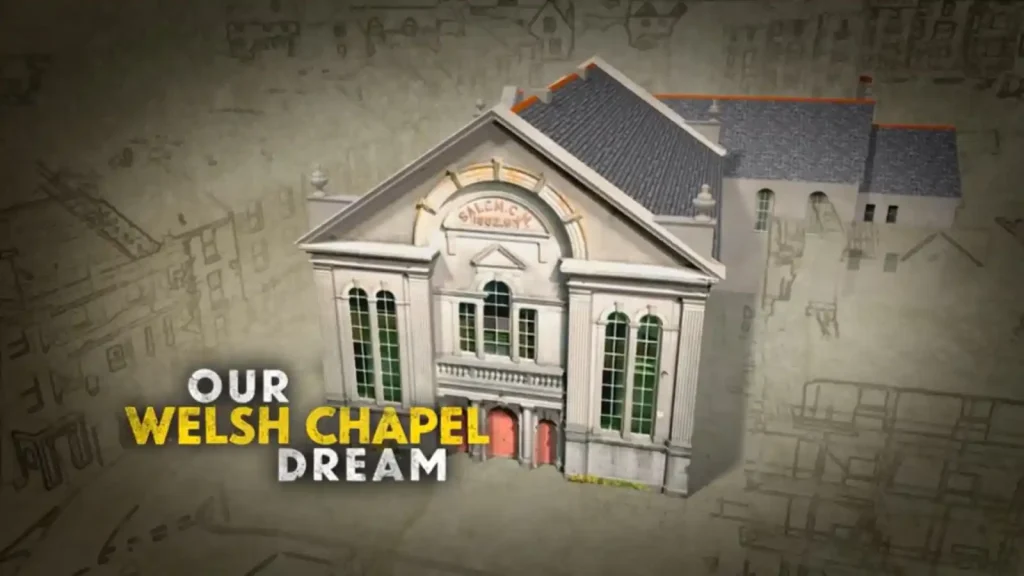
Our Welsh Chapel Dream 2026 episode 1 opens on a project that has become something of a national conversation about what it means to rescue a piece of living history with your own hands, your own money, and your own nerve. Keith Brymer Jones and Marj Hogarth are now deep into the renovation of their 163-year-old Grade 2 listed Welsh chapel in the village of Llanrhystud on the Ceredigion coast, and the work shows no signs of getting easier.
What began as an act of love — a decision to save a deteriorating place of worship from dereliction — has evolved into one of the most ambitious DIY home restoration projects in recent British television. Every wall stripped, every beam inspected, every decision made between the two of them carries the full weight of cultural heritage and personal financial pressure combined.
The chapel itself is not simply old. It is irreplaceable. Grade 2 listed status means that any alteration must be considered carefully, agreed with the relevant conservation authorities, and executed with materials and methods appropriate to the building’s period and character. For Keith and Marj, this is not bureaucratic inconvenience — it is a framework of respect they have largely embraced, understanding that the constraints exist because the building matters beyond their ownership.
The chapel belongs to the story of Welsh nonconformist Christianity, to the community that built it in the 1860s, and to the language and culture that shaped this part of Wales for generations. Renovating it responsibly means carrying all of that alongside the plaster dust and the spreadsheets.
Keith Brymer Jones is known to millions of viewers as the emotionally engaged judge on The Great Pottery Throw Down, a figure whose genuine passion for craft and making has made him one of the more distinctive voices in British television. That background in making things with hands, in understanding materials and process, in respecting the relationship between maker and object, runs directly through the chapel renovation. This is not a celebrity vanity project. It is an extension of the same creative and cultural values Keith has demonstrated throughout his career, now applied at the scale of an entire building.

Scan smarter. Create faster. Free.
Download QR & Barcode Studio — Create and scan unlimited QR codes & barcodes.
No paywalls. No limits. 100% Free.

Marj Hogarth brings her own formidable energies to Our Welsh Chapel Dream. As the episode makes clear, she is as deeply invested in the project as Keith, and frequently the one driving practical decisions forward with clarity and focus. Together they form a working partnership that is not always frictionless — disagreements surface, anxieties are shared openly — but which is held together by a shared commitment to the place and to each other. The chapel is, in a very real sense, both their project and their home in progress, and the stakes of getting things right could not feel more immediate.
By episode 1 of the 2026 series, the project has moved into a phase where visible progress is being made, but the financial reality has become increasingly difficult to ignore. The costs of chapel renovation at this scale, on a Grade 2 listed structure, are substantial. Professional contractors must be involved for certain elements. Specialist materials are required. Conservation standards must be maintained. Against all of this, Keith and Marj have limited resources and a determination to avoid debt that shapes every decision they make. The solution they arrive at for this episode is characteristically direct: they will organise a large-scale vintage clothes sale to raise funds.
The vintage sale is not a peripheral subplot. It becomes one of the episode’s primary engines, drawing in the local community, generating genuine excitement, and ultimately producing a meaningful contribution to the renovation budget. It is also, in a quieter way, a demonstration of the values that underpin the entire Home Restoration project. Reusing, repurposing, giving things a second life — these are the same instincts that drove Keith and Marj to take on the chapel in the first place rather than watch it fall apart or be converted into something that stripped away its character entirely.
The episode also spends considerable time on a specific craft tradition: love spoons. These carved wooden objects carry centuries of Welsh cultural significance, and their appearance in the chapel renovation context is both practically and symbolically apt. Love spoons are gifts of skill and intention, made to express feeling through the language of craft. Keith’s connection to making, to objects that carry meaning beyond their material form, makes his engagement with this tradition feel entirely organic rather than imposed. The love spoon sequences give the episode a depth that extends beyond bricks and mortar.
Throughout episode 1, Our Welsh Chapel Dream uses the daily texture of Keith and Marj’s life in Llanrhystud to ground what might otherwise feel like an abstract restoration project in lived human experience. Arguments about budgets, conversations with tradespeople, quiet moments of satisfaction when something works as planned — all of it accumulates into a portrait of two people who have committed entirely to a very difficult, very meaningful thing, and who are finding their way through it one decision at a time.
Our Welsh Chapel Dream 2026 episode 1
The 163-Year-Old Chapel at the Heart of Our Welsh Chapel Dream
The chapel in Llanrhystud is a mid-Victorian structure, constructed in the 1860s during the height of Welsh nonconformist religious culture. Buildings like this were community projects in the most literal sense — raised by collective effort, funded by congregations of working people, designed to serve both spiritual and social functions within villages that often had no other significant public space. Their architecture reflects that dual purpose: imposing enough to signal importance, plain enough to express the theological convictions of communities that distrusted ornament.
Grade 2 listed status places the chapel within the national framework for protecting buildings of special interest. In practical terms, this means Keith and Marj cannot simply make decisions about their own home in the way owners of unlisted properties can. Changes to the external appearance, to significant internal features, and to the structural fabric of the building all require consent. Working within this framework has been one of the defining challenges of the home restoration, requiring patience, careful documentation, and ongoing dialogue with conservation bodies.
The physical condition of the building when Keith and Marj took it on was challenging. Victorian chapels of this type were built to last, and in structural terms many of them have proved remarkably durable. However, decades of declining use, intermittent maintenance, and the particular vulnerabilities of large unheated spaces — damp, timber decay, failing pointing — take their toll. The chapel renovation has involved addressing these underlying problems systematically, ensuring that any cosmetic or interior work rests on genuinely sound foundations.
Funding the Dream: The Vintage Clothes Sale Strategy in Our Welsh Chapel Dream
One of the most striking sequences in episode 1 involves the planning and execution of a large vintage clothes sale. This is Keith and Marj’s chosen mechanism for raising funds at this stage of the chapel renovation, and the ambition of the event matches the scale of their need. The sale is not a jumble sale in any ordinary sense — it is a carefully organised event drawing on a substantial collection of vintage clothing and attracting buyers from a wide area.
The vintage clothes sector has grown considerably in recent years, driven by environmental awareness, aesthetic interest in period clothing, and a general cultural shift towards valuing the well-made and the durable over the disposable. Keith and Marj’s sale taps into this appetite. The event generates real income, with the proceeds going directly into the chapel renovation fund, and it does so while creating a genuine occasion — a day that brings people together around the building itself, reinforcing its connection to the community that surrounds it.
The logistics of staging a large sale within a partially renovated Grade 2 listed building are not trivial. The space must be made presentable and accessible. Stock must be organised and displayed effectively. Pricing must balance income generation against the goal of actually selling things rather than bringing them all back inside. Keith and Marj approach the challenge with the same practical energy they bring to the renovation itself, troubleshooting problems as they arise and adapting plans when circumstances require it.
The financial result is significant. The funds raised represent a genuine injection into the renovation budget, unlocking progress on elements of the home restoration that had been waiting on available cash. In the context of a project where every pound matters and where the temptation of debt is actively resisted, the vintage sale demonstrates a model of self-funding that is both admirable and practically effective.
Keith and Marj: Partnership, Pressure, and Progress in Our Welsh Chapel Dream
The working relationship between Keith Brymer Jones and Marj Hogarth is as central to Our Welsh Chapel Dream as the building itself. They are, by any measure, a genuinely well-matched pair: both energetic, both committed, both capable of significant practical effort, and both invested in the cultural and personal dimensions of what they are undertaking. However, the episode does not present their partnership as frictionless, and that honesty is one of the things that makes the programme worth watching.
The pressures of an ongoing chapel renovation are not trivial. Financial anxiety is a constant companion. Decisions must be made faster than the information needed to make them perfectly is often available. Living within or alongside a construction project takes a physical and psychological toll that is easy to underestimate from the outside. Keith and Marj absorb all of this and continue, and the moments when the weight of it surfaces in their interactions feel true rather than manufactured.
Keith’s background with The Great Pottery Throw Down has clearly shaped his approach to the project in ways that go beyond his comfort with materials and process. The programme has always been, at its core, about people making things under pressure, about the relationship between intention and execution, and about what it means to care deeply about the thing you are making. All of that translates directly to the chapel. Marj, meanwhile, brings an organisational clarity and a capacity for sustained practical effort that is essential at this stage of the Home Restoration, where many different tasks must proceed in parallel without losing sight of the larger plan.
Love Spoons and Living Cultural Heritage
The love spoon is one of the oldest and most recognisable expressions of Welsh craft culture. These carved wooden objects — typically featuring interlocking rings, chains, hearts, horseshoes, and other symbolic forms — were traditionally made by young men as gifts for women they hoped to court, with each carved element carrying a specific meaning. The tradition dates back several centuries and connects directly to the culture of the communities that originally built chapels like the one Keith and Marj are renovating.
In the episode, love spoons appear as both a craft subject and a cultural touchstone. Keith’s engagement with the tradition reflects his long-standing interest in the relationship between making and meaning — the same interest that drives his work on The Great Pottery Throw Down and that informs his approach to the chapel renovation itself. Objects made by hand, with skill and care, carry something beyond their physical form. They are evidence of attention, of time given willingly, of a relationship between maker and recipient that is expressed through the language of the made thing.
The relevance of love spoons to a chapel renovation project in Wales is not incidental. Welsh cultural heritage encompasses language, music, religion, and craft in a way that resists easy separation into distinct categories. The chapel was not just a place of worship — it was a site of community gathering, of cultural expression, of the transmission of values and traditions across generations. Engaging with love spoons as part of the programme gives that broader cultural dimension a specific, tangible focus.
Understanding the symbolism of individual carved elements — the chain representing togetherness, the horseshoe signifying luck, the interlocking rings suggesting partnership and continuity — deepens appreciation of both the objects and the culture that produced them. For Keith and Marj, working in Wales and restoring a building that is itself a form of cultural heritage, this engagement with craft tradition is entirely consistent with everything else they are doing.
Structural Progress and the Realities of DIY Home Restoration
Beyond the vintage sale and the cultural sequences, episode 1 documents the continuing physical progress of the chapel renovation. The work at this stage involves both addressing legacy problems in the fabric of the building and beginning to shape the interior spaces in ways that will eventually make the chapel function as a comfortable and beautiful home. Neither of these things is straightforward in a Grade 2 listed structure.
The DIY home restoration element of the project is real and substantial. Keith and Marj are not simply overseeing contractors — they are doing significant work themselves, drawing on a combination of practical skill, willingness to learn, and the particular kind of dogged persistence that large projects demand. The episode shows both the satisfactions and the frustrations of this approach: the moments when a problem yields to effort and ingenuity, and the moments when something turns out to be more complicated than it looked.
Working on a Grade 2 listed building means that certain decisions are not solely theirs to make. The conservation framework exists to protect the building’s historic character, and this sometimes creates tension with the practical desire to make progress quickly or to use modern materials that might be easier or cheaper. Keith and Marj navigate this tension carefully, generally choosing approaches that respect the building’s character even when alternatives might have been more convenient.
The cumulative effect of the episode’s structural sequences is a sense of real momentum. Progress is being made. The building is becoming less a project and more a home, slowly but measurably. Each decision documented on screen — about materials, about sequencing, about what to preserve and what to renew — adds to a picture of a restoration that is being thought through carefully rather than rushed.
Our Welsh Chapel Dream and the Wider World of Home Restoration
The success of Our Welsh Chapel Dream in capturing public attention reflects something genuine about current attitudes to home restoration, cultural heritage, and the built environment. The programme arrives at a moment when awareness of what is lost when historic buildings are demolished or unsympathetically converted has never been higher. The chapel restoration offers a model — imperfect, financially precarious, personally demanding — of what it looks like to choose the harder but more meaningful path.
The DIY home element of the project connects Keith and Marj’s endeavour to a broader tradition of British hands-on restoration culture, but the Grade 2 listed context and the specific Welsh setting give it a distinctive character. This is not simply about making a home. It is about making a home within a set of responsibilities to place, to history, and to community that most home renovation projects do not carry. The weight of those responsibilities is something the episode takes seriously.
Interior design at this stage of the chapel renovation is still largely prospective — the decisions being made now are about structure and fabric rather than finish and style. However, the sensibility that will eventually shape the interior is already visible in the choices Keith and Marj make about what to keep, what to expose, and what to restore. The building’s original features — its windows, its proportions, its relationship between vertical and horizontal space — are being treated as assets rather than obstacles, which promises an eventual interior of genuine character.
The Wales setting is not incidental to any of this. Ceredigion is a part of Wales where the Welsh language remains strong, where the nonconformist chapel tradition is still culturally resonant even in its decline, and where the landscape shapes daily life in ways that are immediately apparent. Keith and Marj are not simply renovating a building — they are putting down roots in a community and a culture, and the episode reflects that process of embedding honestly and affectionately.
Our Welsh Chapel Dream as a Document of Commitment and Cultural Stewardship
What distinguishes Our Welsh Chapel Dream from many other home restoration programmes is the combination of genuine stakes and genuine values that runs through every episode. Keith and Marj are not renovating the chapel to sell it. They are not doing it to demonstrate a concept or to generate content, though content it produces. They are doing it because they believe in the building, in its cultural heritage, in the community it sits within, and in the life they are building together within its walls.
This commitment is visible in the detail of how they approach problems. The choice to fund the renovation through a vintage clothes sale rather than debt reflects a set of values about sustainability and self-reliance. The engagement with love spoons and Welsh craft tradition reflects a desire to understand and respect the culture they have moved into. The willingness to work within the constraints of Grade 2 listed status, even when it is frustrating, reflects a genuine respect for the historical heritage the building represents.
Keith’s connection to The Great Pottery Throw Down gives him a particular credibility in this context. He has spent years on television arguing, implicitly and explicitly, that making things matters — that the relationship between human hands and materials is not merely practical but deeply meaningful. The chapel renovation is the fullest possible expression of that argument. It is also, for Keith and Marj both, a daily test of whether the values they hold up in professional contexts can survive contact with the grinding realities of a major building project.
Episode 1 of the 2026 series suggests they are passing that test. The vintage clothes sale raises real money. Work on the chapel continues. Love spoons connect the project to the deep roots of Welsh cultural heritage. And Keith and Marj, whatever pressures they are navigating privately, present to the camera and to each other a partnership that is, in the truest sense, built to last — as durable, one hopes, as the 163-year-old chapel they have chosen to call home.
FAQ Our Welsh Chapel Dream 2026 episode 1
Q: What is Our Welsh Chapel Dream and what makes the 2026 series significant?
A: Our Welsh Chapel Dream follows Keith Brymer Jones and Marj Hogarth as they renovate a 163-year-old Grade 2 listed Welsh chapel in Llanrhystud, Ceredigion. The 2026 series marks a pivotal stage in the chapel renovation, with visible structural progress, a major community fundraising event, and deeper engagement with Welsh cultural heritage making this the most substantial series yet.
Q: Who are Keith Brymer Jones and Marj Hogarth, and why did they take on this home restoration?
A: Keith Brymer Jones is best known as a judge on The Great Pottery Throw Down, celebrated for his passion for craft and making. Marj Hogarth is his partner in both life and the project. Together, they chose the chapel renovation not as a commercial venture but as a personal commitment to saving a culturally significant building from dereliction, putting down genuine roots in Wales.
Q: What does Grade 2 listed status mean for the chapel renovation in Our Welsh Chapel Dream?
A: Grade 2 listed status means the chapel is legally protected as a building of special historical interest. Keith and Marj cannot alter its external appearance, significant internal features, or structural fabric without formal consent from conservation authorities. This framework shapes every decision in the home restoration, requiring specialist materials and methods appropriate to the building’s Victorian character and historical heritage.
Q: How are Keith and Marj funding the Our Welsh Chapel Dream renovation?
A: Keith and Marj actively resist taking on debt, instead funding the chapel renovation through creative self-generated income. In episode 1 of the 2026 series, they organise a large-scale vintage clothes sale, attracting buyers from a wide area. The event raises a meaningful sum that is reinvested directly into the home restoration, unlocking work that had been waiting on available funds.
Q: What is the historical significance of the chapel Keith and Marj are restoring?
A: Built in the 1860s, the chapel is a product of Welsh nonconformist religious culture at its peak. Communities of working people collectively funded and constructed buildings like this to serve both spiritual and social functions. The chapel’s architecture reflects those dual purposes. Its cultural heritage connects directly to the Welsh language, community identity, and traditions that have shaped Ceredigion for over 160 years.
Q: What are Welsh love spoons, and why do they feature in Our Welsh Chapel Dream?
A: Love spoons are hand-carved wooden objects central to Welsh cultural heritage, traditionally gifted as expressions of affection. Each carved element carries symbolic meaning: chains represent togetherness, horseshoes signify luck, and interlocking rings suggest partnership. Their appearance in Our Welsh Chapel Dream is organic, reflecting Keith’s deep interest in craft traditions and the broader cultural history of the communities that originally built the chapel.
Q: How much of the chapel renovation do Keith and Marj do themselves?
A: The DIY home restoration element is genuine and substantial. Keith and Marj carry out significant work themselves, combining practical skill with a willingness to learn on the job. However, certain tasks on a Grade 2 listed structure require professional contractors and specialist input. The programme honestly documents both the satisfactions of hands-on progress and the frustrations when problems prove more complex than anticipated.
Q: How does Keith’s experience on The Great Pottery Throw Down influence the chapel project?
A: The Great Pottery Throw Down has consistently explored the relationship between making, materials, and meaning. Keith brings those same values directly to the chapel renovation. His comfort with process, his respect for craft, and his understanding that objects and buildings carry meaning beyond their material form all inform how he and Marj approach decisions. Furthermore, his experience working under pressure translates visibly into his resilience throughout the home restoration.
Q: What role does the local Welsh community play in Our Welsh Chapel Dream?
A: Community connection is woven throughout the project. The vintage clothes sale in episode 1 of the 2026 series actively draws in local people, transforming a fundraising necessity into a genuine community occasion held within the chapel itself. Additionally, Keith and Marj’s engagement with Welsh cultural heritage — including love spoons and the nonconformist history of the building — reflects a deliberate effort to embed themselves respectfully within Llanrhystud’s living culture.
Q: What distinguishes Our Welsh Chapel Dream from other home restoration programmes?
A: Several factors set Our Welsh Chapel Dream apart. The Grade 2 listed status creates constraints absent from most DIY home projects. The Welsh cultural heritage context adds historical depth rarely present in comparable series. Keith and Marj are renovating a home they intend to live in permanently, not sell. Their self-funding approach, refusal of debt, and genuine partnership give the chapel renovation an authenticity and emotional stakes that distinguish it clearly within the home restoration genre.