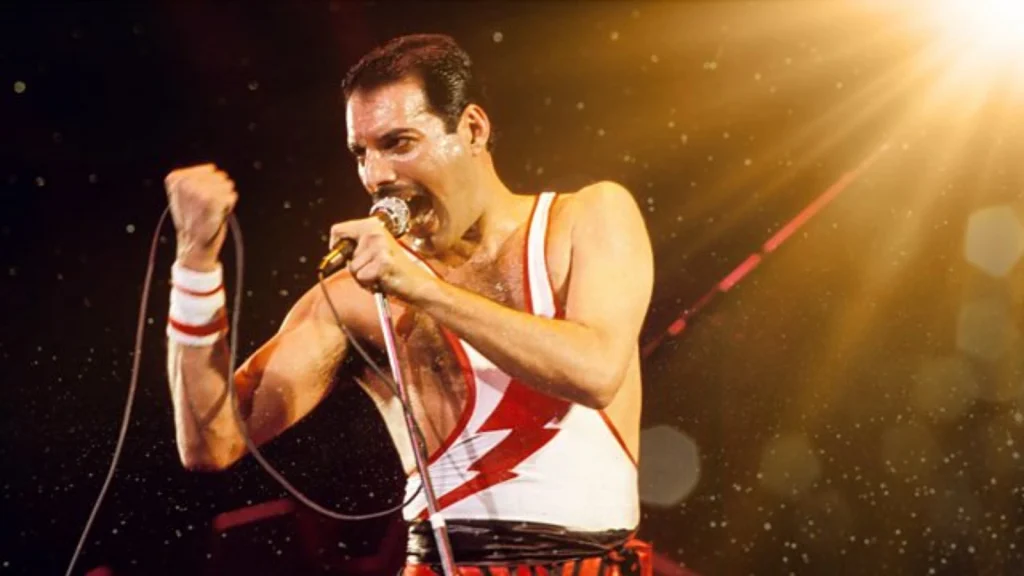
The documentary Freddie Mercury The Final Act chronicles the powerful and poignant final chapter of the iconic singer’s life. It details his private battle with AIDS against a backdrop of public hysteria. Ultimately, it culminates in one of the most significant musical events in history. The film explores how his band, Queen, honored his legacy after his death. They staged a massive concert to celebrate his life and confront the pervasive prejudice surrounding the disease.
In the 1980s, a shadow fell over the world with the emergence of a new illness. This disease, AIDS, was initially and cruelly dubbed a “gay plague”. A wave of moral panic, fueled by fear and misinformation, swept across society. Many prominent voices, from religious leaders to media outlets, framed AIDS not as a medical crisis but as a form of divine punishment for a “promiscuous lifestyle”. This hostile environment created immense fear and stigma for those affected.
The story detailed within Freddie Mercury The Final Act masterfully weaves together these societal threads. It connects the intensely personal journey of a global rock music superstar with the broader, harrowing experiences of the era. The narrative is not just about one man’s illness. It is also the story of a community under siege, of medical professionals fighting a seemingly unwinnable war, and of the power of art to challenge ignorance.
By the mid-1980s, the band Queen stood at the zenith of their career. Following their triumphant performance at Live Aid, they embarked on their biggest tour ever in 1986. This tour was a massive success, playing to enormous crowds, including two sold-out nights at Wembley Stadium. The band was a global phenomenon, with Freddie Mercury as its electrifying and beloved frontman. They seemed completely unstoppable.
However, at the conclusion of that monumental tour, Freddie Mercury delivered shocking news to his bandmates. After a final, colossal show at Knebworth Park, he stated, “I can’t do this any more”. His sudden refusal to tour again was the first clear signal to the rest of Queen that something was seriously wrong. As Freddie Mercury The Final Act reveals, this decision marked the beginning of a profound and painful new reality for the band and its iconic singer.

Scan smarter. Create faster. Free.
Download QR & Barcode Studio — Create and scan unlimited QR codes & barcodes.
No paywalls. No limits. 100% Free.

The fear surrounding AIDS was amplified by the media’s treatment of public figures. The death of actor Rock Hudson sent shockwaves globally and personally affected Freddie. It transformed the disease from a distant threat into an immediate, terrifying reality. This climate of fear and judgment made privacy a fortress. For Mercury, who was intensely private, the invasive speculation and scavenger-like behavior of the press became a constant torment.
Freddie Mercury The Final Act
The Diagnosis and a Vow of Secrecy
Freddie Mercury’s friends and bandmates began noticing subtle but worrying signs. Brian May recalled seeing “burns to his skin” and periods where Freddie would disappear for treatments. A more definitive moment came during a birthday celebration in Ibiza. Interviewer David Wigg noticed a mauve mark on Freddie’s cheek, a potential sign of Kaposi’s sarcoma, a cancer associated with AIDS. When confronted privately, Freddie admitted the truth but made Wigg promise not to report it, stating simply, “I’m going to fight it. We’re going to find a cure. End of subject”.
This secrecy extended even to his closest family. His sister, Kashmira, suspected the illness and asked him directly if it was AIDS, but he denied it. He did not want to discuss it and she respected his wishes. Eventually, he knew he had to tell his band. During a meeting in Montreux, he calmly sat them down and explained his situation. His instructions were clear: he did not want to talk about it or take any action, other than to “keep making music for as long as I fucking can”.
The members of Queen immediately closed ranks around their friend. They all agreed to protect him by denying everything if questioned by the press. Brian May stated he was “absolutely prepared to lie through my teeth right up to the last minute” to honor Freddie’s wishes. This vow created a protective bubble, allowing the band to focus on their work. The studio became a sanctuary, a place where they could be a family and escape the grim reality unfolding outside.
This period of intense creativity produced the albums The Miracle and Innuendo. Work was a distraction and a purpose. One of the most poignant and powerful recordings from this time was “The Show Must Go On.” Brian May wrote the song about a sad clown painting on a smile, a clear metaphor for Freddie’s situation, though it was never explicitly discussed. May worried the song’s high notes would be too demanding, but Freddie, after taking a shot of vodka, delivered one of the most incredible vocal performances of his career.
A Tale of Two Pandemics: Public Fear and Private Grief
While Freddie Mercury fought his battle in private, a public war was being waged against the gay community and anyone with AIDS. The societal response was vicious and dehumanizing. Chief Constable James Anderton of Greater Manchester castigated homosexuals, while others called for extreme measures like gassing them or isolating them on an island. This moral panic was amplified by the government. Margaret Thatcher’s administration enacted Clause 28, which banned the “promotion of homosexuality” by local authorities, further stigmatizing an already marginalized group.
This prejudice had devastating real-world consequences. The documentary highlights the story of one couple who awoke to find “Aids queers” painted on their apartment building, with an arrow pointing directly to their door. It was their elderly neighbor who tried to scrub the hateful graffiti off before they could see it. This was the reality for many. People were thrown out by their families, lost their jobs, and faced violence from their neighbors. The fear and shame were so immense that many suffered and died alone.
The medical establishment was also struggling. Doctors faced immense obstacles in providing care. A junior doctor recounted how merely mentioning an HIV-positive patient over the phone would lead to a sudden lack of available hospital beds. Securing basic procedures like a CT scan felt like going into battle. Before the arrival of effective combination therapies, a diagnosis was seen as a death sentence. Patients lost massive amounts of weight and suffered from numerous afflictions, from brain damage to blindness.
This toxic environment of fear, stigma, and medical uncertainty explains the deep need for secrecy. For a global superstar like Freddie Mercury, a public disclosure would have meant being subjected to relentless scrutiny and pity when he was at his most vulnerable. His decision to remain private was an act of self-preservation. It allowed him to retain his dignity and control over his own life, focusing his remaining energy on the one thing that always gave him solace: his music.
Freddie Mercury The Final Act: A Legacy Beyond Music
In the last two weeks of his life, Freddie Mercury made the decision to stop taking the drugs that were keeping him alive, opting only for painkillers. He spent his final days at his home, Garden Lodge, surrounded by a small, chosen family including his partner Jim Hutton. Outside, a relentless media circus laid siege to the house, photographing groceries and attempting to get any glimpse of the dying star. Roger Taylor described the press behavior as “pretty sick”.
Just over 24 hours before he passed away, Freddie made one final, crucial decision. He issued a public statement confirming he had AIDS. Brian May later described this as a “very brave, and, I think, well-timed act”. By controlling the timing of the announcement, he avoided becoming an object of pity or scrutiny in his final moments. The news broke on a Saturday, and by Sunday evening, November 24, 1991, Freddie Mercury had died at the age of 45.
The immediate reaction was a mix of profound grief and ugly judgment. While fans and friends mourned, some segments of the press were, as Roger Taylor noted, “pretty shitty”. Outlets like The Sun ran stories suggesting he “got what he deserved” because of his lifestyle. This infuriated his bandmates. They felt compelled to defend their best friend and challenge the “disgusting” and unsympathetic narrative being pushed by some in the media.
This anger became a powerful catalyst for action. The surviving members of Queen and their manager, Jim Beach, decided they could not let Freddie be remembered as a victim. They realized that his brave, final statement had given them a “weapon” to talk about AIDS openly and fight the stigma. The idea for a tribute concert began to form. It would be a way to give their friend a “hell of a send-off” while simultaneously raising global awareness about the disease that took his life.
The Freddie Mercury Tribute Concert: A Global Stage for Change
Organizing the Freddie Mercury Tribute Concert for AIDS Awareness was a monumental task. When Roger Taylor and Jim Beach approached promoter Harvey Goldsmith with their plan for a show at Wembley Stadium, he initially thought they were “mad”. The biggest question was who would sing in Freddie’s place. Yet, once the date was booked, the rock music community responded overwhelmingly. The first person called was Elton John, a close friend of Freddie’s, who was a “shoo-in”. Soon, a stunning lineup of artists was secured.
The concert, held at Wembley on April 20, 1992, was broadcast to an estimated half a billion people worldwide. What made the event so powerful was the diverse collection of performers. It brought together Freddie’s heroes, like Roger Daltrey and David Bowie, with younger bands he had inspired, such as Extreme and Metallica. The show’s first half featured hard rock acts like Guns N’ Roses, which some might have found an unlikely fit for an AIDS awareness event. However, this juxtaposition was crucial; it brought a massive, mainstream heterosexual audience to a conversation about a disease wrongly labeled as only a gay issue.
The performances were filled with unforgettable and emotional moments. George Michael, whose partner Anselmo Feleppa was secretly battling AIDS, delivered a breathtaking rendition of “Somebody to Love”. According to his friends, the song was a deeply personal plea, sung for Anselmo. One of the most talked-about moments was the duet of “Bohemian Rhapsody” by Elton John and Axl Rose. Rose, who had faced accusations of homophobia and was famously unpredictable, not only appeared but delivered a powerful performance. At the song’s end, he and Elton John held hands, a spontaneous gesture that symbolized a powerful message of unity.
Ultimately, the tribute concert transcended music. It became a global platform for education and empathy, as emphasized throughout the Freddie Mercury The Final Act documentary. Elizabeth Taylor took the stage not to sing, but to deliver a direct message to the world about the reality of AIDS, urging everyone to “protect yourselves, love yourselves, respect yourselves”. The concert transformed the narrative around Freddie’s death from one of shame and tragedy to one of celebration and activism. It was a fitting tribute that used the power of Queen’s music to honor his life and champion a vital cause.
When Music Becomes Medicine: The Enduring Power of Freddie’s Final Gift
The Freddie Mercury Tribute Concert stands as one of music history’s most profound paradoxes—a celebration born from tragedy that transformed global consciousness in a single afternoon. What began as Queen’s desperate attempt to honor their fallen friend evolved into something far more revolutionary: a masterclass in how art can dismantle prejudice and heal societal wounds.
Think about the audacity of that moment. Here was a disease that had been weaponized by fear-mongers, used to justify hatred and isolation. AIDS had become society’s scarlet letter, marking entire communities as untouchable. Yet on April 20, 1992, half a billion people worldwide tuned in to watch rock legends, pop icons, and heavy metal bands unite under one banner—not just to remember Freddie, but to declare that love transcends all boundaries.
The genius of the concert lay not in its star power, though that was undeniable, but in its strategic inclusivity. When Axl Rose and Elton John clasped hands after “Bohemian Rhapsody,” it wasn’t just a musical moment—it was a symbolic bridge spanning the cultural divide that had allowed AIDS stigma to flourish. The same mainstream, heterosexual rock audience that might never have engaged with AIDS awareness was suddenly listening, learning, and feeling empathy for communities they’d been taught to fear.
Freddie’s decision to remain private about his diagnosis until his final hours initially seemed like missed opportunity for advocacy. But his timing proved brilliant. By controlling his narrative until the very end, he avoided becoming a cautionary tale or object of pity. Instead, his posthumous revelation became a catalyst, transforming his death from tragedy into activism. His bandmates didn’t just inherit his musical legacy—they inherited his courage, using it to challenge the “disgusting” narratives that sought to diminish his memory.
The ripple effects continue today. Every time an artist uses their platform to address social justice, every time music breaks down barriers between communities, every time someone finds the courage to speak their truth despite potential backlash—we see echoes of what Queen accomplished at Wembley. The concert proved that entertainment and education aren’t mutually exclusive; they’re most powerful when united.
For modern audiences grappling with their own social divisions and health crises, Freddie’s story offers both inspiration and instruction. It reminds us that some of history’s most important conversations happen not in boardrooms or legislative chambers, but on stages where music creates the emotional common ground necessary for real understanding.
Perhaps most importantly, the tribute concert demonstrated that legacy isn’t just what we leave behind—it’s what others do with our memory. Freddie may have left us too soon, but through Queen’s determination to honor him properly, his voice continues to sing for acceptance, understanding, and the radical idea that love, in all its forms, deserves celebration rather than condemnation.
In the end, the show truly did go on—and the world became a little more compassionate because of it.
FAQ Freddie Mercury The Final Act
Q: When did Freddie Mercury publicly reveal his AIDS diagnosis?
A: Freddie Mercury confirmed his AIDS diagnosis just over 24 hours before his death on November 24, 1991. He issued a public statement on Saturday, November 23rd, after keeping his illness private for years. This timing was strategic, allowing him to control his narrative and avoid becoming an object of pity during his final moments.
Q: Why did Freddie Mercury choose to keep his AIDS diagnosis secret from the public?
A: Mercury’s secrecy was primarily self-preservation against the toxic social climate of the 1980s. AIDS carried enormous stigma, with victims facing discrimination, violence, and dehumanizing treatment. Additionally, his intensely private nature and the media’s invasive behavior made privacy essential. This approach allowed him to maintain dignity and focus on music rather than becoming a cautionary tale.
Q: What was the Freddie Mercury Tribute Concert and when did it take place?
A: The Freddie Mercury Tribute Concert for AIDS Awareness was held at Wembley Stadium on April 20, 1992. Organized by Queen’s surviving members and broadcast to half a billion people worldwide, it served dual purposes: celebrating Freddie’s life and raising global awareness about AIDS. The concert transformed his death from tragedy into activism.
Q: Which major artists performed at the Freddie Mercury Tribute Concert?
A: The concert featured an impressive lineup including Elton John, David Bowie, George Michael, Guns N’ Roses, Metallica, Extreme, Def Leppard, Roger Daltrey from The Who, and many others. This diverse collection brought together Freddie’s musical heroes with younger bands he had inspired, creating a powerful cross-generational tribute.
Q: How did the media and public initially react to Freddie Mercury’s AIDS revelation?
A: The reaction was mixed, combining profound grief with ugly judgment. While fans mourned globally, some media outlets like The Sun suggested he “got what he deserved” because of his lifestyle. However, the overwhelming response was sympathy and admiration for his courage, ultimately helping shift public perception about AIDS.
Q: What was the social climate surrounding AIDS during Freddie Mercury’s era?
A: The 1980s AIDS crisis was marked by fear, misinformation, and moral panic. AIDS was cruelly labeled a “gay plague,” with many viewing it as divine punishment rather than a medical crisis. Governments enacted discriminatory legislation like Clause 28, while victims faced job loss, family rejection, and violence from neighbors.
Q: How did Queen members protect Freddie Mercury’s privacy during his illness?
A: Queen formed a protective circle around Mercury, with all members agreeing to deny everything if questioned by the press. Brian May stated he was “absolutely prepared to lie through my teeth” to honor Freddie’s wishes. The recording studio became their sanctuary, allowing them to focus on music while shielding him from media scrutiny.
Q: What albums did Queen create while Freddie Mercury was battling AIDS?
A: During Mercury’s illness, Queen produced two critically acclaimed albums: “The Miracle” (1989) and “Innuendo” (1991). Work served as both distraction and purpose for the band. The period also produced the poignant “The Show Must Go On,” which Brian May wrote as a metaphor for Freddie’s situation, featuring one of his most incredible vocal performances.
Q: How did the tribute concert help change global attitudes about AIDS?
A: The concert strategically brought mainstream, heterosexual rock audiences into AIDS awareness conversations. When Axl Rose and Elton John held hands after “Bohemian Rhapsody,” it symbolized unity across cultural divides. Elizabeth Taylor’s direct message about AIDS education further emphasized the event’s educational mission, transforming shame into celebration and activism.
Q: What lasting impact did the Freddie Mercury Tribute Concert have on music and society?
A: The concert demonstrated how entertainment and education could unite powerfully, creating emotional common ground for difficult conversations. Its success inspired countless artists to use their platforms for social justice causes. Moreover, it proved that legacy isn’t just what we leave behind, but what others do with our memory to create positive change.