The Repair Shop 2026 episode 15 opens a door into five extraordinary worlds, each one shaped by love, loss, distance, and the stubborn insistence of families on keeping their most precious things alive. Across an episode that spans continents and decades, the barn at Beamish welcomes objects that carry wars, sporting legends, island cultures, and the luminous noise of childhood happiness within their battered surfaces. Restoration, in this context, means something far more than fixing broken mechanisms or cleaning tarnished leather. It means recovering the emotional frequency of lives well lived, and returning to families the tangible proof that those lives mattered.
Heritage objects rarely arrive in the barn in perfect condition. That is precisely the point. Time, travel, use, and grief all leave their marks, and the craftspeople of The Repair Shop 2026 episode 15 work not against those marks but in dialogue with them. Each repair is a conversation between the past and the present, between the craftsperson’s expertise and the object’s surviving integrity. What emerges from that conversation is never a replica and never a denial of damage. It is something more honest — a restoration that honours both the original life of the object and the years it has endured without it.
This episode is particularly rich in family history that crosses national boundaries. A pachinko machine travelled from Japan to Malaysia to the United Kingdom. A leather football made its way from a rain-soaked Scottish cup final into a suburban back garden, then into a barn in need of professional care. A prisoner-of-war magazine, assembled under conditions of extreme hardship in wartime Taiwan, survives into the present in fragile but still-legible form. A Cretan lyra, the voice of an island’s celebrations, carries within its cracked body the memory of a young man who is no longer there to play it. Each of these objects holds not one story but many, layered across generations.
The craftspeople called upon in The Repair Shop 2026 episode 15 bring specialist knowledge that is rarely gathered in one place. Geoff Harvey, whose affinity with pinball and arcade mechanics has earned him the nickname ‘Pinball’ Geoff, takes on the pachinko machine with characteristic energy. Suzie Fletcher and art conservator Lucia collaborate on the football, combining leather expertise with conservation skills. Bookbinder Chris Shaw approaches the prisoner-of-war magazine with the precision its fragility demands. Luthier Becky Houghton takes on the Cretan lyra, one of the most emotionally charged items the barn has seen in recent memory. Together, these four stories create an episode of unusual emotional depth and technical ambition.
What unifies them is the relationship between memory and craft. Every object in this episode carries a specific sonic or tactile memory. The sisters from Gosport remember the sound of the pachinko machine filling a family home in Malaysia. The brothers from Glasgow remember a grandfather whose name is fading from the leather of a historic football. Peter Moss and his son Alex can trace the arc of their family’s wartime experience through a hand-stitched volume assembled under duress. Emma MacLennan remembers her son playing a lyra with passion and skill in the moments before illness took that ability away. Restoration, in each case, means giving those memories a physical anchor that will outlast the remembering generation.

Scan smarter. Create faster. Free.
Download QR & Barcode Studio — Create and scan unlimited QR codes & barcodes.
No paywalls. No limits. 100% Free.

The episode does not shy away from the weight of that responsibility. Each craftsperson in The Repair Shop 2026 episode 15 articulates, in their own way, the particular pressure of working on something irreplaceable. There is no second copy of the Raggle Taggle magazine. There is no spare lyra that belonged to Alex MacLennan. The pachinko machine is the one their father carried back from Japan. The football is the one Jim Baxter smuggled off a Hampden pitch in 1963. The stakes are always personal, and the craftspeople carry that knowledge into every decision they make.
In this way, The Repair Shop 2026 episode 15 functions as both a showcase of extraordinary craftsmanship and a meditation on what families preserve and why. The objects themselves are not uniformly valuable in any conventional sense. None of them would necessarily command a high price at auction. What they command is something more durable — the absolute loyalty of the families who kept them, damaged and silent and broken, because throwing them away was never a real option. That loyalty is what makes the barn such a singular place, and this episode such a compelling hour of television.
The four stories that follow unfold in sequence, each one a self-contained study in the relationship between memory, craft, antiques, and the human desire to hold onto what has been lost. They share a common structure — an object arrives with damage, a craftsperson assesses the challenge, work begins, emotion surfaces, and something is recovered — but within that structure the details are specific, surprising, and in every case genuinely moving. The repair, in each instance, is only the beginning of the story the object has left to tell.
The Repair Shop 2026 episode 15
The Pachinko Machine: The Repair Shop 2026 Episode 15 and a Childhood Soundtrack from Japan
Sisters Julie and Tracy from Gosport are the first to arrive in the barn, carrying between them a pachinko machine that has not made a sound in more than fifty years. Their father purchased the machine in 1970 while serving in the Royal Navy and stationed in Japan. At that time, the family was living in Malaysia, and the pachinko machine made the journey to their home there, becoming an immediate centrepiece of family life. Julie and Tracy describe it as a machine that filled the house with noise — the bright rattle of ball bearings, the flash of lights, the mechanical symphony of a device designed entirely for joy.
Pachinko is a distinctly Japanese form of entertainment, resembling a vertical pinball machine in which small steel balls cascade through a forest of pins, triggers, and gates. The machine Julie and Tracy have brought to the barn is a vintage example of the form, built at a time when pachinko parlours were a defining feature of Japanese urban life. Their father’s decision to acquire one was a gesture both of enthusiasm for the culture he encountered on his naval posting and of generosity toward the family waiting for him in Malaysia. The machine became, in their words, a much-loved treasure at the heart of many happy times.
Geoff Harvey examines the pachinko machine with visible delight. His nickname, ‘Pinball’ Geoff, captures both his expertise and his temperament. He approaches the assessment with the confidence of someone who has spent years working on arcade machines and understands their internal logic. The machine’s problems are considerable — decades of inactivity have left its mechanisms seized, its electrical components unreliable, and its exterior in need of careful attention.
However, Geoff’s diagnosis is characteristically optimistic. He identifies the specific failures and sets about addressing them with methodical energy, testing each component and replacing what cannot be salvaged. The goal is not merely to make the machine operational but to restore the particular sound that Julie and Tracy remember — the full, bright, mechanical chorus of a working pachinko machine in a Malaysian living room.
The restoration involves both electrical and mechanical work. Geoff works through the machine’s systems, addressing the lighting circuitry, the ball-bearing pathways, and the triggering mechanisms that create the machine’s characteristic sound profile. Each element requires patience and precision. The machine’s age means that some components are no longer in production, requiring adaptation and improvisation within the constraints of historical accuracy. When the machine finally lights up and begins to sing its original song, the reaction from Julie and Tracy is immediate and unguarded. The sound of the pachinko machine is, for them, the sound of childhood itself.
A Legend’s Leather: Football History and Craftsmanship in The Repair Shop 2026 Episode 15
Brothers Iain and Kirk Russell arrive from Glasgow carrying a leather football with a history that most sports collectors would find extraordinary. The ball was used in the 1963 Scottish Cup final replay between Rangers and Celtic, played at Hampden Park. Rangers won the match 3-0. Their grandfather, Ian McMillan, was a Rangers legend whose career was approaching its end, and his teammate Jim Baxter decided to mark the occasion by smuggling the ball off the pitch after the final whistle as a personal souvenir for McMillan.
The gesture was romantic in spirit but immediately controversial in practice. The Scottish Football Association demanded the ball’s return, and what followed was a media frenzy that lasted until the SFA finally relented and returned the ball to Ian McMillan as a commemoration of his distinguished career. The ball thus carries within its battered leather not only the memory of a famous match but the weight of an institutional dispute and the eventual recognition of a great player’s contributions to Scottish football. It is, in every sense, a piece of sporting heritage.
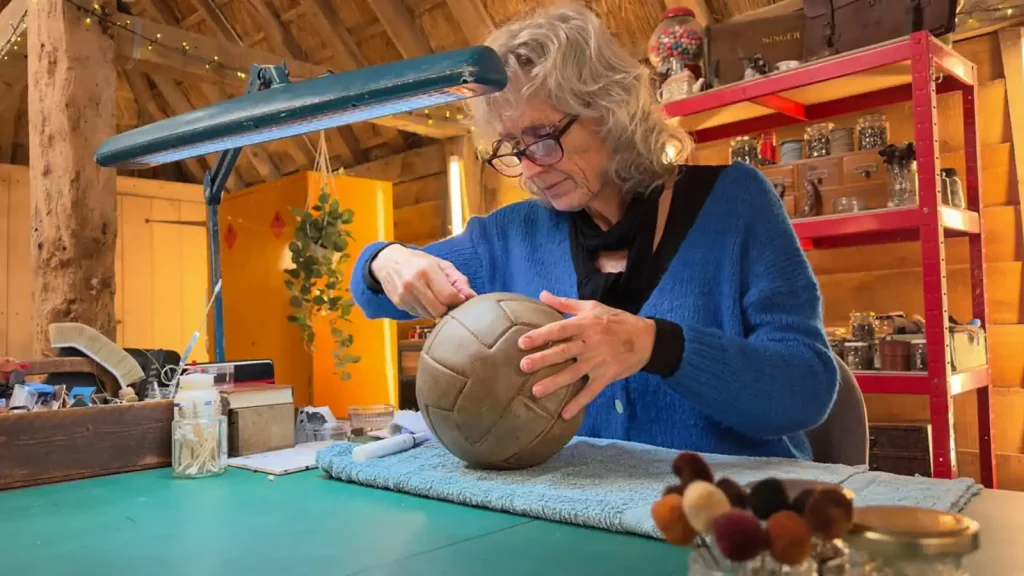
However, Ian McMillan’s young grandsons — among them Iain and Kirk — were not fully aware of this history when they were growing up. The ball entered the family’s everyday life as simply a ball, and they used it accordingly, playing with it in garden kickabouts that left it deflated, scuffed, and damaged. The handwritten signature that Ian had placed on the leather is now barely legible. The challenge for Suzie Fletcher and art conservator Lucia is therefore both structural and cosmetic — the ball needs its integrity restored and its inscription recovered.
Suzie’s expertise in leather provides the foundation of the repair. She and Lucia work as a genuine team, combining leather restoration techniques with conservation approaches drawn from the world of art and documents. They clean the surface carefully, address the damage to the leather’s structure, and work to bring the signature back to legibility without overworking the original material.
The result is a football that no longer looks like a forgotten object in a cupboard. It looks, once again, like what it is — a piece of Scottish sporting history, carrying on its surface the handwriting of one of the game’s finest midfielders. Iain and Kirk’s reaction reflects both personal affection for their grandfather and a genuine appreciation of what the ball represents in the wider story of Scottish football.
Raggle Taggle: A Prisoner of War Magazine Restored in The Repair Shop 2026 Episode 15
Peter Moss and his son Alex bring to the barn one of the most historically significant objects The Repair Shop 2026 episode 15 has encountered in its recent run. Raggle Taggle is a magazine — a genuine, handwritten, hand-illustrated periodical — created by Peter’s father Jock Moss and his fellow prisoners of war while held captive by the Japanese in the Shirakawa camp in what is now Taiwan. The camp was notorious for its brutal conditions, and the creation of the magazine was an act of collective will against despair.
Jock Moss served as the magazine’s editor. The publication was handwritten and illustrated by prisoners and covered by mosquito netting in place of a conventional cover — a practical adaptation to the materials available under captivity. With only one copy shared among approximately 800 men, it circulated through the camp as a source of entertainment, humour, and solidarity. Its purpose was explicitly morale-sustaining. In conditions designed to break the human spirit, the production of something as ordinary and civilised as a magazine was a profound act of resistance.
Chris Shaw, the barn’s bookbinder, examines the volume with careful hands. The magazine’s condition reflects its age and the conditions in which it was created. The mosquito-net cover is fragile, the pages are delicate, and the handwritten content requires protection from further deterioration. Chris assesses the structural challenges methodically, understanding that any intervention must prioritise the document’s survival over its appearance. The goal is stabilisation and preservation rather than cosmetic transformation. Every decision Chris makes is governed by the awareness that this object is singular — there is no other copy, and the words and drawings inside represent a form of witness testimony about life in the Shirakawa camp.
Peter and Alex recount Jock’s experience with a mixture of pride and sorrow. The magazine represents both the ingenuity and the suffering of the men who created it. Its survival into the present is itself remarkable — a fragile volume that crossed decades and territories to arrive in a barn in the north of England, where a skilled craftsperson can give it the care it should always have received.
Chris’s work on the Raggle Taggle is not simply bookbinding. It is an act of historical stewardship, ensuring that a unique document of wartime human resilience remains accessible to future generations. The antiques world occasionally produces objects of this kind — items whose monetary value is almost irrelevant against their historical significance. Raggle Taggle is precisely such an object.
The Cretan Lyra: Music, Memory, and Loss in The Repair Shop 2026 Episode 15
The final arrival of the episode is the one that carries the most immediate emotional weight. Emma MacLennan comes to the barn from Kent with her late son Alex’s Cretan lyra, a traditional bowed instrument that sits at the centre of the musical culture of Crete. Alex MacLennan had a grandmother from Crete and grew up with a deep, self-taught connection to the island’s life. He learned the dialect, attended local festivals, worked alongside shepherds during sheep shearing, and taught himself to play the lyra with what his mother describes as genuine passion and skill.
The lyra is not a widely known instrument outside Greece and its diaspora. It is a small, pear-shaped bowed instrument played vertically, producing a sound that is distinctive and immediately identifiable to anyone familiar with Cretan music. Its role in the island’s celebrations — weddings, festivals, communal gatherings — is central and ancient. For Alex to have mastered it as an outsider, without formal teaching, speaks to the depth of his engagement with Cretan culture. The lyra was not an affectation but an expression of genuine belonging.
Motor neurone disease ended Alex’s ability to play. The progressive neurological condition, which attacks the motor neurons controlling movement, robbed him first of the fine motor control required for lyra playing, and ultimately of his life. Alex died at the age of thirty-one. The lyra he left behind is damaged and silent, and Emma has brought it to the barn in the hope that luthier Becky Houghton can restore its voice.
Becky approaches the task with the combination of technical knowledge and emotional sensitivity it demands. Luthier work — the making and repair of stringed instruments — requires an understanding of acoustics, wood behaviour, and the precise geometry of instruments whose design has been refined over centuries. The Cretan lyra presents specific challenges, both in terms of its condition and its relative rarity outside Greece. Becky must work within the instrument’s original specifications while addressing the damage that has silenced it. The repair involves structural work on the body, attention to the strings and bow, and careful assessment of the instrument’s acoustic integrity.
What makes Becky’s work on this particular lyra so affecting is the context Emma provides. Throughout the repair process, the understanding that this instrument was the last point of creative connection between Alex and the culture he loved gives every technical decision an additional layer of significance. The lyra was not simply Alex’s instrument. It was, in a real sense, the most concentrated expression of who he was — his connection to a grandmother’s island, his willingness to immerse himself in a culture not immediately his own, and his determination to participate in it fully rather than observe it from a distance.
When Becky presents the restored lyra, Emma’s response is measured but profound. The instrument’s return to a playable state does not bring Alex back, and Emma is not performing a grief she has moved beyond. What the restoration offers is more specific — the knowledge that the lyra Alex played still exists, still has a voice, and can still speak in the musical language of Crete. That is, under the circumstances, an enormous gift.
Craftsmanship as Heritage Preservation Across The Repair Shop 2026 Episode 15
The four stories of this episode together constitute a case study in the relationship between skilled craft and the preservation of family heritage. None of the objects brought to the barn this week could have been adequately addressed by an amateur enthusiast with goodwill and a toolkit. Each required a specific, professionally developed expertise that took years to acquire. Geoff Harvey’s knowledge of arcade mechanisms, Suzie Fletcher’s mastery of leather, Chris Shaw’s bookbinding precision, and Becky Houghton’s luthiery skills are not interchangeable. Each is the product of dedicated practice and accumulated experience.
What the barn provides is the rare circumstance in which such expertise is available and applied to objects whose value is entirely personal. Museums and archives apply similar skills to objects of public historical record. The Repair Shop 2026 episode 15 applies them to a Japanese pachinko machine bought by a naval officer in 1970, to a football used in a back garden by boys who did not fully understand what they were kicking around, to a hand-stitched prison-camp magazine covered in mosquito netting, and to a small Greek instrument that a young man taught himself to play in the mountains of Crete.
The value of the objects is not institutional. It is familial, emotional, and irreducible to any external measure.
The antiques and restoration world has long understood that the most important objects are not always the most famous ones. A piece of Chinese porcelain worth tens of thousands at auction carries no more human significance than a pachinko machine that once made two sisters dance in a Malaysian living room. The Repair Shop 2026 episode 15 makes this point not through argument but through demonstration. By giving equal care and screen time to each of its four stories, the episode implicitly argues that heritage is not a hierarchy. Every family’s history deserves the same attention, the same skill, and the same respect.
The Emotional Architecture of Repair and the Season’s Recurring Themes
Across the season thus far, The Repair Shop 2026 episode 15 represents a continuation and deepening of themes that have been present since the series began. The relationship between repair and grief is one of them. Several of the objects brought to the barn this week are connected to people who are no longer alive. Ian McMillan, the football legend, is present in this episode only through his signature on a battered ball. Jock Moss, the prisoner-of-war editor of Raggle Taggle, is present only through the handwritten pages his son and grandson have carried to the barn. Alex MacLennan is present only through the lyra his mother holds in her hands.
Repair, in these contexts, is not about returning to the past. The past is not recoverable, and the craftspeople of the barn do not pretend otherwise. What repair offers is continuity — the extension of an object’s life, and therefore of the story it carries, into a future that the people who originally owned it will not see. That is a different and more honest ambition than resurrection. It asks not what the object was but what it can still be, and answers that question with skill, patience, and genuine care.
The memories that the objects in this episode carry are not abstractions. They are specific and sensory. The sound of the pachinko machine. The feel of a leather football in a back garden in Scotland. The texture of mosquito netting on a handwritten cover. The sound of a lyra played by a young man in a Cretan festival. Restoration, in each case, means giving those specific sensory memories a future. The craftspeople of The Repair Shop 2026 episode 15 understand this implicitly, and it shapes every decision they make from the moment an object arrives in their hands.
Why The Repair Shop 2026 Episode 15 Continues to Matter
The lasting significance of an episode like this one lies partly in what it refuses to do. It refuses to treat heritage as exclusively institutional. It refuses to rank the importance of objects by their monetary value or public recognition. It refuses to separate craftsmanship from emotion, or technical skill from human meaning. In doing so, it makes a quiet but persistent argument about what preservation is actually for.
Families keep things because the things carry people. A pachinko machine carries a father. A football carries a grandfather. A hand-stitched magazine carries a prisoner who chose creativity over despair. A lyra carries a son. The craftspeople who work on these objects in The Repair Shop 2026 episode 15 are not merely repairing mechanisms and materials. They are honouring the human decision to keep, to carry, and to care — the decision that brought each object to the barn in the first place.
That decision, repeated across every episode and every season of this programme, is what makes the barn at Beamish something more than a workshop. It is a place where the repair of objects and the repair of families occur simultaneously, quietly, and with the kind of craftsmanship that deserves to be called art.
FAQ The Repair Shop 2026 episode 15
Q: What items are restored in The Repair Shop 2026 Episode 15?
A: Episode 15 features four remarkable restorations. Geoff Harvey tackles a vintage Japanese pachinko machine from 1970. Suzie Fletcher and art conservator Lucia restore a football from the 1963 Scottish Cup final. Bookbinder Chris Shaw works on a handwritten prisoner-of-war magazine called Raggle Taggle. Finally, luthier Becky Houghton restores a Cretan lyra belonging to a young man who passed away at 31.
Q: What is a pachinko machine, and why is it significant in this episode?
A: A pachinko machine is a Japanese vertical pinball device in which small steel balls cascade through pins and gates. Sisters Julie and Tracy from Gosport brought theirs to The Repair Shop 2026 Episode 15 because their father purchased it in Japan in 1970 during naval service. The family used it in Malaysia, where it became a beloved centrepiece of family life. It had not worked for over 50 years.
Q: Who is Ian McMillan, and what makes his football historically important?
A: Ian McMillan was a Rangers football legend whose teammate Jim Baxter smuggled a match ball off the Hampden pitch after the 1963 Scottish Cup final replay. Rangers won that game 3-0 against Celtic. The Scottish FA initially demanded the ball back, sparking a media frenzy. Eventually, the SFA returned it to McMillan in recognition of his distinguished career. His grandsons Iain and Kirk brought the damaged ball to the barn.
Q: What is Raggle Taggle, and why is it considered historically significant?
A: Raggle Taggle is a handwritten, hand-illustrated magazine created by British prisoners of war held at the Shirakawa camp in what is now Taiwan during the Second World War. Peter Moss’s father Jock edited it to lift the spirits of around 800 men. Only one copy existed, shared among all the prisoners. Its mosquito-net cover reflects the extreme conditions of its creation. Furthermore, it survives as a unique document of wartime resilience.
Q: Who was Alex MacLennan, and what is the story behind his Cretan lyra?
A: Alex MacLennan was a young man from Kent whose grandmother was Cretan. He immersed himself deeply in Cretan culture, learning the dialect, attending festivals, and teaching himself to play the lyra, a traditional Greek bowed instrument. Motor neurone disease ended his ability to perform, and he passed away at just 31. His mother Emma brought the damaged lyra to The Repair Shop 2026 Episode 15, hoping luthier Becky Houghton could restore its voice.
Q: How did Geoff Harvey approach restoring the pachinko machine?
A: Geoff Harvey, nicknamed ‘Pinball’ Geoff for his expertise in arcade mechanics, assessed the machine’s electrical and mechanical systems methodically. Decades of inactivity had seized its mechanisms and left its circuitry unreliable. He worked through the lighting, ball-bearing pathways, and triggering mechanisms, replacing components that could not be salvaged. Some original parts were no longer in production, requiring careful adaptation. His goal was to restore the specific sound that Julie and Tracy remembered from childhood.
Q: How did Suzie Fletcher restore Ian McMillan’s football?
A: Suzie Fletcher and art conservator Lucia worked as a team to restore the leather match ball. Suzie’s leather expertise provided the structural foundation, while Lucia contributed conservation techniques drawn from the world of art and documents. They cleaned the surface carefully, addressed damage to the leather’s structure, and worked to recover the barely legible handwritten signature McMillan had placed on the ball. The result was a recognisable piece of Scottish sporting heritage, ready for future generations.
Q: What challenges did bookbinder Chris Shaw face with the Raggle Taggle magazine?
A: Chris Shaw faced a restoration of exceptional delicacy. The magazine’s mosquito-net cover was fragile, its pages aged and vulnerable, and its handwritten content required protection from further deterioration. Additionally, the object is entirely singular — no other copy exists. Chris therefore prioritised stabilisation and preservation over cosmetic improvement. Every decision reflected the awareness that this prisoner-of-war document represents irreplaceable witness testimony. His work ensures that Raggle Taggle remains accessible to future generations as a record of wartime ingenuity.
Q: What does The Repair Shop 2026 Episode 15 reveal about the value of family heirlooms?
A: The episode demonstrates clearly that family heirlooms derive their value from personal history rather than monetary worth. None of the four objects would command exceptional auction prices. However, each carries layers of memory, identity, and emotional significance that make it irreplaceable to its family. The pachinko machine, the football, the magazine, and the lyra are all artefacts of love — kept across decades not because of financial value but because discarding them was never a genuine option.
Q: What broader themes connect the four restorations in The Repair Shop 2026 Episode 15?
A: Several powerful themes connect all four stories. Each object crosses national or cultural boundaries — Japan, Malaysia, Scotland, Taiwan, and Crete all feature in the episode’s heritage. Furthermore, three of the four items carry the memory of someone no longer living. The episode therefore explores repair not as simple restoration but as an act of continuity — extending an object’s life so that the person it represents remains present for future generations through craft, memory, and skilled preservation.