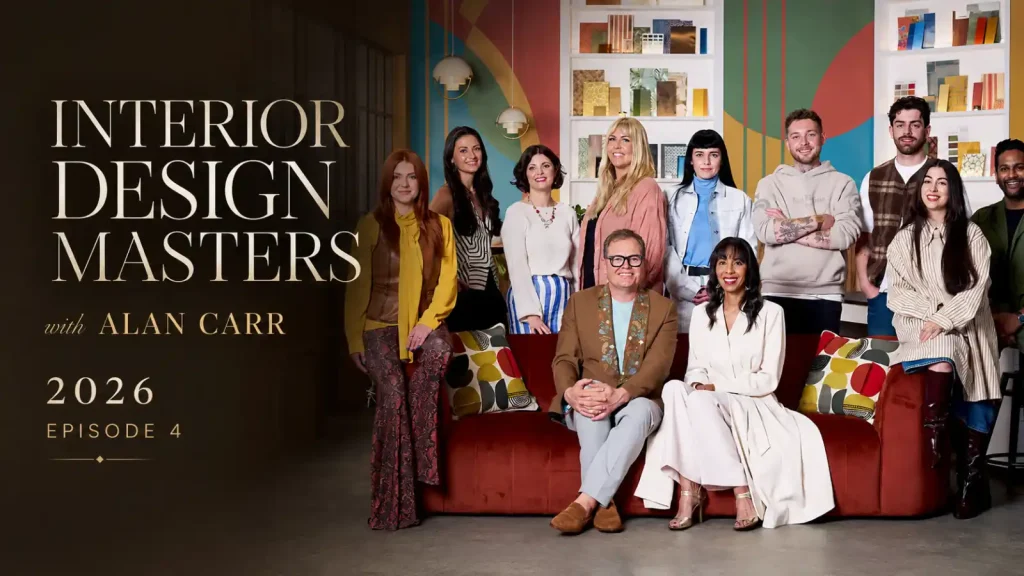
Interior Design Masters with Alan Carr 2026 episode 4 transported its remaining designers far from the polished interiors of domestic living rooms and into one of Britain’s most demanding real-world briefs yet. Royal Naval Air Station Yeovilton, a working military base in Somerset, became the unlikely backdrop for one of the most emotionally charged and practically complex challenges the series has set. The stakes were immediate and tangible: these were not show homes or boutique hotel suites, but sailors’ mess decks — the communal spaces where young recruits cook, eat, rest, and rebuild their morale between demanding shifts of service.
The significance of the brief extended well beyond aesthetics. These spaces function as lifelines for personnel who spend long hours in high-pressure environments. A poorly designed mess deck is not merely ugly; it actively undermines the wellbeing of the people who depend on it. Interior design in this context becomes a genuinely humanitarian undertaking, and the designers arriving at Yeovilton were walking into that responsibility whether they had considered it in those terms or not. The challenge brought the vocabulary of home design into direct contact with the realities of institutional living.
Alan Carr arrived on base with his characteristic energy, immediately lightening the atmosphere among designers who had clearly felt the weight of the previous elimination. The mood within the group was fragile. Losing a fellow competitor always shifts the internal dynamics of a design competition, and the remaining contestants entered Yeovilton knowing the field was narrowing and the judges’ scrutiny was intensifying. Michelle Ogundehin, the series’ lead judge and an authority in interior design, would be joined for this episode by a guest assessor whose background gave the judging panel an entirely different perspective.
Dame Kelly Holmes, Olympic champion and former servicewoman, joined Michelle to evaluate the finished rooms. Her presence was not decorative. Holmes brought lived experience of military communal spaces — she knew what it felt like to return to a mess deck exhausted and in need of genuine comfort. That insider knowledge shaped every element of the judging conversation. The designers were not simply being assessed by design professionals; they were being judged by someone who had actually inhabited environments like the ones they were transforming. That distinction raised the emotional temperature of the episode considerably.
Each designer received an individual mess deck to redesign. The rooms were identical in their bleakness at the outset: institutional, functional, stripped of personality, and entirely devoid of the warmth that recruits would need to feel at home. The brief required spaces that could support cooking, eating, and socialising — multifunctional environments demanding intelligent planning as well as visual ambition. Some designers rose to that complexity immediately. Others struggled to reconcile their aesthetic instincts with the practical demands of spaces that would receive hard daily use from multiple users simultaneously.

Scan smarter. Create faster. Free.
Download QR & Barcode Studio — Create and scan unlimited QR codes & barcodes.
No paywalls. No limits. 100% Free.

The episode revealed, as Interior Design Masters with Alan Carr 2026 consistently does, that talent in design is never uniform. Some designers lead with spatial thinking, mapping function before colour or surface. Others begin with atmosphere, building outward from a mood board or a single visual anchor. Neither approach is inherently superior, but in a brief as demanding as Yeovilton, the gap between instinct and execution became visible very quickly. The designers who planned carefully in the early hours tended to find their confidence growing as the build progressed. Those who chased aesthetic ambition without securing the practical foundations often found themselves under severe pressure by the final day.
Across the two-day build, the episode tracked each designer’s process with unusual granularity. The cameras caught moments of genuine creative problem-solving alongside moments of near-collapse — budget crises, furniture delays, design pivots made under extreme time pressure. These were not manufactured tensions. The Yeovilton brief was genuinely hard, and the designers’ responses to that difficulty revealed character as much as skill. Interior design, the episode argued implicitly, is not a performance of taste. It is a discipline requiring resilience, adaptability, and the capacity to make clear decisions when circumstances resist clarity.
By the time Michelle and Dame Kelly Holmes began their walk-through, the mess decks had been transformed beyond recognition. The judging was forensic, generous where generosity was earned, and bracingly direct where it was not. The final deliberations produced results that surprised several of the designers and confirmed the episode’s central proposition: that designing for real people in real need demands more than visual intelligence. It demands empathy, and empathy, in this context, is measurable.
Interior Design Masters with Alan Carr 2026 episode 4
The Yeovilton Brief and What Interior Design Masters with Alan Carr 2026 Required of Its Designers
Royal Naval Air Station Yeovilton is one of the busiest military air stations in the United Kingdom. Its personnel operate under conditions of sustained physical and mental demand, and the quality of their rest and recreation facilities has a direct bearing on their performance and wellbeing. The mess decks that the designers encountered were functional but joyless — spaces that served a purpose without serving the people inside them.
Michelle set out the brief with characteristic precision. The designers needed to create spaces that young recruits would genuinely want to spend time in. That meant addressing acoustics, durability, colour, lighting, and layout in equal measure. A room that looked beautiful in photographs but fell apart under the friction of daily communal use would fail the brief entirely, regardless of its visual ambition. The standard was not photographic. It was human.
The designers absorbed this information with varying degrees of visible anxiety. Several immediately began calculating how to balance their individual design signatures against the practical requirements of a heavily used communal space. Others focused first on the emotional register of their rooms, asking what feeling they wanted the recruits to experience on entering. Both starting points were legitimate, but the brief rewarded those who could hold both questions simultaneously.
How Each Designer Approached the Two-Day Build in Interior Design Masters with Alan Carr 2026
The build unfolded across two intensive days, and the choices each designer made in the first few hours shaped everything that followed. Budgets were fixed and relatively modest given the scale of the spaces, which meant that every purchasing decision carried genuine weight. Designers who spent early on hero pieces without securing basics found themselves scrambling later. Those who mapped their spending against a clear spatial plan moved through the build with greater composure.
Several designers opted for strong colour as their primary tool. The institutional neutrality of the original mess decks made colour both an obvious and a risky strategy — obvious because the rooms desperately needed visual warmth, risky because colour at scale in a communal space can either energise or overwhelm. The designers who committed to bold palettes needed to understand tonal balance, ensuring that accent colours supported rather than competed with the room’s primary function as a place of rest and sociability.
Furniture selection presented its own complications. The rooms needed seating and dining arrangements that could accommodate multiple users across multiple activities simultaneously. Pieces that worked beautifully in a domestic context sometimes failed to translate into a communal one, either because they were too delicate for heavy use or because they disrupted the flow of movement through the space. The designers who visited Yeovilton with a clear sense of how people actually move through communal rooms consistently made better furniture choices than those who selected pieces primarily for their visual appeal.
Dame Kelly Holmes and the Human Standard Applied to Interior Design
Dame Kelly Holmes arrived at Yeovilton with a frame of reference that no purely design-trained judge could replicate. Her years of service had given her intimate knowledge of what military communal spaces actually feel like to inhabit — the particular quality of exhaustion that follows a long duty shift, the specific kind of comfort a recruit needs when they finally have time to decompress. She applied that knowledge directly and without sentiment throughout the judging process.
Holmes was generous in her responses to rooms that had prioritised human warmth. Where a designer had created a space that felt genuinely inviting — where the lighting was considered, the seating arrangements encouraged conversation, and the overall atmosphere communicated care for the people who would use it — she responded with visible emotion. Her approval was not easily given, which made it meaningful when it arrived.
Conversely, Holmes was unsparing about spaces that had prioritised visual effect over human function. A room that photographed well but lacked practical comfort, or one whose layout discouraged the natural rhythms of communal socialising, did not impress her regardless of its technical finish. Her presence on the judging panel introduced a quality of assessment that pure design expertise cannot generate: the authority of lived experience. Michelle engaged with Holmes’s perspective consistently throughout the walk-through, and the conversation between the two judges produced some of the episode’s most illuminating moments of critical analysis.
Interior Design Masters with Alan Carr 2026 and the Standout Rooms at Yeovilton
Among the completed mess decks, several stood apart with particular clarity. The rooms that succeeded most fully tended to share common qualities: confident colour use, thoughtful spatial planning, durable materials chosen with longevity in mind, and lighting that shifted the emotional register of the space from institutional to welcoming.
One designer created a room anchored by a strong warm palette, using layered textiles and considered furniture arrangement to generate a sense of genuine domestic comfort within an institutional shell. The achievement was not merely visual. The room’s layout encouraged people to gather naturally, with seating grouped to support conversation rather than arranged in the parallel rows more typical of canteen environments. Michelle praised the spatial intelligence of the design, noting that the room understood its purpose as a social space first and a designed object second.
Another standout room demonstrated exceptional skill in lighting design. The designer had understood that the original overhead institutional lighting was actively hostile to relaxation, and had replaced or supplemented it with layered sources that created distinct zones within the room. The effect was transformative — the same physical space felt simultaneously larger and more intimate, depending on where you stood and which light sources were active. Holmes responded to this room with particular warmth, connecting it directly to the experience of wanting to feel human again after a demanding shift.
Where Designers Struggled and What Interior Design Masters with Alan Carr 2026 Revealed About Pressure
Not every room at Yeovilton succeeded, and the episode was honest about that. Several designers encountered difficulties that exposed genuine gaps in either planning or execution. The most common failure mode was ambition outrunning resources — designers who conceived of interventions that their budgets and timelines could not support, and who then made poor decisions under pressure rather than decisive ones.
One designer arrived with a concept that was visually coherent in theory but proved difficult to execute within the available time. As the build progressed and key elements failed to materialise as planned, the room began to lose its conceptual clarity. By the final hours, the designer was making reactive choices rather than considered ones, and the finished space reflected that instability. Michelle’s assessment was precise: the room had ideas but lacked resolution, and in a brief that demanded functional completeness, incompleteness was a serious shortcoming.
Another designer struggled with spatial planning, underestimating how the scale of the mess deck would affect the visual weight of chosen furniture and colour. Pieces that had seemed appropriately scaled in the planning stage read as either too small or too heavy once installed, disrupting the balance of the room. This is a common challenge in interior design — the gap between a plan and a completed space — and the episode treated it not as a moral failure but as a professional problem demanding honest acknowledgment.
The Judging Process and Michelle Ogundehin’s Assessment in Interior Design Masters with Alan Carr 2026
Michelle conducted the walk-throughs with the methodical rigour that defines her presence in this design competition. She moved through each room systematically, assessing materials, proportions, lighting, colour relationships, and spatial flow before offering her overall response. Her commentary was constructive where possible and unflinchingly direct where necessary, and she consistently connected aesthetic observations to functional consequences.
Her conversation with Holmes during the judging process demonstrated the value of multi-perspectival assessment. Michelle could identify, for example, that a particular material choice would age poorly or that a colour relationship was technically unresolved. Holmes could respond by noting that the room nonetheless felt welcoming to someone entering it for the first time after a long shift — or that it did not, despite its visual polish. The two perspectives complemented each other in ways that produced a fuller picture of each room’s success or failure than either judge could have achieved alone.
The deliberations were genuinely difficult in several cases. Rooms that had strong individual elements but unresolved overall coherence required careful adjudication. Michelle was consistent in her view that a room must work as a unified whole — that a beautiful detail embedded in a poorly resolved space does not redeem the space. Holmes supported that position while adding a user-experience dimension: if a recruit entering the room felt confused or uncomfortable, the design had failed regardless of its individual merits.
Alan Carr’s Role and the Emotional Register of Interior Design Masters with Alan Carr 2026 at Yeovilton
Alan Carr’s presence at Yeovilton served multiple functions simultaneously. He provided the designers with moral support during the most pressurised phases of the build, arriving at moments of visible stress with the kind of warm, deflating humour that resets the emotional temperature of a room without dismissing the anxiety that produced it. Several designers clearly found his visits genuinely reassuring rather than merely entertaining.
Carr also engaged with the brief’s human dimension in ways that were more than performative. His interactions with the naval personnel at Yeovilton — both the recruits who would use the finished rooms and the base staff who had requested the redesign — gave the episode an emotional grounding that prevented it from becoming purely a technical design exercise. The recruits’ responses to the finished rooms carried weight in the episode’s overall assessment of success, and Carr facilitated those responses with genuine curiosity.
His exchanges with the designers during the build also occasionally produced useful moments of clarity. A designer doubting a colour choice mid-build, or uncertain whether to pursue a planned intervention with the time remaining, sometimes found that articulating the problem to Carr — even knowing he would not provide a technical solution — helped them arrive at their own decision. In a competition setting, that kind of reflective conversation has real value.
The Elimination Decision and What It Means for the Interior Design Competition
The episode’s conclusion brought the elimination process into sharp relief. With the judging complete and the mess decks assessed in full, Michelle and Dame Kelly Holmes made their determination. The designer who left Yeovilton was not necessarily the one whose room had the fewest attractive elements. The decision reflected the judges’ consistent standard: a room must function as a complete, coherent response to its brief, and a brief as specific as Yeovilton demanded nothing less.
The designer who was eliminated received Michelle’s assessment with dignity. The critique was specific and constructive — identifying not a generalised failure of talent but a particular set of decisions, made under pressure, that had prevented the room from achieving its potential. That distinction is important in the context of Interior Design Masters with Alan Carr 2026 as a whole. Elimination is not a verdict on a designer’s overall ability; it is a response to a specific room, on a specific day, against a specific brief.
The designer who received the best room designation earned it through a combination of spatial intelligence, material confidence, and emotional attunement to the brief. Their mess deck demonstrated that the requirements of a working military communal space and the ambitions of skilled interior design are not in conflict. When a designer understands both the practical and the human dimensions of a brief, the result is a space that functions beautifully precisely because it was designed for the people who would inhabit it.
The Yeovilton episode confirmed Interior Design Masters with Alan Carr 2026 at its most purposeful — a design competition in which the stakes are real, the judgment is rigorous, and the finished rooms will be used, daily, by people who genuinely need them to be good.
FAQ Interior Design Masters with Alan Carr 2026 episode 4
Q: What happens in Interior Design Masters with Alan Carr 2026 episode 4?
A: In episode 4, the remaining designers travel to Royal Naval Air Station Yeovilton in Somerset. They transform sailors’ mess decks into vibrant, functional communal spaces where young recruits can cook, eat, and socialise. Olympic champion and former servicewoman Dame Kelly Holmes joins lead judge Michelle Ogundehin to assess the finished rooms.
Q: Where does the design competition take place in episode 4?
A: The episode is set at Royal Naval Air Station Yeovilton, one of the United Kingdom’s busiest working military air stations, located in Somerset. The designers work directly on the base, transforming real mess decks used daily by serving naval personnel and recruits.
Q: Who is Dame Kelly Holmes and why does she judge Interior Design Masters with Alan Carr 2026?
A: Dame Kelly Holmes is a double Olympic champion and former servicewoman who brings firsthand knowledge of military communal living to the judging panel. Her experience of mess deck environments gives her a unique perspective on whether a designed space genuinely serves the wellbeing of serving personnel. Her assessment goes beyond aesthetics and addresses human comfort directly.
Q: What is the specific design brief the contestants must fulfil in episode 4?
A: Each designer receives an individual mess deck to redesign from scratch. The brief requires the finished space to support cooking, eating, and socialising for young recruits. Furthermore, the rooms must be durable, emotionally welcoming, and practically functional under conditions of hard daily communal use. Visual ambition alone is not sufficient to satisfy the brief.
Q: How long do the designers have to complete their rooms in this home design challenge?
A: The designers work across a two-day build period. The condensed timeline places significant pressure on planning and decision-making. Contestants who map their budgets and layouts carefully in the first hours tend to progress with greater composure, while those who chase ambitious concepts without securing practical foundations often struggle significantly by the final day.
Q: What interior design skills does episode 4 of Interior Design Masters with Alan Carr 2026 test most rigorously?
A: The Yeovilton brief tests spatial planning, material durability, lighting design, colour confidence, and budget discipline simultaneously. Additionally, the episode reveals how well designers can balance their individual aesthetic instincts against the functional demands of a heavily used communal space. Empathy for the end user proves as important as technical skill throughout the challenge.
Q: What role does Alan Carr play in the episode beyond hosting the design competition?
A: Alan Carr provides moral support to designers during the most pressurised phases of the build. He visits contestants at moments of visible stress, using warm humour to reset the emotional atmosphere without dismissing genuine anxiety. He also engages with naval personnel on the base, helping to give the episode an emotional grounding rooted in the real needs of the recruits.
Q: How does Michelle Ogundehin approach the judging process in this episode of Interior Design Masters?
A: Michelle conducts each walk-through methodically, assessing materials, proportions, lighting, colour relationships, and spatial flow before offering her overall verdict. She consistently connects aesthetic observations to functional consequences. Her collaboration with Dame Kelly Holmes produces a layered critical analysis, combining design expertise with the lived perspective of someone who has actually inhabited military communal spaces.
Q: What are the most common reasons designers struggle in the Yeovilton interior design challenge?
A: The most frequent failure is ambition exceeding available resources. Designers who plan interventions their budgets and timelines cannot support make reactive choices under pressure, and their finished rooms reflect that instability. Spatial misjudgement is also common, with furniture and colour choices that appear well-scaled in planning reading as unbalanced once installed within the actual mess deck dimensions.
Q: What standard determines which designer wins best room and which faces elimination in Interior Design Masters with Alan Carr 2026 episode 4?
A: Michelle and Dame Kelly Holmes assess each room as a unified response to the brief rather than a collection of individual design decisions. A room must function as a coherent, complete whole. However, strong individual elements embedded in an unresolved overall scheme do not secure a positive result. The designer whose space best serves the recruits’ practical and emotional needs earns the best room designation.