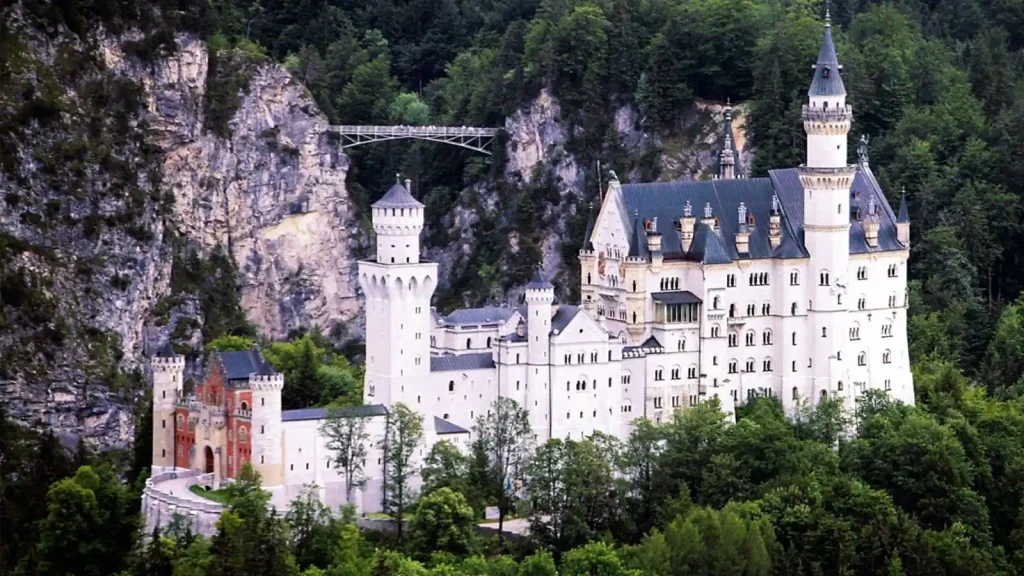
The Fairy-Tale Castles of King Ludwig II represent one of the most fascinating architectural legacies in European history, a testament to a monarch whose pursuit of beauty and escape from political reality produced buildings that continue to captivate millions of visitors each year. Ludwig II of Bavaria, known variously as the Swan King and the Dream King, remains an enigmatic figure more than a century after his mysterious death. His three great building projects stand not merely as monuments to royal extravagance but as windows into the psyche of a man who found the modern world intolerable and sought refuge in the architectural recreation of idealized pasts.
The significance of these Bavarian castles extends far beyond their function as tourist attractions. They embody the romantic movement’s final, most extravagant flowering in architecture. They influenced popular culture in ways their creator could never have imagined, most notably inspiring the iconic Sleeping Beauty Castle at Disneyland. Understanding Ludwig’s buildings means understanding the collision between artistic vision and political reality, between medieval romanticism and nineteenth-century industrialization, between personal fantasy and public duty.
Dan Cruickshank’s exploration of these three remarkable structures reveals layers of meaning that casual visitors often miss. The castle of Neuschwanstein, the palaces of Linderhof and Herrenchiemsee each represent distinct phases of Ludwig’s architectural vision and psychological development. Together, they form a coherent artistic statement about kingship, beauty, and the relationship between art and life.
The context of Ludwig’s reign proves essential to understanding his buildings. He ascended to the Bavarian throne at just eighteen years old in 1864, inheriting a kingdom caught between the great powers of Prussia and Austria. His personal interests lay not in statecraft but in art, music, and architecture. His passionate patronage of Richard Wagner and his obsessive building projects defined his reign far more than any political achievement. These pursuits eventually contributed to his downfall, as his cabinet grew increasingly alarmed by mounting debts and his withdrawal from governmental duties.
Bavaria itself occupies a unique position in German history and culture. The region possesses a strong independent identity, distinct from the Prussian north. Its landscape of mountains, forests, and lakes provided the perfect setting for Ludwig’s romantic architectural visions. The natural beauty of the Alpine foothills around Neuschwanstein and the pastoral charm of the countryside surrounding Linderhof offered backdrops that enhanced rather than competed with his buildings.

Scan smarter. Create faster. Free.
Download QR & Barcode Studio — Create and scan unlimited QR codes & barcodes.
No paywalls. No limits. 100% Free.

The king’s personality remains the subject of endless speculation. Contemporary accounts describe a handsome, cultured young man whose initial popularity gradually gave way to increasing isolation and eccentricity. His nocturnal habits, his elaborate theatrical performances for audiences of one, and his eventual refusal to meet with ministers all contributed to his reputation as a mad king. Yet his architectural legacy suggests a mind of considerable sophistication, capable of synthesizing diverse historical styles into coherent artistic wholes.
The circumstances of Ludwig’s death in 1886 added a final layer of mystery to his legend. Found drowned in Lake Starnberg alongside his physician, the official verdict of suicide has never satisfied many investigators. The tragedy transformed him from a troublesome monarch into a romantic martyr, and his castles became places of pilgrimage for those drawn to his story.
Cruickshank’s documentary approach treats these buildings not as mere curiosities but as serious architectural achievements deserving careful analysis. His examination reveals how Ludwig’s castles function as three-dimensional autobiographies, expressing their creator’s deepest convictions about art, history, and the nature of kingship itself.
The Fairy-Tale Castles of King Ludwig II
The Mock-Medieval Vision of Neuschwanstein Castle
Neuschwanstein Castle stands as the most recognizable of Ludwig’s creations, its white limestone towers rising dramatically above the Bavarian countryside. The structure exemplifies the nineteenth-century fascination with medieval revival architecture, though it pushes that revival to extremes of fantasy that genuine medieval builders never imagined. Its silhouette, perched on a rocky outcrop overlooking a deep gorge, deliberately evokes the romantic ideal of the castle as fortress and refuge.
The castle’s genesis reveals Ludwig’s working methods. He collaborated closely with theatrical designer Christian Jank on the initial concepts, prioritizing visual effect over historical accuracy or practical function. The result draws on multiple medieval sources, combining elements of Romanesque and Gothic architecture in ways that medieval builders would have found incomprehensible. Yet the effect achieves precisely what Ludwig intended, creating a building that looks more medieval than actual medieval castles.
The interior spaces of Neuschwanstein serve as galleries for Ludwig’s obsessions. The Singers’ Hall dominates the upper floors, a vast space modeled on the legendary Wartburg Castle where medieval minnesingers supposedly competed. This room, though it never hosted an actual performance during Ludwig’s lifetime, embodies his belief in the transformative power of music and poetry. The walls display scenes from the operas of Richard Wagner, whose work Ludwig worshipped with an intensity that transcended mere patronage.
The throne room represents another key space, though ironically Ludwig died before the throne itself could be installed. Byzantine mosaics cover the walls, depicting images of Christ and the saints that assert the divine nature of kingship. The room makes a theological argument for monarchy at precisely the moment when such arguments were becoming untenable in the modern world.
Neuschwanstein’s technical innovations often go unnoticed beneath its medieval trappings. The castle incorporated the most advanced building technologies of its era, including steel framing, central heating, running water on all floors, and an elaborate system of bells and speaking tubes for communication. Ludwig embraced modern technology not for its own sake but as a means of realizing visions that pure historical reconstruction could never achieve.
The construction process itself became a major economic undertaking. Hundreds of workers labored for years on the rocky site, which presented enormous logistical challenges. Materials had to be hauled up steep mountain roads. The costs mounted relentlessly, contributing to the financial crisis that eventually gave Ludwig’s enemies the pretext for his removal from power.
Linderhof Palace and the Cult of French Absolutism
Linderhof Palace represents a dramatic departure from Neuschwanstein’s mock-medievalism. This smallest of Ludwig’s completed palaces pays homage to the baroque splendour of French court architecture, particularly the Versailles of Louis XIV. The shift in style reveals a corresponding shift in Ludwig’s conception of kingship, from the feudal ideal of the medieval castle to the absolutist ideal of the Sun King.
The palace itself occupies a secluded valley, hidden from casual observation by surrounding forest. Ludwig valued this privacy intensely, creating an environment where he could enact his fantasies of royal life without the intrusion of the actual world. The scale remains intimate compared to Versailles, but the decorative intensity exceeds anything the French originals achieved.
The Hall of Mirrors at Linderhof multiplies Ludwig’s reflection infinitely through carefully angled glass panels. This room, like much of the palace, functions as a stage set for the performance of kingship. Ludwig would dine alone in elaborate state, served by a table that rose mechanically through the floor so that servants need never intrude upon his solitude. The fantasy of absolute power merged with the reality of absolute isolation.
The gardens surrounding Linderhof extend Ludwig’s vision into the landscape. Formal parterres in the French manner give way to romantic grottos and follies. The most remarkable of these, an artificial cave inspired by Wagner’s Tannhauser, contained an underground lake where Ludwig would float in a shell-shaped boat while hidden orchestras played and colored lights illuminated artificial stalactites. The technical sophistication required to create this environment demonstrates Ludwig’s willingness to deploy modern engineering in service of romantic fantasy.
A Moorish kiosk, purchased from an international exhibition and installed in the grounds, reveals Ludwig’s interest in orientalist fantasies that paralleled his medieval and baroque obsessions. The building’s peacock throne became a favorite retreat, offering yet another variation on the theme of royal solitude. These eclectic additions to the Linderhof grounds suggest a mind restlessly seeking new expressions for essentially unchanging preoccupations.
The cult of Louis XIV that pervades Linderhof reached its fullest expression in Ludwig’s habit of setting a place at dinner for the long-dead French king. This ritual enactment of communion with historical royalty epitomizes Ludwig’s relationship with the past, treating history not as something to be studied but as something to be inhabited and relived.
Herrenchiemsee Palace and the Versailles Obsession
Herrenchiemsee Palace represents Ludwig’s most ambitious project and his most direct engagement with French court architecture. Built on an island in the Chiemsee lake, this palace replicates major portions of Versailles on an even grander scale. The project remained unfinished at Ludwig’s death, but the completed sections reveal the full extent of his obsession with Louis XIV and the world that monarch represented.
The choice of an island location carries obvious symbolic weight. Herrenchiemsee became Ludwig’s ultimate retreat, accessible only by boat and thus insulated from the demands of the modern world more completely than any of his other residences. The journey across the water enacted a passage from reality into dream, from the nineteenth century into the seventeenth.
The Hall of Mirrors at Herrenchiemsee exceeds its Versailles model in both length and decorative elaboration. Seventeen chandeliers illuminate a space designed to overwhelm visitors with the sheer accumulation of gilding, mirrors, and painted ceilings. Ludwig reportedly spent only nine nights in the entire palace, but the building was never really intended for habitation in any conventional sense. It functioned as a temple to the idea of absolute monarchy, a pilgrimage site for the worship of a vanished world.
The staircase of ambassadors, reconstructed from Versailles originals that had been destroyed during the French Revolution, demonstrates Ludwig’s conception of himself as preserving and continuing French royal tradition. He saw the destruction wrought by revolution as a catastrophe requiring architectural redemption. Herrenchiemsee would restore what revolutionary violence had erased.
The financial burden of Herrenchiemsee proved immense. The Bavarian state could not sustain building projects of this magnitude, and Ludwig’s personal debts mounted catastrophically. His cabinet used this financial crisis as justification for declaring him mentally unfit to rule, though the true motivations likely combined fiscal concern with political frustration at his withdrawal from governmental responsibilities.
The Fairy-Tale Castles of King Ludwig II as Psychological Autobiography
The three building projects together form a coherent statement about their creator’s inner life. Dan Cruickshank’s analysis treats them as texts to be read, sources for understanding a man who left few conventional written records of his thoughts and feelings. The buildings speak where Ludwig himself remained silent.
The progression from Neuschwanstein to Linderhof to Herrenchiemsee traces a psychological journey. The medieval castle represents youthful romanticism, the dream of chivalric virtue and artistic fellowship that Ludwig associated with Wagner’s operas. Linderhof marks a turn inward, toward increasingly private fantasies of power without responsibility. Herrenchiemsee represents the final apotheosis, the identification with Louis XIV that allowed Ludwig to see himself as the culmination of a royal tradition stretching back centuries.
Each building also reveals Ludwig’s relationship with history. He did not approach the past as an academic subject to be studied objectively but as a treasury of images and ideals to be appropriated and inhabited. His castles create immersive environments for historical fantasy, three-dimensional stage sets for the performance of roles that modern political reality made impossible to enact genuinely.
The tension between modern technology and historical imagery pervades all three projects. Ludwig employed the most advanced construction techniques, materials, and mechanical systems available, yet concealed these modern elements behind historical facades. This combination of technological sophistication and aesthetic nostalgia anticipates much of twentieth-century architecture, which similarly deploys advanced engineering to create buildings that evoke other times and places.
The influence of Richard Wagner deserves particular emphasis. Ludwig’s patronage rescued Wagner from financial ruin and made possible the composition of his greatest works. In return, Wagner’s operas provided the iconographic program for Neuschwanstein and shaped Ludwig’s understanding of medieval legend. The relationship between monarch and composer remains one of the most consequential artistic patronages in European history.
The Mysterious Death and Enduring Legend of Ludwig II
The circumstances surrounding Ludwig’s death continue to generate controversy. The official account describes a suicide by drowning in Lake Starnberg, following his deposition on grounds of mental illness. Yet numerous details remain unexplained, and alternative theories ranging from assassination to escape attempt have found advocates.
The deposition itself followed a dubious process. The doctors who declared Ludwig insane never examined him personally, basing their diagnosis on testimony from servants and courtiers. The political motivations of those seeking his removal remain obvious, as Ludwig’s building debts and governmental neglect had created a genuine crisis. Whether mental illness actually existed beyond political inconvenience remains impossible to determine at this distance.
The death transformed Ludwig from a problematic monarch into a romantic martyr. The circumstances seemed to confirm the narrative of a sensitive artist destroyed by a world that could not accommodate his vision. His castles became shrines to this interpretation, their unfinished state testimony to a life cut tragically short.
Bavaria’s subsequent history gave Ludwig’s legend additional resonance. The kingdom lost its independence following German unification under Prussian leadership, making Ludwig’s resistance to Prussian dominance appear prescient rather than merely stubborn. His castles preserved a distinctly Bavarian identity that might otherwise have been submerged in the new German Empire.
The Fairy-Tale Castles of King Ludwig II in Contemporary Culture
The global fame of Ludwig’s buildings owes much to their adoption by Walt Disney as inspiration for the Sleeping Beauty Castle at Disneyland. This appropriation, while sometimes dismissed as kitsch, actually honors Ludwig’s original intentions. He created buildings designed to evoke fairy tales and romantic legends, and Disney recognized their power to transport visitors into imaginary worlds.
Tourism to the Bavarian castles generates substantial economic activity for the region. Neuschwanstein alone receives well over a million visitors annually, making it one of Germany’s most popular attractions. The infrastructure required to manage these crowds has transformed the surrounding villages, creating an industry built entirely on Ludwig’s vision.
The preservation challenges posed by such heavy visitation require careful management. The buildings were never designed to accommodate mass tourism, and the wear of countless feet threatens delicate interiors. Conservation efforts must balance public access against the need to preserve these irreplaceable structures for future generations.
Scholarly reassessment of Ludwig’s architectural legacy has moved beyond earlier dismissals of his buildings as mere kitsch. Architectural historians now recognize the sophistication of his designs and their importance within the history of revivalist architecture. The castles occupy a significant position in the development of architectural theory and practice during the nineteenth century.
The Fairy-Tale Castles of King Ludwig II as Architectural Achievement
The technical accomplishment of Ludwig’s buildings demands recognition. Neuschwanstein’s construction required innovative solutions to challenging terrain and incorporated structural systems far more advanced than its medieval appearance suggests. The hydraulic mechanisms at Linderhof demonstrated cutting-edge engineering applied to theatrical effect. Herrenchiemsee’s scale demanded organizational capabilities comparable to major industrial projects.
The decorative programs of all three buildings display extraordinary craftsmanship. Ludwig employed the finest artisans available, and their work in wood, metal, paint, and textile achieves standards rarely matched in the nineteenth century. The sheer accumulation of decorative detail creates environments of overwhelming richness that reward extended contemplation.
Dan Cruickshank’s assessment ultimately places these buildings within the broader context of European architectural history. They represent the final flowering of romantic architecture before modernism swept away historical revivalism. Their influence persists in theme parks, film sets, and popular imagination, demonstrating that Ludwig’s vision possessed a universal appeal that transcended its particular historical circumstances.
The fairy-tale castles of King Ludwig II with Dan Cruickshank illuminated in this documentary stand as monuments to an impossible dream, the dream of escaping modernity through the recreation of idealized pasts. That dream failed in political terms, costing Ludwig his throne and his life. Yet in architectural terms, it succeeded magnificently, creating buildings that continue to inspire wonder more than a century after their creator’s death. The Swan King built for eternity, and eternity has thus far proved willing to preserve his vision.
FAQ The Fairy-Tale Castles of King Ludwig II
Q: Who was King Ludwig II of Bavaria and why is he called the Dream King?
A: King Ludwig II ruled Bavaria from 1864 until his mysterious death in 1886. He earned the nicknames Swan King and Dream King due to his obsessive pursuit of artistic beauty and architectural fantasy. Rather than focusing on politics, Ludwig dedicated his reign to building extraordinary fairy-tale castles. His romantic vision and tragic end transformed him into a legendary figure in European history.
Q: What are the three main castles built by King Ludwig II?
A: Ludwig II created three remarkable structures during his reign. Neuschwanstein Castle represents his mock-medieval vision with dramatic white limestone towers. Linderhof Palace embodies French baroque splendour in an intimate setting. Furthermore, Herrenchiemsee Palace stands as his most ambitious project, replicating Versailles on a Bavarian island. Together, these buildings attract millions of visitors annually.
Q: How did Neuschwanstein Castle inspire the Disney Sleeping Beauty Castle?
A: Walt Disney visited Neuschwanstein and recognized its power to transport visitors into imaginary worlds. The castle’s romantic silhouette and fairy-tale appearance made it the perfect model for Disneyland’s iconic centerpiece. Consequently, Ludwig’s architectural vision achieved global recognition through Disney’s adaptation. This connection demonstrates how the Dream King’s creations continue influencing popular culture today.
Q: What architectural styles did Ludwig II incorporate into his Bavarian castles?
A: Ludwig employed diverse historical styles across his building projects. Neuschwanstein combines Romanesque and Gothic elements in its medieval revival architecture. Additionally, Linderhof showcases French baroque influences honoring Louis XIV’s court aesthetic. Herrenchiemsee directly replicates Versailles with elaborate gilding and mirrors. Despite their historical appearances, all three incorporated cutting-edge nineteenth-century technology.
Q: What role did composer Richard Wagner play in Ludwig II’s architectural vision?
A: Wagner’s operas profoundly shaped Ludwig’s building projects. The king’s passionate patronage rescued Wagner from financial ruin. In return, Wagnerian mythology provided the iconographic program for Neuschwanstein’s interiors. The Singers’ Hall displays scenes from Wagner’s operas throughout its walls. This collaboration represents one of history’s most consequential artistic patronages between monarch and composer.
Q: Why did Ludwig II build Herrenchiemsee Palace on an island?
A: Ludwig selected the island location in Chiemsee lake for maximum isolation from the modern world. The journey across water symbolically transported visitors from reality into dream. Moreover, the setting provided privacy for Ludwig’s increasingly solitary lifestyle. He reportedly spent only nine nights in the palace, using it primarily as a temple to absolute monarchy.
Q: What modern technologies did Ludwig II incorporate into his medieval-looking castles?
A: Despite their historical facades, Ludwig’s castles featured remarkable technical innovations. Neuschwanstein included steel framing, central heating, and running water on all floors. Linderhof contained hydraulic mechanisms allowing dining tables to rise through floors. Similarly, Herrenchiemsee required engineering capabilities comparable to major industrial projects. Ludwig embraced modernity to realize visions pure historical reconstruction could never achieve.
Q: How did Ludwig II’s building projects contribute to his downfall?
A: The enormous costs of Ludwig’s architectural ambitions created a severe financial crisis for Bavaria. His mounting personal debts alarmed government ministers increasingly frustrated by his withdrawal from duties. Consequently, his cabinet used this financial situation to declare him mentally unfit to rule. The deposition followed a dubious process where doctors diagnosed Ludwig without ever examining him personally.
Q: What are the mysterious circumstances surrounding Ludwig II’s death?
A: Ludwig died in Lake Starnberg in 1886 alongside his physician under unexplained circumstances. The official verdict declared suicide by drowning, yet numerous details remain unexplained. Alternative theories include assassination and escape attempts. However, the mystery transformed Ludwig from a problematic monarch into a romantic martyr, and his fairy-tale castles became pilgrimage sites.
Q: Why are King Ludwig II’s castles considered more than flamboyant kitsch today?
A: Dan Cruickshank argues these buildings reveal sophisticated artistic and psychological depth. Architectural historians now recognize their importance within nineteenth-century revivalist architecture. The castles function as three-dimensional autobiographies expressing Ludwig’s convictions about art, history, and kingship. Therefore, they represent the romantic movement’s final, most extravagant flowering rather than mere decorative excess.